
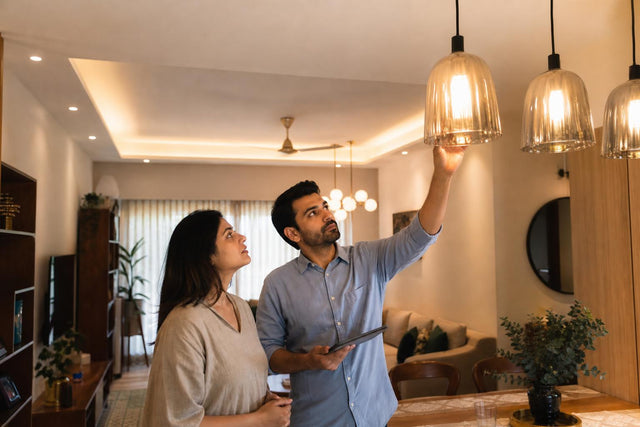
Residence Lighting Design: 2026 Glossary for Indian Homes
TL;DR
Residence lighting design is the discipline of planning fixture types, placement, light layers, and measurable qualities (lumens, lux, CCT, CRI) to make every room in a home functional and beautiful. Indian homes present specific challenges, from false-ceiling culture and multi-use rooms to pooja spaces and double-height living areas, that demand India-specific guidance rather than Western defaults. This glossary covers every term homeowners and designers need, organized by theme, with recommended values for each room.
Good lighting does more than illuminate a room. It shapes how you feel in it, how well you see, and whether a space looks flat or alive. Residence lighting design is the process of choosing the right fixture types, positioning them thoughtfully, combining multiple layers, and specifying measurable light qualities to make a home both practical and emotionally resonant.
The discipline sits at the intersection of science and aesthetics. On one side, you have hard numbers: lumens, lux, correlated color temperature, color rendering index, beam angles. On the other, you have artistic judgment: where shadows fall, which surfaces glow, how a room transitions from morning to midnight. This glossary exists to bridge both sides.
Whether you are a homeowner planning a new build, a designer specifying fixtures for a client, or an architect coordinating with an electrical contractor, the terms below will sharpen your decisions.
Explore ALC Studio’s full collection for fixtures that match every concept covered here.
Light Quality and Measurement Terms
These are the numbers that determine whether a room feels inviting or clinical. Skipping them is like choosing paint without looking at the color swatch.
Lumens
A measure of how much visible light a source produces. Lumens tell you how bright a bulb actually is. Unlike watts, which measure energy consumption, lumens measure output. A 10W LED can produce 800 lumens, roughly equivalent to what a 60W incandescent used to deliver. Always compare lumens, not watts, when shopping for LEDs.
Lux
Illuminance: the amount of light falling on a surface. One lux equals one lumen spread across one square meter. Lux is the number that tells you whether your kitchen counter has enough light for chopping vegetables or your bedroom is dim enough for sleep. Room-specific lux recommendations are the backbone of any residence lighting design plan.
Recommended Lux Levels for Indian Homes
| Room | Recommended Lux |
|---|---|
| Living room | 100 to 300 |
| Bedroom | 60 to 100 (up to 150 with dimmers) |
| Kitchen (general) | 250 to 300 |
| Kitchen worktop | 400+ |
| Bathroom | 150 to 300 |
| Dining room | 150 to 500 (varies by activity) |
| Home office | 300 to 500 |
CCT (Correlated Color Temperature)
The color appearance of light, measured in Kelvins (K). Lower numbers produce warm, amber-toned light. Higher numbers produce cool, bluish-white light. CCT is one of the most consequential choices in residential lighting, and one of the most debated among Indian homeowners.
Jennifer Jones, principal designer at Niche Interiors, puts it bluntly: “Fluorescent bulbs are the worst. They can make any home feel like a corporate office.” She and other designers recommend bulbs in the 2700K range for living spaces.
CCT Quick Reference
| Range (Kelvin) | Appearance | Best Residential Use |
|---|---|---|
| 2200K to 2700K | Warm amber, candlelight | Bedrooms, dining areas, living rooms |
| 3000K to 3500K | Warm white | General living areas, hallways |
| 4000K to 4500K | Neutral/cool white | Home offices, kitchens, bathrooms |
| 5000K to 6500K | Daylight | Generally too harsh for living spaces |
For most Indian homes, 3000K works well for living areas and bedrooms, while 4000K suits kitchens, bathrooms, and study rooms. One detail often overlooked: dark walls absorb light and make warm whites feel even dimmer. If your living room has deep grey or dark brown walls, bumping to 3000K instead of 2700K prevents the room from feeling cave-like.
CRI (Color Rendering Index)
A score from 0 to 100 measuring how accurately a light source reveals the true colors of objects compared to natural sunlight. A CRI of 80 or higher is considered adequate for most residential spaces. For areas where color accuracy matters, like dressing rooms, pooja rooms, and kitchens, aim for CRI 90 or above. CRI is the hidden quality indicator most buyers ignore entirely.
Beam Angle (Beam Spread)
The angle at which light radiates from a fixture. It determines how concentrated or diffused the light pool is on a surface. Narrow beams (15 to 30 degrees) create a spotlight effect, ideal for accenting artwork or a pooja room niche. Medium beams (30 to 60 degrees) offer balanced distribution and are the most common choice for general illumination. For ambient lighting from recessed downlights, a wide beam of 40 to 60 degrees provides soft, even coverage.
Watt
A unit of electrical power. In the LED era, wattage measures energy consumption, not brightness. Practitioners report that many homeowners still ask for “a 100-watt bulb” when they actually need to specify lumens. This confusion leads to buying fixtures that are either far too dim or unnecessarily bright.
Foot-candle
The imperial counterpart to lux, measuring lumens per square foot. One foot-candle equals approximately 10.764 lux. Primarily used in American specifications. If you are referencing a US lighting guide, convert foot-candles to lux by multiplying by roughly 10.76.
Efficacy (Lumens per Watt)
How efficiently a light source converts electricity into visible light. A standard LED might deliver 80 to 120 lumens per watt. Higher efficacy means lower electricity bills for the same brightness, a real consideration when you are running 30 to 50 light points across a home.
Glare
Brightness that is misplaced or unwanted. Glare causes visual discomfort and eye fatigue. It typically results from exposed bulbs, poorly positioned downlights, or overly bright fixtures in a low-ceiling room. Recessed fixtures with proper shielding and wall lamps with diffused shades are common glare-reduction strategies.
Lighting Layers and Design Techniques
If there is one principle that separates good residence lighting design from bad, it is layering. Most Indian rooms have a single light in the middle of the ceiling: a tube light, a flush fitting, or a grid of identical downlights all on one switch. It floods the room evenly, and that is exactly the problem. Flat, even light has no shadows to give shape, no bright pools to draw you in, no dim corners to make a space feel calm. It is lit, but it is lifeless.
Ambient (General) Lighting
The base layer. Ambient light provides overall brightness so you can see and move around safely. It is the foundation that every other layer builds upon. Common ambient sources include ceiling-mounted fixtures, cove lighting, and recessed downlights with wide beam angles.
Task Lighting
Focused light directed at areas where you need to work, read, cook, or concentrate. A table lamp like the Stello on a reading desk, under-cabinet LEDs on a kitchen worktop, or a vanity light flanking a bathroom mirror all qualify as task lighting. Without it, you strain your eyes or cast shadows with your own body.
Accent Lighting
Directed light that draws attention to a specific object or architectural feature, making it stand out from its surroundings. Accent lighting creates visual hierarchy: your eye goes where the light is brightest. The key ratio to remember is that accent light should be approximately three times brighter than the ambient light in the same space. This 3:1 contrast creates depth and dimension. Wall-mounted fixtures like the Kobe work well for accenting artwork or textured feature walls.
Layered Lighting
The practice of combining ambient, task, and accent light sources at different heights, intensities, and angles so a room can adapt throughout the day. Layered lighting is the core principle of professional residential lighting design. It is especially critical in Indian homes where, as Philips India notes, rooms serve many purposes. The living room becomes a study room during exams. The dining area doubles as a conference call zone. Bedrooms are not just for sleeping.
Cove Lighting
A hidden light source tucked into a ledge, recess, or false-ceiling cove that washes the ceiling or upper wall with indirect light. In Indian homes, the false-ceiling cove is the classic ambient layer. An LED strip like the Ledios running along a cove produces a soft, diffused glow without any visible fixture.
Wall Washing
A technique where light is aimed at a wall to illuminate it smoothly and evenly, reducing the appearance of texture or imperfections. Wall washing makes rooms feel larger because the illuminated vertical surface visually expands the space. It is different from accent lighting, which deliberately highlights texture.
Uplighting and Downlighting
Directional strategies. Uplighting aims light toward the ceiling or upper walls, creating indirect, reflected illumination that softens a room. Downlighting directs light from the ceiling toward the floor, providing focused coverage for tasks and navigation. Most well-designed rooms use both.
Practitioners consistently point out that many homeowners focus entirely on ceiling fixtures and overlook wall lighting. This is a missed opportunity. Lighting from directly above can feel too harsh or clinical, and wall lamps like the Caral provide the mid-height layer that balances a room.
Dimming
The ability to adjust a fixture’s light output. Dimmers are not optional accessories; they are fundamental to any functional residence lighting design. Without dimmers, you are stuck with one level of brightness for every mood and activity. A bedroom that needs 100 lux for getting dressed at 7 AM also needs 30 lux for winding down at 10 PM. Dimmers make that possible with one set of fixtures.
Fixture Types Used in Residences
Each fixture type serves one or more lighting layers. Understanding which layer a fixture belongs to prevents the common mistake of expecting a single chandelier to do everything.
Chandelier
A multi-arm or tiered suspended fixture, often the decorative centrepiece of a room. Chandeliers primarily provide ambient light, though crystal or glass versions also create accent sparkle through refraction. Sizing matters enormously. For guidance on getting proportions right, the chandelier sizing guide covers formulas for Indian rooms in detail.
Pendant Light
A single fixture suspended from the ceiling by a cord, chain, or rod. Pendants are workhorses over dining tables and kitchen islands, delivering a focused pool of light at a lower height than ceiling-mounted options. The LumaCloud pendant is a good example of a fixture that combines ambient glow with directional downlight for the table below.
Wall Sconce / Wall Lamp
A fixture mounted on a vertical surface. Wall sconces fill the critical mid-height lighting layer that ceiling fixtures miss. They work for accent lighting in hallways, task lighting flanking a bathroom mirror, or ambient uplighting in living rooms. The Troy wall lamp illustrates how a sculptural wall-mounted fixture can serve double duty as decor and functional light.
For installation details specific to Indian wiring standards, the wall light installation guide walks through the full process.
Flush Mount / Semi-Flush Mount
Ceiling fixtures that sit directly against (flush) or a few inches below (semi-flush) the ceiling surface. They are practical choices for rooms with low ceilings, typically 8 feet or less, where a pendant or chandelier would hang too low. Flush mounts serve the ambient layer.
Recessed Downlight
A fixture installed into a hole in the ceiling so the light sits flush with the surface. Recessed downlights provide clean, uncluttered ambient or task lighting. They are common in modern Indian interiors, particularly in false-ceiling grids. The critical specification is beam angle: narrow for accent spots, wide for general wash.
Table Lamp and Floor Lamp
Portable fixtures that provide task or ambient light at desk, side-table, or floor height. Their portability makes them the easiest way to add a lighting layer without calling an electrician. A floor lamp in the corner of a living room eliminates the dark zone that a single central ceiling light always creates.
LED Strip / Linear Light
Long, narrow fixtures producing a continuous line of light. LED strips are the backbone of cove lighting, under-cabinet illumination, staircase wayfinding, and shelf-highlight applications. Quality varies widely. Look for strips with consistent color temperature, high CRI (90+), and a proper aluminium profile for heat dissipation.
Vanity Light
Wall-mounted fixtures designed to flank or sit above a bathroom or dressing mirror. Proper vanity lighting eliminates the harsh under-eye shadows that a single overhead light creates. Mounting them at face height on both sides of the mirror produces the most flattering, even illumination.
Illuminated Mirror / Lighted Mirror
A mirror with integrated LED lighting, often featuring touch sensors, motion sensors, or tunable white options. Illuminated mirrors combine the vanity light and mirror into one product, simplifying installation and providing consistent, shadow-free light. The Absolute illuminated mirror is an example with integrated sensor controls. For step-by-step mounting, the LED mirror installation guide covers everything from wall marking to wiring.
Room-by-Room Lighting Glossary for Indian Homes
Residence lighting design is always room-specific. A plan that works for a kitchen will fail in a bedroom. Here is what each room demands.
Living Room
Recommended lux: 100 to 300, depending on activities.
Suggested CCT: 2700K to 3000K for warmth; 3000K if walls are dark.
Priority layers: Ambient + accent + task (reading corners).
The living room is where layered lighting matters most. A central chandelier or flush mount handles ambient. Wall sconces and cove lighting add the mid-layer. A table or floor lamp near the sofa creates a reading pool. One of the most common mistakes homeowners make is depending on a single light source, such as a chandelier, for the entire room. Relying on one fixture often contributes to an unevenly lit space, increasing the risk of eye strain and accidents.
Kitchen
Recommended lux: 250 to 300 general; 400+ on worktops.
Suggested CCT: 4000K for task clarity.
Priority layers: Task (over counters and cooktop) + ambient (ceiling) + accent (optional, under upper cabinets).
Kitchens need the highest lux levels in any home because you are working with knives, heat, and small measurements. Under-cabinet LED strips are the simplest upgrade, providing direct task light exactly where you need it without ceiling-level glare.
Bedroom
Recommended lux: 60 to 100 ambient.
Suggested CCT: 2700K to 3000K.
Priority layers: Ambient (cove or flush mount) + task (bedside lamps or wall-mounted reading lights).
Bedrooms are low-lux zones by design. The primary requirement is dimmability: bright enough for getting dressed, dim enough for sleep. Bedside wall lamps mounted at 1200 to 1400mm from the floor give focused reading light without disturbing a partner.
Bathroom
Recommended lux: 150 to 300.
Suggested CCT: 3000K to 4000K.
Priority layers: Task (vanity/mirror lighting) + ambient (ceiling).
CRI is critical in bathrooms. You are judging skin tone, applying makeup, or checking how clothes look. Anything below CRI 80 produces misleading colors. Aim for CRI 90+ near the mirror. Moisture-rated fixtures (IP44 or higher) are essential for zones near the shower or bathtub.
Dining Room
Recommended lux: 150 to 200 for dining; 400 to 500 if the table doubles for homework or work calls.
Suggested CCT: 2700K to 3000K for meals.
Priority layers: Task/ambient (pendant or chandelier over the table) + accent (wall sconces or cove lighting).
A pendant or chandelier hung 750 to 900mm above the table surface is the standard for Indian dining rooms. The fixture should be roughly two-thirds the width of the table. For sizing specifics, the dining room chandelier sizing guide provides formulas and visual examples.
Foyer and Entryway
Recommended lux: 100 to 150.
Suggested CCT: 3000K.
Priority layers: Ambient (statement fixture) + accent (wall sconces for wayfinding).
The foyer is statement fixture territory. It is the first impression of a home. A dramatic pendant like the Dijon sets tone immediately. In double-height foyers, longer-drop chandeliers create visual drama, but you need to account for the extra distance light must travel. The double-height ceiling lighting guide covers lumen planning for tall spaces.
Study / Home Office
Recommended lux: 300 to 500.
Suggested CCT: 4000K to 4500K for focus.
Priority layers: Task (desk lamp) + ambient (overhead).
Home offices need the coolest CCT in the house. Neutral white light in the 4000K range promotes focus and concentration. Position a task lamp so it shines on your work surface from the side (not behind you, which creates screen glare).
Pooja Room
Recommended CRI: 90 or above.
Suggested CCT: 2700K to 3000K warm glow.
Priority layers: Accent (directed at the deity or artwork) + ambient (soft, warm fill).
Pooja rooms demand the highest CRI in the house. You want brass, gold leaf, flowers, and painted murals to appear in their true colors. Warm CCT combined with high CRI produces the rich, reverent atmosphere these spaces deserve. Narrow beam spotlights (15 to 25 degrees) aimed at the central figure create the 3:1 accent-to-ambient ratio that gives depth.
Double-Height Spaces
Common in Indian luxury apartments and villas, these rooms (typically 4.5 to 6 meters high) require longer-drop chandeliers and significantly more lumens than standard-height rooms. Light disperses over a greater distance, so a fixture that seems bright at 3 meters may feel underwhelming at 5.5 meters. Plan for 30 to 50 percent more lumens than you would in a standard 3-meter ceiling room.
False-Ceiling Lighting in Indian Homes
False ceilings (drop ceilings) are widespread in Indian residential construction. They hide electrical conduits, air conditioning ducts, and structural beams while creating the recesses and coves that enable sophisticated lighting layers. The typical Indian false-ceiling setup includes a perimeter cove with LED strips for ambient wash, recessed downlights for general illumination, and occasionally a central cutout for a chandelier or pendant.
The key consideration: plan your lighting before finalizing the false-ceiling design, not after. The position, depth, and profile of every cove, niche, and recess should be driven by the lighting plan. Reversing the sequence (building the ceiling first, then trying to fit lights) almost always produces compromises.
Warm vs. Cool Light for Indian Interiors
This is one of the most searched lighting topics among Indian homeowners, and for good reason. The wrong color temperature can make a beautifully designed room feel sterile or gloomy.
The consensus among lighting designers: 3000K for living areas, bedrooms, and dining rooms. 4000K for kitchens, bathrooms, and study areas. Anything above 5000K is generally too harsh for residential use.
Two additional considerations for Indian homes:
- Wood and warm-toned finishes (teak, rosewood, brass, terracotta) look their best under 2700K to 3000K. Cool white light strips these materials of their natural richness.
- Dark wall colors absorb light. If you have chosen deep jewel tones or dark greys, you may need to go slightly higher on the Kelvin scale (3000K instead of 2700K) and add more lumen output to compensate for absorption.
Never mix two different color temperatures in the same line of sight. A 3000K cove next to a 4000K downlight creates a jarring, inconsistent look that no amount of furniture styling will fix.
Smart Lighting and Control Terms
Dimmer Switch
A control device that adjusts the light output of a fixture. Dimmers are the single most cost-effective upgrade in any lighting plan. They turn a one-mood room into a multi-scene space. Make sure your LED fixtures are dimmer-compatible; not all LEDs work with all dimmer types (leading-edge vs. trailing-edge).
Tunable White
A lighting system that allows you to shift the color temperature dynamically, from warm (2700K) in the evening to cool (5000K) during work hours. Tunable white mimics the natural progression of daylight throughout the day, supporting circadian rhythms.
Smart Lighting / Automation
Smart LED lighting systems that connect to mobile apps, voice assistants (Alexa, Google Home), or centralized home automation platforms. Smart lighting is now mainstream in Indian homes, enabling control of brightness, color temperature, scheduling, and scene selection from a phone or voice command.
Scene Control
Preset lighting combinations that adjust multiple fixtures simultaneously. A “Dinner” scene might dim the overhead pendant to 40 percent, turn on wall sconces at low intensity, and switch off task lights. A “Movie” scene drops everything to minimal. Scenes save you from walking around the room adjusting six different switches.
Motion Sensor / Touch Sensor
Activation methods common in illuminated mirrors, pathway lights, and closet fixtures. Motion sensors turn lights on when you enter and off when you leave, saving energy in low-traffic areas. Touch sensors (capacitive or proximity-based) provide on/off and dimming control without physical switches.
Common Residence Lighting Design Mistakes
These errors show up repeatedly in designer forums and practitioner discussions. Each one links back to a term defined above.
1. Single-source dependency. Expecting one central ceiling light to serve an entire room. This is the most universal mistake in Indian homes and the opposite of layered lighting. The fix is always more layers, not a brighter single fixture.
2. Ignoring wall lighting. Focusing entirely on ceiling fixtures while leaving the mid-height layer empty. Wall sconces and picture lights add dimension that overhead lights simply cannot.
3. Wrong CCT for the room. Using 6500K “daylight” bulbs in the bedroom because they were cheapest at the hardware store. The result is a space that feels like a hospital corridor. Match CCT to function.
4. No dimmers. Installing all lights on simple on/off switches. You lose the ability to adapt the room to different activities and times of day.
5. Lumens-vs-watts confusion. Buying LEDs by wattage instead of lumens. A 7W LED from one brand and a 7W LED from another can differ by hundreds of lumens.
6. Mixing CCTs in one sightline. Running a warm cove strip next to a cool downlight creates visual dissonance. Keep the same color temperature within each room, or at minimum within each visual zone.
7. Undersized or oversized fixtures. A tiny pendant over a large dining table or a massive chandelier in a low-ceiling room throws off spatial proportions. The fixture sizing guide provides room-by-room rules.
Frequently Asked Questions
What is residence lighting design?
Residence lighting design is the process of planning fixture types, their placement, light layers (ambient, task, accent), and measurable light qualities (lumens, lux, CCT, CRI) across every room of a home. The goal is to create spaces that are both functional for daily tasks and emotionally comfortable to live in.
How many lumens do I need for a living room in India?
A living room typically needs 100 to 300 lux of illumination. To calculate lumens, multiply the room’s area in square meters by your target lux level. For a 20-square-meter living room at 200 lux, you need roughly 4,000 lumens total, distributed across multiple fixtures and layers.
What is the best color temperature for Indian homes?
For living rooms, bedrooms, and dining areas, 2700K to 3000K (warm white) is the most recommended range. Kitchens, bathrooms, and home offices benefit from 4000K (neutral white). Avoid 5000K and above for residential spaces unless you have a specific need for high-contrast, daylight-equivalent light.
What is CRI and why does it matter for home lighting?
CRI (Color Rendering Index) measures how accurately a light source shows the true colors of objects. A CRI of 80 is adequate for most rooms, but 90 or above is recommended for bathrooms, dressing areas, pooja rooms, and kitchens where color accuracy directly affects daily activities.
What is the difference between lumens and watts?
Lumens measure light output (brightness). Watts measure energy consumption (electricity used). In the LED era, a bulb can use very few watts while producing many lumens. Always compare lumens when evaluating brightness, and use watts only to estimate your electricity bill.
How do I avoid flat, lifeless lighting in my home?
Use layered lighting: combine ambient (ceiling-level), task (desk or counter-level), and accent (directed at objects or walls) sources in every room. Add dimmer switches so you can adjust intensity. The 3:1 accent-to-ambient brightness ratio creates the sense of depth that prevents a room from looking flat.
Is smart lighting worth it for Indian homes?
Smart lighting adds convenience (app control, voice commands, scheduling) and energy savings (automated off-times, occupancy sensing). For multi-use Indian rooms where the same space serves as a living room, study room, and entertainment zone, the ability to switch between preset scenes is particularly valuable.
Where can I get a free lighting design consultation in India?
ALC Studio offers free consultations, either virtually or in person at their showrooms in Delhi (Kirti Nagar) and Lucknow (Vipul Khand). Their team helps with fixture selection, sizing, CCT recommendations, and layering plans, with dispatch within three working days on ready-stock products and pan-India delivery.
0 Comments
There are no comments for this article. Be the first one to leave a message!