
How to Choose Lighting Fixtures: 2026 Guide (7 Steps)
TL;DR
To choose lighting fixtures correctly, start with the room’s function, decide which lighting layer you need (ambient, task, accent, or decorative), then match fixture type, size, and specs to the space. Always check lumens, CCT, CRI, dimming compatibility, and installation requirements before buying. A beautiful fixture is only the right fixture if it fits the room, gives comfortable light, and can be maintained. This guide breaks down every term and decision you will face.
Start Here: The Smarter Way to Choose Lighting Fixtures
Most people choose lighting backwards. They fall in love with a fixture in a showroom or on Instagram, bring it home, and then discover it is too small for the wall, too harsh for the room, hung too high to light the dining table, or impossible to dim. The fixture was beautiful. It was also wrong.
The smarter order flips the process. Function first, beauty last. This does not mean aesthetics do not matter. It means a stunning chandelier that produces clinical white light in your bedroom is a worse choice than a well-sized wall light in warm white that actually makes the room feel good.
This glossary exists to give you that decision process. Every fixture type, every technical spec, every sizing rule, and every room-specific tip is explained in plain language so you can read a product page with confidence, talk to your electrician without confusion, and avoid the mistakes that turn exciting purchases into regrets.
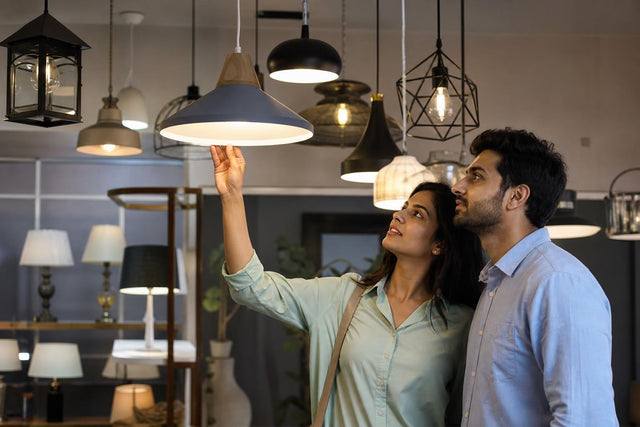
If you want to see how these ideas look in real fixtures, browse pendant lights as a starting point.
How to Choose Lighting Fixtures in 7 Steps
Before opening any product catalogue, work through these seven steps in order. Skip one and you risk choosing a fixture that looks right but performs wrong.
Step 1: Define the room’s function
A living room used for TV watching, reading, and weekend hosting needs different light than a kitchen where you chop vegetables at 7 AM. List what actually happens in the room. That list drives everything else.
Step 2: Choose the lighting layer
Every well-lit room uses multiple layers of light. The four layers are ambient (overall brightness), task (focused work light), accent (highlighting objects or surfaces), and decorative (the fixture itself as a visual element). More on each layer below.
Step 3: Pick the fixture type
Once you know the layer, the fixture type becomes clearer. Ambient might mean a chandelier or cove light. Task might mean under-cabinet strips or a desk lamp. Accent might mean track lights or picture lights. Decorative might mean a sculptural pendant.
Step 4: Size it to the room or surface
A fixture that looked enormous in the store can look tiny on a double-height wall. Sizing formulas exist for chandeliers, pendants, and wall lights. Use them as starting points, then adjust for ceiling height, furniture scale, and visual weight.
For detailed chandelier math, see our chandelier sizing formulas guide.
Step 5: Choose light quality
This is where most guides fail readers. Light quality means lumens (brightness), CCT (warm vs cool), CRI (color accuracy), beam angle (spread), and glare control. These specs determine whether a room feels inviting or clinical.
Step 6: Check controls and installation
Can it dim? Is the dimmer compatible? Does the ceiling support the weight? Is the wiring ready? Does the bathroom fixture have the right moisture protection? These practical questions prevent installation-day disasters.
Step 7: Match style, finish, and maintenance
Now, finally, pick the finish, material, and design. Metal or glass? Brass or matte black? Crystal or fabric shade? And consider maintenance: can you reach it to dust it, and can you replace the bulb or LED module when needed?
Lighting Layers Explained
The concept of layered lighting is the single most useful framework for choosing lighting fixtures in any room. Every top interior lighting guide, from Bright Ideas to Architectural Digest India, treats it as the foundation.
Ambient lighting
The base layer that makes the whole room usable. It is the general brightness you need to walk around safely, clean, and see faces.
Typical fixtures: ceiling lights, downlights, cove lighting, chandeliers, flush mounts, large wall lights.
Common mistake: Using one harsh ceiling light as the only source. Indian homeowners on Reddit frequently describe this as the “tube-light setup” that makes every room feel like a hostel corridor. Practitioners on IndianHomeDecor recommend layering warm ambient sources instead of relying on a single cool-white ceiling fixture.
Task lighting
Focused light for a specific activity: reading, cooking, grooming, working, applying makeup.
Typical fixtures: under-cabinet lights, desk lamps, bedside lamps, vanity lights, reading sconces, pendants over counters.
Common mistake: Relying on ambient light for tasks. Ambient light fills a room but does not concentrate where your hands or face need it. Ledrise’s home lighting guide recommends higher illuminance for kitchens, desks, and work surfaces than for general living areas.
Accent lighting
Directional light that highlights an object, texture, or architectural feature. It creates visual depth and draws the eye.
Typical fixtures: spotlights, track lights, wall washers, picture lights, LED strips aimed at a surface.
Common mistake: Making accent light too weak. The whole point is contrast. If your accent light blends into the ambient glow, it is not accenting anything.
Decorative lighting
A fixture chosen partly because the object itself is beautiful. The light it produces matters, but its visual presence is the primary purpose.
Typical fixtures: chandeliers, sculptural pendants, statement wall lamps, designer table and floor lamps.
Common mistake: Expecting a single decorative fixture to handle all the room’s lighting needs. A pendant alone creates a bright island in a dim room unless it is supported by ambient and accent layers.
Fixture Types: A Practical Glossary
Chandelier
A suspended multi-arm or statement fixture, usually serving both decorative and ambient roles. Best for dining rooms, foyers, double-height spaces, stairwells, and living rooms with sufficient ceiling height.
Check before buying: Diameter, total height (including chain or rod), weight, number of light points, dimming capability, and ceiling structural support.
Common mistake: Buying too small. In one InteriorDesign Reddit thread, a 12-inch fixture in a large entry looked obviously undersized to nearly every commenter. The fix is simple: use the sizing formula (covered below) before ordering.
For help choosing a dining room chandelier, see our dedicated guide.
Pendant light
A single suspended fixture or a repeated group of suspended fixtures. Use pendants over dining tables, kitchen islands, breakfast counters, bedsides, foyers, and consoles.
Check before buying: Shade diameter, drop length, glare from below, table or counter alignment, and dimming options.
Common mistake: Centering the pendant on the room instead of the surface below it. If the dining table is off-center, the pendant should follow the table, not the ceiling.
Linear pendant
A long horizontal pendant designed for rectangular surfaces. Perfect over long dining tables, kitchen islands, bars, and work tables.
Check before buying: Length relative to the table or island (leave visual breathing room on each side), even light distribution, and whether the fixture needs multiple mounting points.
Common mistake: Using one small round pendant over a 6-foot table. The light pools in the center and leaves the ends in shadow.
Semi-flush light
A ceiling fixture that mounts close to the ceiling but drops a few inches. This is the practical answer when you want something more interesting than a flat flush mount but do not have the ceiling height for a chandelier.
Check before buying: Total drop from ceiling, diameter, diffuser quality, and glare.
Why it matters for Indian homes: Many Indian apartments have 8.5 to 9 foot ceilings. A full chandelier with a long drop can feel claustrophobic. WoodenStreet’s guide identifies semi-flush fixtures as better suited to these standard ceiling heights.
Flush mount
A fixture mounted directly against the ceiling. Used in low-ceiling rooms, corridors, utility areas, and compact bedrooms.
Common mistake: Choosing a plain flush mount as the only source in a room that needs atmosphere. A flush mount can handle ambient, but you still need lamps or wall lights for mood.
Downlight
A recessed or surface-mounted fixture that directs light downward. Downlights handle general ceiling illumination, task pools in kitchens, and accent highlighting.
Check before buying: Lumens, beam angle, cutout size (for recessed types), false ceiling depth, CRI, CCT, glare control, and dimming compatibility.
Common mistake: Filling the ceiling with rows of bright downlights and creating what Houzz users call a “Swiss cheese ceiling,” all glare and no warmth.
Track light
Adjustable spotlights mounted on a track or rail. Useful for flexible accent and task lighting where furniture layouts change, art rotates, or the room serves multiple functions.
Common mistake: Installing track lighting as a style statement without actually aiming the heads at anything specific.
Wall sconce
A fixture mounted on a wall. One of the most versatile fixture types, wall sconces work for bedside lighting, hallway glow, mirror flanking, feature walls, and staircase illumination.
Check before buying: Mounting height, projection from wall, beam direction (up, down, or both), glare angle, and switch location.
For exact mounting heights room by room, see our wall light installation height guide.
Explore the Caral Wall Light as an example of a compact, versatile wall fixture.
Table lamp
A portable light placed on a nightstand, console, desk, or side table. Table lamps are one of the easiest ways to add a warm task or mood layer without any electrical work.
Common mistake: Using a bare, harsh bulb where a shaded lamp would diffuse the light and feel softer.
IndianHomeDecor users often recommend floor and table lamps as high-impact fixes for renters or anyone who cannot change ceiling wiring. A lamp like the Stello Lamp can transform a dark corner without civil work.
Floor lamp
A freestanding lamp that adds light at standing or seated height. Reading corners, living room layering, rented homes, and rooms without false ceilings all benefit from a good floor lamp.
Common mistake: Buying one bright uplighter and expecting it to solve all room lighting. Floor lamps work best as a layer, not a replacement for ambient.
Cove lighting
Indirect lighting hidden inside a ceiling or wall recess, usually produced by LED strips. The glow bounces off the ceiling or wall, creating soft ambient fill without any visible fixture.
Check before buying: LED strip quality, driver access, heat dissipation, diffuser (to avoid visible LED dots), CCT consistency along the run, and dimming capability.
LED strip and profile light
A linear LED source, often mounted inside an aluminium channel with a diffuser cover. LED strips go inside coves, under cabinets, along shelves, behind TV units, inside wardrobes, and along stairs.
Common mistake: Cheap strips with visible individual LED dots, uneven brightness, or mismatched color temperatures.
Illuminated mirror
A mirror with integrated lighting, used in bathrooms, dressing areas, and vanity spaces. Good illuminated mirrors provide face-level task light for grooming while also functioning as an ambient glow.
Why this matters: Bathroom users on Reddit consistently complain that overhead-only vanity light creates shadows under the eyes, nose, and chin. An illuminated mirror solves this by placing light at face height.
Check before buying: Light direction (front-lit vs backlit only), CCT, CRI, IP rating for bathroom moisture, sensor type (touch, motion, handwave), warranty, and installation wiring.
If you are considering one, see our guide on how to install an LED mirror.
Lighting Specs Glossary: What the Numbers Mean
This section covers the technical terms you will see on product pages, spec sheets, and quotes. Understanding them is the difference between confident buying and guesswork.
Lumens
How much visible light a bulb or fixture produces. This is the brightness number.
The FTC requires bulb labels to show brightness in lumens, and notes that a traditional 60-watt incandescent replacement is about 800 lumens. When choosing lighting fixtures, always compare lumens, not watts.
Common mistake: Asking for “more watts” when you actually mean “more light.” A 12W LED can easily outshine a 40W incandescent.
Watts
How much electrical power the light consumes. Watts tell you about energy use and electrical load, not about brightness.
The U.S. Department of Energy shows that LED products can deliver 800 lumens at roughly 6 to 10 watts, compared to 60 watts for an old incandescent bulb. This is why wattage alone is useless for comparing modern fixtures.
Lumens per watt
Efficiency: how much light you get for each watt of energy consumed. Higher is better, but do not chase efficiency numbers at the expense of CRI, color quality, or comfort.
Lux
How much light lands on a specific surface. One lux equals one lumen per square meter. This matters when you are planning task lighting for kitchen counters, desks, or vanity mirrors, because the fixture’s total lumens mean nothing if the light does not reach where you need it.
CCT (Correlated Color Temperature) / Kelvin
The color appearance of white light, measured in Kelvin. This is one of the most emotionally significant specs when choosing lighting fixtures for a home.
- 2700K: Warm, yellowish, cozy. Best for bedrooms, dining rooms, and living rooms in the evening.
- 3000K: Warm but slightly cleaner. A versatile residential choice.
- 3500K to 4000K: Neutral to cool-neutral. Good for kitchens, bathrooms, studies, and dressing zones.
- 5000K and above: Daylight or bluish-white. Can feel clinical in living spaces.
The DOE describes 2700K as “warm and friendly” and warns that radical CCT changes across a space are noticeable and can cause dissatisfaction.
One IndianHomeDecor user offered a practical room-by-room breakdown: 4000K for general ceiling lighting, 3000K for cove and profile lighting, 2700K to 3000K for wall sconces, and 2700K for bedside lamps. This graduated approach keeps each zone feeling intentional rather than random.
Common mistake: Mixing 2700K and 6000K bulbs in the same chandelier. Reddit lighting communities joke about how jarring one mismatched bulb looks, and they are right.
CRI (Color Rendering Index)
How accurately a light source renders colors compared to natural light, on a scale of 0 to 100. Higher CRI means skin looks natural, wood grain shows warmth, food looks appetizing, and fabrics display their true color.
The DOE says ENERGY STAR bulbs require a CRI of 80 or greater. That is the floor, not the target.
For living rooms, bedrooms, dining areas, mirrors, and anywhere finishes matter, aim for CRI 90 or above. One lighting practitioner on LinkedIn noted that low-glare optics with CRI 90+ let materials like wood, stone, and fabric “read true” without hot spots. A lighting community member on Reddit put it more bluntly: choose 90+ CRI for any space where you care about how things look.
R9
A supplementary color rendering score specifically for saturated red. R9 matters wherever skin tones, warm wood, food, brass finishes, and red or orange textiles are present. ENERGY STAR’s downlight criteria require CRI Ra of 80+ and R9 above zero, recognizing that overall CRI alone does not capture red rendering quality.
Common mistake: Assuming CRI tells the whole story. Two fixtures with CRI 85 can render reds very differently if one has negative R9.
Beam angle
How wide or narrow the light spreads from a fixture. Narrow beams (15 to 25 degrees) create focused accent pools. Medium beams (36 to 60 degrees) suit task and general lighting. Wide beams (above 60 degrees) provide broad ambient wash.
Common mistake: Using narrow spotlights for general room brightness (you get bright spots and dark gaps) or wide floods for accent lighting (you lose the contrast that makes accents work).
Glare
Light that is too bright in the eye, either directly from the source or reflected off glossy surfaces like polished stone, glass tables, or TV screens.
Glare is what separates comfortable lighting from aggressive lighting. A room can have plenty of lumens and still feel unpleasant if the light sources are exposed, unshielded, or poorly positioned. AD India advises strategic placement to avoid glare and shadows, including keeping floor lamps away from TV screens.
Another LinkedIn lighting practitioner warns that glare control, optics, and dimming quality are often the first features to disappear when projects are value-engineered on a budget. These “quiet” performance features matter more than fixture shape in daily comfort.
Diffuser
A translucent material (glass, acrylic, fabric) placed over or around a light source to spread and soften the output. Diffusers reduce glare, hide individual LED dots in strip lights, and create a more even glow.
Dimmable
The light output can be raised or lowered. Essential for living rooms, dining rooms, bedrooms, and any space where mood changes through the day.
Critical warning: “Dimmable” on a product page is not enough. You need fixture, driver, and dimmer switch to all be compatible with each other. Incompatible combinations cause flickering, buzzing, or limited dimming range. The DOE specifically tells buyers to verify dimming compatibility before purchase. Reddit lighting users confirm that flicker and buzzing from mismatched dimmers are among the most common real-world complaints.
Driver
The electronic component that powers an LED. Drivers convert mains voltage to the low voltage LEDs need. In integrated LED fixtures, the driver is typically hidden inside the canopy or fixture body.
Check before buying: Is the driver replaceable? Where is it accessed after installation? Is it compatible with your dimmer? What does the warranty cover?
Integrated LED
The LED is built into the fixture rather than using a removable, replaceable bulb. This allows slimmer designs, better optics control, and modern forms, but it creates a serviceability trade-off.
Pros: Compact profiles, tailored beam control, efficient, ideal for illuminated mirrors, profile lights, and sleek contemporary pendants.
Cons: If the LED module or driver fails, replacing it is harder than swapping a bulb. HomeDecorating users on Reddit advise thinking about what fails first and how it gets replaced before choosing purely by style.
Bottom line: Integrated LEDs are not bad. They are essential for many modern fixture types. But always ask: what is the warranty, is the driver accessible, and can the LED module be serviced?
IP rating
A two-digit code describing protection against solids/dust (first digit) and water (second digit). For example, IP64 means dust-tight and protected against splashing water from any direction.
Use it when: Choosing fixtures for bathrooms, balconies, gardens, outdoor walls, terraces, and kitchens near water sources.
Common mistake: Installing a decorative indoor fixture on a damp balcony wall without checking its moisture suitability.
L70 / LED life
The estimated number of hours until an LED source retains only 70% of its original brightness. ENERGY STAR downlight criteria require a minimum L70 of 25,000 hours.
LEDs do not “burn out” like old incandescent bulbs. They gradually dim over time, or the driver components fail. Understanding this distinction helps set realistic maintenance expectations.
Which Lighting Fixtures Work Best in Each Room?
Use the table below as a starting point when choosing lighting fixtures for specific rooms. Each suggestion assumes layered lighting, not a single fixture doing everything.
| Room | Primary need | Recommended fixture mix | CCT starting point | Key warning |
|---|---|---|---|---|
| Living room | Flexible mood and hosting | Chandelier or pendant, wall lights, lamps, downlights or cove | 2700K to 3000K for mood, 3000K to 4000K for task zones | Do not rely on one ceiling light |
| Dining room | Table focus, flattering faces and food | Chandelier or pendant over table, dimmer, wall or accent light | 2700K to 3000K | Hung too high, it stops lighting the table |
| Bedroom | Rest and reading | Bedside lamps or sconces, soft ambient, optional statement light | 2700K to 3000K | Avoid harsh downlights directly over the bed |
| Kitchen | Bright task work | Downlights, under-cabinet profile lights, island pendants | 3000K to 4000K | Under-cabinet task light often matters more than extra ceiling fixtures |
| Bathroom | Grooming and safety | Illuminated mirror or side sconces, overhead ambient, wet-rated shower light | 3000K to 4000K for grooming | Overhead-only vanity light creates face shadows |
| Foyer | First impression | Pendant or chandelier, wall lights, accent | 2700K to 3000K | Fixture must clear head height and door swing |
| Staircase | Safety and vertical drama | Step lights, wall lights, long-drop chandelier if height allows | 3000K | Avoid glare into eyes while descending |
| Balcony / Outdoor | Weather resistance and mood | Outdoor-rated wall lights, bollards, step lights, waterproof strips | 2700K to 3000K | Check IP and wet-location suitability |
For statement fixtures that need to anchor a large room, always start with the sizing rules below.
Lighting Fixture Sizing Rules of Thumb
Getting the size wrong is one of the most visible and most avoidable mistakes. These formulas give you a starting point, not a rigid law. Adjust based on ceiling height, furniture scale, open-plan sightlines, and whether the fixture is visually airy or dense.
Chandelier diameter
Formula: Room length in feet + room width in feet = approximate chandelier diameter in inches.
A 12 ft by 14 ft room starts at roughly 26 inches. A 10 ft by 10 ft room starts at 20 inches.
Both WoodenStreet and Reddit design communities cite this formula as a practical baseline. It is not perfect for every space, but it prevents the “too small” mistake that is obvious to everyone except the person who bought it.
Pendant over a dining table
Height: 75 to 90 cm (roughly 28 to 34 inches) from the tabletop to the bottom of the pendant.
Width: A practical guide is table width minus about 30 cm, leaving breathing room on both sides.
Always measure from the surface below, not from the ceiling. The clearance above the table is what determines comfort, sightlines, and effective light distribution.
Pendant over a kitchen island or counter
Height: 75 to 85 cm above the counter surface.
Count: One pendant for compact surfaces, two to three for medium-to-long islands, or a single linear pendant spanning the length.
Pendant beside the bed
Height: 45 to 60 cm above the mattress top, per Studio Matrx’s India-specific pendant guide.
Wall sconce height
General guidance places wall sconces at around eye level for the typical user, though this shifts depending on whether you are seated (bedside, sofa-side) or standing (hallway, staircase). For vanity sconces, NKBA guidelines recommend placement at each side of the mirror near the user’s eye level to minimize face shadows.
The 4S Fixture Test: Use This Before Every Purchase
Before you commit to any fixture, run it through four checks.
1. Scale. Does the fixture’s size suit the room, ceiling, wall, or surface it will live with? Use the sizing formulas. Hold a piece of cardboard cut to size against the wall or hang it from the ceiling with string to visualize.
2. Spec. Are lumens, CCT, CRI, dimming capability, IP rating, and driver details appropriate for the room’s function? A gorgeous brass pendant with 6000K cool white and CRI 70 will make your dining room feel like a hospital cafeteria.
3. Support. Can the ceiling, wall, or electrical point physically support the fixture? Heavy chandeliers need structural anchoring, not just a standard junction box. Confirm with your electrician or contractor before installation.
4. Service. Can bulbs, drivers, or LED modules be replaced or repaired when something eventually fails? Ask the manufacturer or retailer about warranty coverage and part availability. This matters especially for integrated LED fixtures and illuminated mirrors.
The “Pretty But Wrong” Diagnostic
Sometimes you already own a fixture and something feels off. Use this table to diagnose the problem.
| Symptom | Likely issue | Fix |
|---|---|---|
| Room still feels dark despite a nice fixture | Decorative fixture is not producing enough ambient light | Add wall lights, cove lighting, lamps, or downlights as a supporting layer |
| Faces look harsh or shadowed | Overhead-only lighting casting downward shadows | Add side or front light at face height (sconces, illuminated mirror) |
| Room feels clinical or cold | CCT too cool, CRI too low, or glare too high | Switch to warmer CCT, add a diffuser, install a dimmer |
| Fixture looks tiny after installation | Wrong scale for the room | Use the sizing formula, go bigger next time |
| Fixture feels uncomfortably low | Ceiling height vs drop length mismatch | Switch to semi-flush mount or shorten the drop |
| Light flickers or buzzes | LED and dimmer incompatibility | Match driver, bulb, and dimmer; verify compatibility specs |
| Bathroom fixture fails early | Wrong moisture protection rating | Replace with an IP-rated or damp/wet-location fixture |
| LED died and replacement is difficult | Integrated LED with no service path | Ask about warranty, driver access, and module replacement before buying next time |
What to Check Before Buying a Lighting Fixture
Use this checklist every time you review a product page, showroom spec sheet, or contractor quote.
- Room and use case: Which room? Which lighting layer?
- Fixture type: Chandelier, pendant, wall light, downlight, lamp, mirror, etc.
- Dimensions: Width or diameter, height, depth, drop length, canopy size
- Ceiling height and clearance: Will the fixture clear your head? Does it fit the room’s proportions?
- Weight and mounting method: Does the ceiling or wall need reinforcement?
- Material and finish: Metal, glass, acrylic, fabric, crystal, brass, matte black, etc.
- Bulb base or integrated LED: Can you replace the light source?
- Lumens: Total light output
- Watts: Energy consumption
- CCT / Kelvin: Warm, neutral, or cool white
- CRI: 80 minimum, 90+ for premium residential
- R9: Ask when skin, food, wood, or warm finishes matter
- Beam angle: Narrow for accent, wide for ambient
- Dimmability: And dimmer switch compatibility
- Driver location and serviceability: For integrated LED fixtures
- IP rating or location suitability: Dry, damp, or wet
- Warranty: Duration and what it covers
- Cleaning and maintenance needs: Can you reach it? How often?
- Delivery and installation timeline: Ready stock or made to order?
India-Specific Considerations When Choosing Lighting Fixtures
Indian homes have particular realities that global lighting guides often miss. Keep these in mind.
Ceiling heights. Many Indian apartments have ceilings between 8.5 and 9 feet. A full chandelier with a 2-foot drop may leave only 6.5 feet of clearance, which is uncomfortable. Semi-flush fixtures, compact pendants, or flush mounts often work better in standard-height flats. Save long-drop chandeliers for double-height spaces, villas, or rooms with false ceilings designed with extra depth.
False ceilings. If your home has or will have a false ceiling, plan the lighting before the ceiling is built. Recessed downlights need specific cutout sizes and depths. Cove lighting requires hidden channels. Profile lights need driver access points. Late decisions create messy retrofits. Bright Ideas warns that late lighting decisions cause conduit, cutout, and dimming problems during construction.
The warm vs cool white confusion. India has a long history of cool white tube lights, and many homeowners default to them out of habit. If your living room, bedroom, or dining room feels cold and clinical, CCT is probably the culprit. Switching to 2700K or 3000K warm white creates an immediate transformation, no renovation required.
Plug-in solutions for renters. If you cannot change wiring or ceilings, floor lamps, table lamps, and plug-in wall fixtures solve most lighting problems without any civil work.
Indian standards. BIS covers LED luminaires, modules, drivers, and safety testing under compulsory registration. BEE’s star labelling programme rates energy efficiency for certain LED lamp categories. When reviewing product specs, look for disclosed lumens, wattage, CCT, CRI, material, dimensions, and warranty information.
Electrician coordination. For heavy fixtures, always confirm structural ceiling support with your electrician or contractor before installation. For damp-area fixtures (bathrooms, balconies, terraces), verify IP or wet-location suitability and ensure proper waterproof wiring.
When to Decide on Lighting Fixtures During a Renovation
Lighting should not be an afterthought squeezed in after the paint is dry. Here is a rough timeline.
- Floor plan and furniture layout finalized
- Ceiling plan (false ceiling, beam positions, height zones) decided
- Lighting layers and fixture types chosen per room
- Electrical points, switches, and dimmers marked on the plan
- Fixture selection and purchase completed with specs confirmed
- Installation and testing done before final finishes
Planning early means your wiring, switch plates, dimmer circuits, and ceiling reinforcements are all ready when the fixtures arrive. Planning late means compromises, extra costs, and exposed conduits.
ALC Studio offers free design consultations to help with sizing, layering, CCT selection, and fixture specification. If you are mid-renovation or starting fresh, getting fixture guidance early saves both money and frustration.
Book a free design consultation at ALC Studio
Frequently Asked Questions
How do I choose the right lighting fixture for a room?
Follow the 7-step process: define the room’s function, choose the lighting layer (ambient, task, accent, decorative), pick the fixture type, size it to the room or surface, choose light quality specs (lumens, CCT, CRI), check installation and control requirements, and then match style and finish.
What are the main types of lighting fixtures?
The primary types are chandeliers, pendants (including linear pendants), ceiling lights (flush and semi-flush), downlights, wall sconces, track lights, table lamps, floor lamps, cove and profile lights, LED strips, and illuminated mirrors.
Should I choose warm white or cool white lights?
Use warm white (2700K to 3000K) for cozy spaces like living rooms, bedrooms, and dining rooms. Use neutral to cool white (3500K to 4000K) for task-heavy spaces like kitchens, studies, and bathrooms. Avoid mixing extreme temperatures in the same room or fixture.
What is CRI and why does it matter?
CRI measures how accurately a light renders colors on a 0 to 100 scale. CRI 80 is the common minimum. CRI 90 or above is better for premium interiors, mirrors, art, food presentation, wood finishes, and fabrics. Low CRI makes everything look flat and slightly off.
How do I know what size chandelier to buy?
A common starting formula: add the room’s length and width in feet, then convert the sum to inches for the approximate chandelier diameter. A 12 ft by 14 ft room starts at roughly 26 inches. Adjust for ceiling height, furniture scale, and how visually heavy the fixture is.
How low should a pendant hang over a dining table?
The standard range is 75 to 90 cm (28 to 34 inches) from the tabletop to the bottom of the fixture. Measure from the table surface, not from the ceiling.
Are integrated LED fixtures reliable?
Yes, they work well for slim profiles, illuminated mirrors, and modern designs. The trade-off is serviceability: if the LED or driver fails, replacement may be harder than changing a bulb. Always ask about warranty duration, driver accessibility, and module replacement options before buying.
What does IP rating mean for bathroom or outdoor lights?
The IP rating has two digits. The first digit describes protection from solids and dust. The second digit describes water protection. Any fixture going in a bathroom, balcony, garden, or outdoor area should have an appropriate IP or damp/wet-location rating. Check with your electrician if you are unsure.
0 Comments
There are no comments for this article. Be the first one to leave a message!