
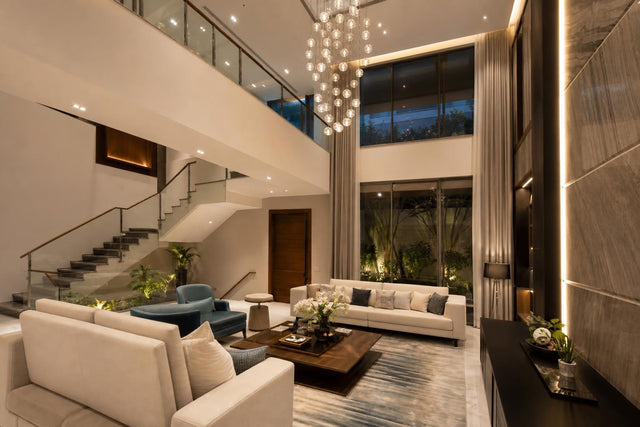
Lighting Ideas for Double-Height Ceilings: 2026 Guide
TL;DR
Double-height ceilings (16 to 22 feet) need a layered lighting approach, not just a single chandelier. Combine ambient, task, and accent lighting across multiple vertical zones. Use warm white (2700–3000K) for living areas, increase total lumen output by 10–25% compared to standard rooms, and size your chandelier using the rule of thirds: it should fill roughly one-third of the vertical space. Integrated LED fixtures save you from the nightmare of replacing bulbs at 20 feet.
Why Lighting a Double-Height Space Is Different
A double-height ceiling is any space where the ceiling sits at roughly twice the standard 8-foot height, typically between 16 and 22 feet. These spaces are common in Indian duplexes, villas, and luxury apartments, especially in foyers, living rooms, and stairwells.
The problem is simple physics. As ceiling height increases past 12 feet, light dissipates before it can effectively reach your dining table, walls, or floor. The result is harsh glare overhead and dark shadows everywhere else. A single overhead fixture, no matter how grand, won’t solve this. You need to think in layers and zones.
There’s also a practical concern that rarely gets discussed in design magazines. Practitioners on forums like AnandTech describe the frustration of replacing bulbs on high ceilings, with one homeowner noting they’re “not comfortable going up a ladder that high,” especially over a staircase. This makes fixture choice about maintenance, not just aesthetics.
If you’re starting to plan lighting for a double-height living room, explore ALC Studio’s collection for fixtures designed to work at scale in Indian homes.
Fixture Types That Work in Double-Height Spaces
Double-Height Chandelier
A double-height chandelier is a large-format fixture, usually around 10 feet tall, specifically proportioned for spaces with 18 to 22-foot ceilings. These are the statement pieces you see in foyers, duplex living rooms, and stairwells.
Why it works here: the sheer vertical drop of a tall space demands a fixture with visual weight. A chandelier meant for a standard 8-foot ceiling will look lost, like hanging a picture frame on the side of a building.
For sizing, a practical formula works well: measure the room’s length and width in feet, add them together, and that number in inches gives you the approximate diameter. A room that’s 16 feet by 12 feet calls for a chandelier roughly 28 inches across. For double-height great rooms, you can typically go 31 inches or wider.
The Crysta crystal chandelier is the kind of fixture built for this purpose, designed to anchor a tall space visually while distributing light effectively.
Multi-Tier Chandelier
Multi-tier chandeliers feature stacked rings or layers of light, often with modern crystal or glass arrangements. They’re designed to fill vertical space proportionally, which is exactly what a double-height room demands.
The rule of thirds applies here: a chandelier should occupy approximately one-third of the vertical space. In an 18-foot foyer, that means a fixture roughly 6 feet tall. This sounds enormous for anyone used to standard ceiling heights, but it’s exactly right for the scale.
Pendant Light and Cluster Pendant
Pendants are more versatile than chandeliers. A single pendant works as a focal point, while cluster pendants (multiple pendants grouped at varying heights) create a visual anchor that draws the eye upward. Indian lighting retailers recommend cluster pendants at staircase landings for exactly this reason.
For double-height areas, pendant fixtures should be at least 12 to 18 inches in diameter. Anything smaller disappears. The Dew Drops cascading pendant is a good example of a fixture that uses vertical drop to its advantage, and the LumaCloud pendant offers a more contemporary silhouette for tall ceilings.
Hanging height matters. For ceilings between 17 and 20 feet, the bottom of the pendant or chandelier should hang at least 7 to 10 feet above the floor. This provides clearance while keeping the light source close enough to be useful.
Wall Sconce
Wall sconces are one of the most effective lighting ideas for double-height ceilings because they solve a problem no ceiling fixture can: illuminating the middle zone of a tall wall. Without sconces, you get a bright ceiling, a lit floor, and a dark band in between.
For stairwells, the guideline is to mount sconces 60 to 66 inches above the stair tread (roughly eye level) and space them every 6 to 8 feet. This distributes light evenly across the wall and steps without consuming floor space.
The Caral wall sconce is designed for this kind of application, while the Troy accent wall light works well when you want to highlight architectural details or artwork on a tall wall.
Cove Lighting and LED Profile Lighting
Cove lighting uses hidden fixtures placed in ledges, recesses, or ceiling valences. The light points upward and bounces off the ceiling, producing a smooth ambient glow that adds depth and warmth without any visible fixture.
In Indian homes, cove lighting inside false ceilings is nearly universal. For double-height spaces, you can run cove lighting at the transition point where the false ceiling meets the full-height wall, creating a defined horizontal line that makes the room feel intentional rather than cavernous.
Most installations work best with a recess depth of 3 to 5 inches and enough setback to keep the LED strip hidden from view at floor level.
Recessed Downlights
Recessed lights sit flush with the ceiling and cast light directly downward. They’re clean and minimal, but they come with a challenge at height.
Contractors on the Mike Holt electrical forum confirm that for residential ceilings between 14 and 20 feet, each recessed fixture needs at least 1,000 lumens. Standard 600-lumen downlights that work fine at 8 feet produce nothing but strong shadows at double height.
One professional electrician on the same forum makes a compelling point: ceiling mounting on a 25-foot ceiling is a poor choice because you end up with less light at floor level. The better option is mounting fixtures facing down on a strut, 10 to 12 feet above the floor. This is a technique worth discussing with your electrician during planning.
Floor Lamps and Uplighters
Floor lamps and uplighters fill the lowest layer of a tall room. An uplighter throws light toward the ceiling, which is especially useful in corners of a double-height space where ceiling fixtures don’t reach. The Stello floor lamp is a good option for creating a warm pool of light in a living room reading corner.
Understanding Lighting Layers (And Why One Chandelier Isn’t Enough)
A common mistake in double-height rooms is installing a magnificent chandelier and calling it done. The chandelier looks beautiful, but the rest of the space sits in shadow. The problem isn’t the fixture. It’s the absence of a layered lighting strategy.
Ambient Lighting
Ambient lighting is your base layer: the general, even illumination that makes a room feel open and usable. In a standard room, one or two ceiling lights handle this. In a double-height space, you need multiple sources because light dissipates over distance.
For a living room, aim for 10 to 20 lumens per square foot of ambient light. A 200-square-foot living room needs 2,000 to 4,000 lumens just for the ambient layer.
Task Lighting
Task lighting directs focused light onto work surfaces: a desk, a kitchen counter, a reading chair. Because it needs to illuminate a specific area, it requires more lumens than ambient light, and it should sit closer to the activity. In a double-height living room, task lighting almost always lives at the lower level: table lamps, adjustable floor lamps, or pendant lights hung low over a dining table.
Accent Lighting
Accent lighting highlights specific features, like artwork, textured walls, architectural columns, or a statement piece of furniture. The standard rule: accent fixtures should be about three times brighter than the ambient lighting around them to create the contrast that makes them effective.
In a double-height space, accent lighting is what brings the walls to life. Without it, those tall surfaces become blank and imposing.
Vertical Layering: The Key Technique for Tall Rooms
This is the concept that ties everything together for double-height lighting ideas. Vertical layering means distributing light sources across three horizontal zones:
Upper zone (ceiling to roughly 10 feet): Chandelier, cove lighting, recessed downlights
Middle zone (roughly 5 to 10 feet): Wall sconces, picture lights, accent fixtures
Lower zone (floor to 5 feet): Floor lamps, table lamps, low-mounted LED strips
Effective layered lighting for a high-ceiling room incorporates a central chandelier, recessed ambient lights, wall sconces, and accent fixtures at different heights. This combination eliminates the vertical shadows that plague tall rooms.
A practical benchmark from interior practitioners: aim for 5 to 7 individual light sources in a double-height living room, all at warm white (2700K or below), with at least one dimmer switch on the main ceiling light.
For deeper guidance on choosing your primary fixture, this chandelier selection guide walks through the full decision process.
Technical Terms You Need to Know
Colour Temperature (CCT)
Colour temperature is measured in Kelvins (K) and describes how “warm” or “cool” a light appears:
Warm white (2700–3000K): Golden, cozy tone. Best for living rooms, bedrooms, dining areas.
Natural white (4000K): Neutral, balanced. Good for kitchens, home offices, bathrooms.
Cool white (6000–6500K): Bright, bluish. Suitable for study rooms, garages, or task-heavy spaces.
For Indian homes specifically, 2700K to 3000K warm white is the strong recommendation for living areas. It works beautifully with wood tones, marble floors, and fabric upholstery, all common in Indian interiors. It makes skin tones look flattering. And it pairs perfectly with false ceiling cove lighting.
A note from Quora discussions among Indian homeowners: many electricians and shopkeepers still use “yellow light” for warm white and “white light” for cool white. These terms are technically imprecise but extremely common. If your electrician asks whether you want “yellow or white,” you almost certainly want yellow for your living room.
Multiple respondents on Quora also flag a common mistake: using cool white (6500K) in bedrooms because it feels “brighter” or “cleaner.” Cool white at 6500K actively signals wakefulness to your brain. It’s the opposite of what you want in a space designed for relaxation.
Lumens
Lumens measure total light output. More lumens means more light, regardless of wattage. This matters for double-height ceilings because the same fixture produces noticeably less useful light when mounted 18 feet up compared to 8 feet.
The calculation for standard ceilings: multiply your room’s square footage by the recommended lumens per square foot (10–20 for living rooms, 30–40 for kitchens). For ceilings 10 feet or higher, increase your total lumen output by 10 to 25%.
A quick example: a 12×14-foot living room (168 sq ft) at 20 lumens per square foot needs roughly 3,360 lumens at standard height. At double height, bump that to 3,700 to 4,200 lumens for the ambient layer alone.
Lux and Foot Candles
Lux measures how much light actually arrives on a surface, not how much a fixture produces. It’s lumens per square meter. Recommended levels by room type:
Room |
Target Lux |
|---|---|
Living room |
100–300 |
Kitchen |
300–500 |
Home office |
300–500 |
Bedroom |
100–200 |
In double-height spaces, reaching these lux levels at floor height requires significantly more lumens from the source, which is why the 10–25% uplift matters.
CRI (Colour Rendering Index)
CRI measures how accurately a light source reveals the true colours of objects, on a scale from 0 to 100. Sunlight scores 100. For residential spaces, look for fixtures with a CRI of 80 or above. For areas where colour accuracy matters (a dining room with rich wood tones, an art wall), aim for CRI 90+.
Dimmable Lighting
Dimmers let you adjust light output to match activity and time of day. In a double-height living room, dimming your chandelier from full brightness during a party to a gentle glow for movie night transforms the space without changing a single fixture. Not all LED fixtures are dimmer-compatible, so check specifications before purchasing.
Sizing and Placement Formulas
These formulas are scattered across dozens of sources online. Here they are in one place.
Chandelier Diameter Formula
Add the room’s length and width in feet. That sum, in inches, is your target diameter.
Example: 16 ft + 12 ft = 28 inches diameter.
For double-height great rooms, you can usually go wider, up to 36 inches for large spaces.
Chandelier Height Formula
For standard ceilings: multiply ceiling height in feet by 2.5 to 3. The result in inches gives you the fixture height.
Example: 9 ft ceiling × 3 = 27 inches tall.
Taller ceilings can accommodate more vertical presence. Multi-tier designs and elongated silhouettes are specifically made for this.
Rule of Thirds for Double-Height Foyers
A chandelier should occupy approximately one-third of the total vertical space. In an 18-foot foyer, that’s a 6-foot-tall fixture. In a 21-foot stairwell, roughly 7 feet.
This rule ensures the fixture feels proportional rather than either swallowed by the space or overwhelming it.
Hanging Height for Double-Height Ceilings
For ceilings between 17 and 20 feet, the bottom of the chandelier should sit at least 7 to 10 feet above the floor. This provides safe clearance while keeping the fixture in the visual sweet spot.
Width Proportionality
Beyond the diameter formula, the fixture’s width should also relate to the horizontal space. A common guideline: the chandelier’s diameter should be roughly half the width of the room or foyer. In a 14-foot-wide foyer, aim for a fixture around 7 feet (84 inches) wide at most, though most residential fixtures won’t approach that size.
Sconce Placement in Double-Height Stairwells
Height: 60 to 66 inches above the stair tread
Spacing: every 6 to 8 feet along the wall
This positions light near eye level and creates an even wash down the staircase
Practical Tips for Indian Homes
Warm White Is Almost Always the Right Choice
Indian living rooms tend to be designed for warmth and welcome. Warm white light at 2700–3000K enhances wood tones, marble, and fabric sofas. It pairs with false ceiling cove lighting. As one Indian interior practitioner put it, think of it as replacing tube light harshness with the comfort of a diya.
The prevalence of cool white (6500K) in Indian homes is a cultural habit from the era of fluorescent tubes, not a design choice. If you’re building a new double-height space or renovating, this is the single easiest upgrade you can make.
False Ceiling and Cove Lighting in Double-Height Spaces
Almost every Indian duplex or villa uses a false ceiling with integrated cove lighting. In a double-height room, the false ceiling typically runs around the perimeter at the standard floor level (8 to 10 feet), while the center opens up to the full height. This creates a natural ledge for cove lighting that defines the room’s boundaries and provides warm ambient light.
The LED strips in these coves should be warm white and high-CRI. Use a recess depth of 3 to 5 inches with enough setback that the strip isn’t visible when you’re standing in the room.
Why Integrated LED Fixtures Matter at Height
Changing a bulb at 20 feet is not a weekend task. It requires scaffolding, a very tall ladder (risky over staircases), or calling a professional. Integrated LED fixtures, where the light source is built into the fixture and rated for 30,000 to 50,000 hours, eliminate this problem for years.
When choosing fixtures for double-height spaces, prioritize integrated LEDs or fixtures with extremely long-rated lamp life. The Ledios LED fixture is one example of this approach.
Custom Sizing for Non-Standard Indian Proportions
Indian double-height spaces don’t always follow Western proportions. A duplex in Noida might have a 17-foot ceiling but a narrow 10-foot-wide living room. Standard imported fixtures often won’t fit these dimensions properly.
This is where custom lighting solutions become valuable. ALC Studio offers custom lighting design and production, with fixtures tailored to specific dimensions, finishes, and styles. If your space doesn’t match the standard formulas, a custom consultation can save you from an expensive mistake.
Quick Reference: Sizing and Specification Table
Parameter |
Value |
Notes |
|---|---|---|
Double-height ceiling range |
16–22 ft |
Typical in Indian duplexes and villas |
Chandelier diameter formula |
Length (ft) + Width (ft) = Diameter (in) |
Go wider for very tall rooms |
Chandelier height formula |
Ceiling height (ft) × 2.5–3 = Height (in) |
Multi-tier designs can go taller |
Rule of thirds |
Fixture fills ~⅓ of vertical space |
Essential for foyers and stairwells |
Minimum hanging clearance |
7–10 ft from floor |
For 17–20 ft ceilings |
Recessed light lumens (14–20 ft) |
≥1,000 lumens per fixture |
Per contractor recommendations |
Lumen uplift for high ceilings |
+10–25% over standard |
Compensates for light dissipation |
Warm white range |
2700–3000K |
Recommended for Indian living spaces |
Cool white range |
6000–6500K |
Study rooms and task areas only |
Accent lighting brightness |
3× ambient level |
Creates effective visual contrast |
Sconce height on stairs |
60–66 in above tread |
Eye level for most adults |
Sconce spacing |
Every 6–8 ft |
Along staircase walls |
Frequently Asked Questions
How many lights do I need for a double-height living room?
Aim for 5 to 7 individual light sources spread across three vertical zones: upper (chandelier, cove lights, recessed), middle (wall sconces), and lower (floor lamps, table lamps). This layered approach eliminates the dark bands that a single fixture creates in tall spaces.
What size chandelier is right for a double-height ceiling?
Add the room’s length and width in feet, and that number in inches gives you the diameter. For the height, the chandelier should fill approximately one-third of the total ceiling height. In an 18-foot room, that means a fixture roughly 6 feet tall and at least 28 to 36 inches wide.
Should I use warm white or cool white light in a double-height living room?
Warm white at 2700–3000K. It enhances wood, marble, and fabric, which are the dominant materials in Indian interiors. Cool white (6500K) should be reserved for study rooms and task-heavy areas. The widespread use of cool white in Indian living rooms is a holdover from fluorescent tube days, not an intentional design choice.
How do I change bulbs in a double-height ceiling?
This is a real pain point. For fixtures above 14 feet, you’ll need scaffolding or professional help, which makes integrated LED fixtures the better choice. These have light sources rated for 30,000+ hours and don’t require bulb changes for years. When selecting fixtures for tall spaces, prioritize this feature.
Can recessed downlights work at 18 to 20 feet?
Yes, but each fixture needs at least 1,000 lumens. Standard 600-lumen downlights that work at 8 feet will produce weak, shadow-heavy light at double height. Some professionals recommend mounting fixtures on a strut at 10 to 12 feet rather than at the actual ceiling to keep the light source closer to where it’s needed.
What is vertical layering in lighting design?
Vertical layering means placing light sources at different heights throughout a tall room: ceiling fixtures in the upper zone, wall sconces in the middle zone, and floor or table lamps in the lower zone. It’s the single most important concept for lighting ideas for double-height ceilings because it ensures no vertical band of the room sits in darkness.
How far above the floor should a chandelier hang in a double-height room?
For ceilings between 17 and 20 feet, the bottom of the chandelier should hang at least 7 to 10 feet above the floor. This keeps the fixture in the room’s visual center rather than floating too high or creating a clearance problem.
Is cove lighting enough for a double-height space?
On its own, no. Cove lighting provides beautiful ambient warmth, but it bounces light off the ceiling rather than directing it downward. In a double-height room, it works best as one layer within a larger system that includes a central fixture, sconces, and lower-level lamps.
Planning lighting for a double-height space takes more thought than a standard room, but the payoff is dramatic. Start with the formulas, think in layers, and prioritize warm white with high-CRI fixtures. If you need help sizing fixtures for a specific space, ALC Studio offers free design consultations to get the proportions right.
0 Comments
There are no comments for this article. Be the first one to leave a message!