
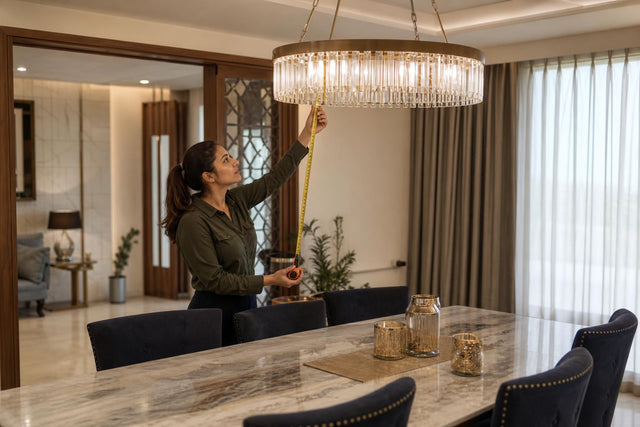
How to Size a Dining Room Chandelier: 2026 Step-by-Step
TL;DR
To size a dining room chandelier, use the table-based formula: choose a fixture with a diameter between one-half and two-thirds of your table’s width. Hang it 30 to 36 inches above the table surface at a standard 8-foot ceiling, adding 3 inches for every extra foot of ceiling height. For Indian homes, that translates to roughly 15 to 20 inches for a 4-seater, 18 to 24 inches for a 6-seater, and 20 to 27 inches for an 8-seater. Always adjust for visual weight: airy fixtures can go bigger, dense crystal designs should stay conservative.
Every chandelier purchase comes down to three numbers: the right diameter, the right body height, and the right hanging height. Get them wrong and a beautiful fixture looks awkward, either floating like a lost ornament near the ceiling or hovering so low it blocks eye contact across the table. Get them right and the chandelier anchors the entire room.
This guide walks through every formula, rule, and judgment call involved in sizing a dining room chandelier, with pre-calculated numbers for standard Indian dining tables so you don’t have to convert a single unit yourself.
Explore ALC Studio’s chandelier collection for fixtures available in custom sizes and finishes across India.
Key Sizing Terms You Should Know
Before jumping into formulas, a few definitions will save confusion later.
Chandelier Diameter (Width): The widest horizontal measurement of the fixture, from one edge to the opposite edge. This is the single most important number when sizing.
Fixture Body Height: The height of the chandelier itself, not including the chain, rod, or canopy above it. This determines how much vertical space the fixture occupies.
Total Drop: The full distance from ceiling to the chandelier’s lowest point. It includes the canopy, chain or rod, and the fixture body combined.
Hanging Height (Clearance): The gap between the table surface and the bottom of the chandelier. This is what controls comfort and sightlines for seated guests.
Visual Weight: How heavy or light a fixture appears, regardless of its actual dimensions. A crystal chandelier packed with glass prisms has high visual weight. A thin metal ring pendant has low visual weight. This concept matters more than most guides acknowledge, and we’ll cover it in detail below.
Linear Chandelier: An elongated fixture designed specifically for rectangular or oval tables, measured by length rather than diameter.
CCT (Correlated Colour Temperature): The warmth or coolness of light, measured in Kelvin. For dining rooms, 2700K to 3000K is the standard recommendation for warm, flattering light.
Lumens: The total light output of a fixture. Sizing affects how many bulbs a chandelier holds and, by extension, how much light actually reaches your table.
The Two Core Formulas for Sizing a Dining Room Chandelier
There are two established methods for calculating chandelier diameter. Both are widely cited by lighting manufacturers and interior designers. The key is knowing which one to use and when.
Formula 1: Room-Based Sizing (When You Don’t Have a Table Yet)
Add the length and width of your dining room in feet. The sum, converted to inches, gives you the minimum chandelier diameter.
Example: A dining room measuring 12 feet by 14 feet gives you 12 + 14 = 26. A chandelier with at least 26 inches of diameter would be proportional to the room.
This formula works best for empty rooms or open floor plans where the dining area isn’t defined by a table yet.
Formula 2: Table-Based Sizing (When Your Table Is Already Chosen)
Choose a chandelier with a diameter between one-half and two-thirds of your table’s width. This is the more precise and widely preferred method.
Example: A table that is 60 inches (150 cm) wide calls for a chandelier between 30 and 40 inches.
Which Formula Should You Follow?
Here’s where confusion creeps in. Practitioners on home design forums regularly report that the two formulas produce conflicting numbers. One commenter noted her room formula suggested 26 inches, while her table formula pointed to 40 inches. That’s a massive gap.
The rule is straightforward: if you already own the table, the table-based formula overrides the room-based formula. The chandelier lives directly above the table, so proportional harmony with the table matters more than the room’s overall dimensions. The room formula is a fallback for situations where furniture hasn’t been selected.
Ready-Reckoner Table: Chandelier Sizes for Indian Dining Tables
No ranking guide on this topic provides pre-calculated sizes for standard Indian dining tables. That’s a problem, because Indian table dimensions don’t always match the American 36-by-72-inch default that most Western guides assume.
Here are the numbers, based on standard Indian dining table dimensions and the one-half to two-thirds width rule:
| Indian Table Type | Typical Dimensions (cm) | Typical Dimensions (inches) | Recommended Chandelier Width |
|---|---|---|---|
| 4-seater rectangular | 120 × 75 cm | 48" × 30" | 15–20 inches (38–50 cm) |
| 6-seater rectangular | 150–180 × 90 cm | 60–72" × 36" | 18–24 inches (45–60 cm) |
| 8-seater rectangular | 200 × 100 cm | 80" × 40" | 20–27 inches (50–67 cm) |
| 4-seater round | 100–120 cm dia | 40–48" dia | 20–32 inches (50–80 cm) |
| 6-seater round | 130–140 cm dia | 50–56" dia | 25–37 inches (63–93 cm) |
A few notes. For rectangular tables, the chandelier width is calculated from the table’s narrower dimension (width, not length). For round tables, it’s based on the full diameter. These ranges give you a safe zone; where you land within that zone depends on visual weight, which we’ll discuss next.
If you’re shopping for a pendant for your dining table, these same width guidelines apply.
How to Determine Hanging Height
Getting the diameter right is only half the job. A chandelier hung at the wrong height looks off no matter how perfectly it’s sized.
The Base Rule
The bottom of the chandelier should sit 30 to 36 inches above the table surface. This provides enough clearance for seated guests to see each other comfortably while keeping the fixture at a visually impactful height.
Adjusting for Taller Ceilings
For every foot of ceiling height above 8 feet, add 3 inches to the hanging height. So if your ceiling is 10 feet, hang the chandelier 36 to 42 inches above the table instead of 30 to 36.
This adjustment matters especially for Indian homes. Many independent houses, older flats, and luxury apartments have ceilings of 10 to 12 feet. Without adjusting, a chandelier sized for an 8-foot ceiling will look like it’s pressing down on the table.
For double-height spaces (common in modern Indian villas and duplexes), the rules change substantially. ALC Studio has a dedicated guide on chandelier sizing for double-height living rooms that covers those scenarios.
Fixture Body Height
A useful guideline: allow about 2.5 inches of fixture body height per foot of ceiling height. An 8-foot ceiling handles a chandelier body of about 20 inches. A 10-foot ceiling can accommodate 25 inches. This keeps the fixture from eating up too much vertical space in the room.
Visual Weight: Why the Formula Isn’t the Final Answer
This is the concept that separates confident sizing from guesswork. Two chandeliers with identical 30-inch diameters can look completely different in a room. One might feel just right. The other might overwhelm the space. The difference is visual weight.
What Visual Weight Means in Practice
A dense crystal chandelier packed with solid arms, glass drops, and opaque shades reads as heavy. It fills visual space aggressively. A fixture like the Crysta chandelier carries significant visual weight because of its material density and reflective surfaces.
By contrast, a thin metal frame pendant with clear glass, or an open ring design, has low visual weight. A design like the Dew Drops takes up physical space without dominating it visually. You could comfortably size it to the upper end of your calculated range.
The Practical Adjustment
Airy, open fixtures: Safe to size up by 10 to 20% beyond the formula’s midpoint. The transparency and slim profiles let air and light through, reducing perceived bulk.
Dense, ornate fixtures: Stay at the conservative end (closer to one-half of table width rather than two-thirds). Polished metallic finishes also amplify visual weight because they catch and reflect light more aggressively than matte finishes.
As one factory-floor lighting expert noted, the best approach for challenging rooms (low ceilings, compact spaces) is to choose a fixture with less vertical height and a wider, more open design. This creates a sense of scale without sacrificing headroom.
A glass-and-metal fixture like the Prism sits somewhere in the middle of the visual weight spectrum. Pieces like these work well at the midpoint of your calculated range.
Shape Matching: Picking the Right Chandelier Shape for Your Table
Shape matters almost as much as size. The wrong silhouette creates a visual mismatch even when the dimensions are technically correct.
Round and Square Tables
A round or drum-shaped chandelier mirrors the geometry of a round table. The circular symmetry creates a natural pairing. Square tables work with either round or square fixtures.
Rectangular and Oval Tables
Rectangular tables call for linear chandeliers or elongated pendant arrangements. A linear chandelier’s length should be between one-third and one-half the length of the table. So for an 8-seater table at 200 cm (80 inches) long, a linear fixture between 27 and 40 inches would work well.
A fixture like the Reims is designed specifically for this kind of rectangular table application.
Two Fixtures Over a Long Table
For 8-seater or 10-seater rectangular tables, a single chandelier sometimes can’t cover the full length without being disproportionately large. The solution: two smaller chandeliers or pendants.
When hanging two fixtures, each should have a diameter roughly one-third of the table’s width. Space them 26 to 30 inches apart for balanced visual rhythm. Two Lorient pendants, for example, could create an elegant paired arrangement over a long dining table.
The Edge Clearance Rule
Here’s a safety and aesthetics detail that’s easy to overlook. The chandelier’s edges should sit at least 6 inches inside the table’s edge on every side. This prevents guests from bumping their heads when standing up or leaning across the table. It also ensures the light cone falls primarily on the table rather than spilling into surrounding space.
If your formula calculation puts you right at the maximum (two-thirds of table width), double-check that 6-inch clearance. On narrower Indian tables (75 cm or 30 inches wide, common in 4-seater setups), this clearance rule effectively caps your chandelier at about 18 inches.
Common Chandelier Sizing Mistakes
Undersizing
This is the most common error by far. When in doubt between two sizes, go larger. A slightly oversized chandelier creates a statement. A slightly undersized one just looks like something is missing. Practitioners on interior design forums consistently recommend leaning larger when you’re stuck between options.
Buying by Photo Without Checking Dimensions
Product photos can be deceptive. A chandelier photographed in a staged room with tall ceilings and a wide-angle lens will look bigger than it actually is. Always verify the stated diameter and body height against your formula calculations before ordering.
Ignoring Visual Weight
We’ve covered this extensively, but it bears repeating: many sizing mistakes come from treating the formula output as final rather than as a starting range that needs adjustment based on the fixture’s material and design density.
Hanging Too High
A chandelier pushed close to the ceiling often looks undersized even if the diameter is correct. The distance between the table and the fixture matters. Stick to the 30 to 36 inch range (adjusted for ceiling height) and resist the urge to hang it higher “just to be safe.”
Hanging Too Low
The opposite problem. A chandelier that’s too low blocks sightlines across the table and creates an uncomfortable, claustrophobic feeling. It also becomes a collision risk when people stand.
Using the Room Formula When You Have a Table
If your dining table is already in the room, the room-based formula becomes irrelevant. The table is the reference point. Using the wrong formula is one of the most common reasons people end up with a chandelier that feels disproportionate.
For a deeper walkthrough on choosing a chandelier for your dining room, including style and design considerations beyond sizing, ALC Studio’s dining room guide is worth reading.
The DIY Test: Visualize Before You Buy
Indian buyers frequently order chandeliers online without the chance to see them in person first. These low-tech tricks can save you from a costly misjudgment.
The newspaper cutout method. Cut a piece of cardboard or newspaper to the chandelier’s diameter. Hold it or place it flat on the table directly below where the fixture would hang. This gives you an immediate sense of whether the width feels right relative to the table.
The balloon-and-string method. Blow up a balloon to roughly the fixture’s body size, tie it to a string, and tape the string to the ceiling at the right hanging height. As one design blog put it, this gives you a real sense of how it will look above your dining table. Walk around the room. Sit in each chair. Check sightlines.
The masking tape method. Use painter’s tape on the ceiling to outline the chandelier’s diameter. This is especially useful for verifying that the fixture won’t overhang the table’s edges.
These methods take five minutes and cost nothing. They’re particularly valuable when you’re ordering a custom or made-to-order piece that can’t easily be returned.
Lighting Output: Size Affects How Well Your Chandelier Lights the Table
Sizing guides rarely mention this, but the chandelier’s diameter directly affects its light output. A larger fixture holds more bulbs or larger light sources, which means more lumens reaching the table.
The general guideline for dining rooms is 30 to 50 lumens per square foot. For a 6-seater table covering roughly 10 square feet of surface, that’s 300 to 500 lumens on the table. Most chandeliers with 4 to 6 bulbs will meet this comfortably.
A few lighting quality details worth getting right:
Colour temperature: 2700K to 3000K (warm white) is standard for dining. It flatters food, skin tones, and wood finishes. Avoid cool white (4000K+) in dining spaces.
CRI (Colour Rendering Index): Look for CRI 90 or higher. This ensures that the reds in your food, the grain in your table, and your guests’ complexions all appear natural rather than washed out.
Dimmers: Install a dimmer switch regardless of fixture choice. A chandelier that’s perfectly bright for weeknight dinners may be too intense for a candlelit gathering. Dimmability gives you one fixture that works for every occasion. For broader guidance on sizing chandeliers for any room, see ALC Studio’s guide on what size chandelier for a room.
Open-Concept and High-Ceiling Adjustments
In open-plan Indian apartments where the dining area flows into the living room or kitchen, the room-based formula can produce misleadingly large numbers because it uses the combined room dimensions. In these cases, define the dining zone as the area directly around the table (roughly 3 feet beyond the table on each side) and calculate accordingly. The table-based formula becomes even more important here.
For homes with ceilings of 10 to 12 feet (common in independent houses, older construction, and premium apartments across Indian metros), remember the +3 inches per foot rule for hanging height. A 12-foot ceiling means the chandelier should hang about 42 to 48 inches above the table surface. You’ll also want a fixture with more body height (roughly 25 to 30 inches) to fill the vertical space proportionally.
For truly dramatic ceiling heights, lighting ideas for double-height ceilings covers cascading fixtures, stacked pendants, and other solutions designed for those spaces.
Frequently Asked Questions
What size chandelier do I need for a 6-seater dining table in India?
A standard Indian 6-seater rectangular table measures approximately 150 to 180 cm long by 85 to 90 cm wide. Using the one-half to two-thirds width rule, you need a chandelier between 18 and 24 inches (45 to 60 cm) in diameter. For a round 6-seater (130 to 140 cm diameter), aim for 25 to 37 inches.
Should I use the room formula or the table formula to size my chandelier?
If you already have a dining table, always use the table-based formula (one-half to two-thirds of table width). The room-based formula (length + width in feet = diameter in inches) is a fallback for when you haven’t picked furniture yet. The table formula is more precise because the chandelier hangs directly above the table.
How high should a chandelier hang above a dining table?
The bottom of the chandelier should be 30 to 36 inches above the table surface at a standard 8-foot ceiling. For every additional foot of ceiling height, add 3 inches. A 10-foot ceiling means 36 to 42 inches of clearance; a 12-foot ceiling means 42 to 48 inches.
Can a chandelier be too big for a dining room?
Technically yes, but undersizing is far more common. If a chandelier’s edges extend past the table edge or come within 6 inches of it, the fixture is too wide. A slightly oversized chandelier generally looks more intentional than a slightly undersized one.
What’s the difference between visual weight and actual size?
Visual weight describes how heavy or substantial a fixture appears based on its materials, finish, and transparency, not its physical dimensions. A 30-inch crystal chandelier can feel as dominant as a 40-inch open ring pendant. Dense fixtures should stay at the conservative end of your sizing range; airy fixtures can safely go larger.
How do I size a chandelier for a rectangular table?
For rectangular tables, consider a linear chandelier with a length between one-third and one-half of the table’s length. The width should still follow the standard one-half to two-thirds of the table’s width. For tables longer than 200 cm, two smaller fixtures spaced 26 to 30 inches apart often work better than a single oversized piece.
What colour temperature is best for a dining room chandelier?
Warm white, between 2700K and 3000K. This range flatters food presentation, skin tones, and typical Indian wood-finish dining furniture. Pair it with a dimmer switch so you can adjust brightness for different meals and moods.
How do I test chandelier size before buying online?
Cut cardboard or newspaper to the fixture’s diameter and place it on the table, or blow up a balloon to roughly the right size and hang it from the ceiling with string at the correct height. Both methods give you a physical sense of proportion without spending a rupee.
Ready to find a chandelier that fits your dining room perfectly? Browse ALC Studio’s full range of chandeliers and pendants, or book a free design consultation for personalized sizing advice.
0 Comments
There are no comments for this article. Be the first one to leave a message!