
Bedroom Wall Lights Ideas: 10 Styles That Work (2026)
TL;DR
A single ceiling light is the most common bedroom lighting mistake in Indian homes. Wall lights fix that by adding layers of warm, targeted illumination without eating into floor or nightstand space. This guide covers 10 bedroom wall lights ideas, from minimalist bedside sconces to renter-friendly plug-in options, with specific specs (CCT, lumens, mounting heights) and wiring tips tailored to Indian masonry construction. For bedrooms, always stick to warm white (2700K to 3000K) and aim for 3 to 5 light sources across ambient, task, and accent layers.
Why Your Bedroom Needs More Than One Light
Walk into most Indian bedrooms and you’ll find a single tube light or ceiling fixture doing all the work. It’s harsh. It’s flat. And it makes the room feel like an office rather than a place to unwind.
The fix is simple: add wall lights. They create depth, free up surface space on crowded nightstands, and let you control brightness where you actually need it. A well-lit bedroom uses 3 to 5 light sources spread across three layers: ambient (general glow), task (reading, getting dressed), and accent (mood, focal points).
If you’re building or renovating, explore the Caral Wall Light as a starting point for a clean, modern bedside setup.
Wall lights are also the fastest upgrade path. Unlike recessed ceiling work, adding a pair of sconces involves minimal disruption, especially if your electrician plans the concealed wiring points before plastering.
Here’s a breakdown of 10 bedroom wall lights ideas, each with real specs, placement rules, and notes on what works (and what doesn’t) in Indian homes.
At-a-Glance Comparison: All 10 Ideas
| # | Idea | Best For | Wattage / CCT | Mounting Type | Price Signal |
|---|---|---|---|---|---|
| 1 | Matched Pair of Minimalist Sconces | Couples, master bedrooms | 5–8W / 2700–3000K | Hardwired | ₹5,000–₹15,000 per pair |
| 2 | Swing-Arm Reading Lamp | Avid readers, shared beds | 8–12W / 2700–3000K | Hardwired | ₹4,000–₹12,000 |
| 3 | LED Strip Behind Headboard | Modern/small bedrooms | 12V or 24V strip / 2700K | Adhesive + driver | ₹1,500–₹6,000 |
| 4 | Up-Down Wall Washer | Feature walls, compact rooms | 5–12W / 2700–3000K | Hardwired | ₹5,000–₹10,000 |
| 5 | Decorative Halo / Sculptural Light | Minimal decor bedrooms | 8–15W / 2700–3000K | Hardwired | ₹6,000–₹15,000 |
| 6 | Picture Light / Art Accent | Art collectors, reading nooks | 5–8W / 3000K | Hardwired or plug-in | ₹3,000–₹8,000 |
| 7 | Cove / Recessed Niche Lighting | False ceiling bedrooms | LED strip / 2700K | Built-in during construction | ₹3,000–₹10,000 |
| 8 | Wall-Mounted Pendant | Hotel-look bedrooms | 5–10W / 2700K | Ceiling bracket or wall arm | ₹5,000–₹15,000 |
| 9 | Plug-In Wall Sconce | Renters, PG rooms | 5–8W / 2700K | Plug-in (no wiring) | ₹1,500–₹6,000 |
| 10 | Warm-Glow Night Light | Kids’ rooms, elderly bedrooms | <3W / 2200–2700K | Plug-in or hardwired | ₹500–₹3,000 |
Now, the details.
1. Matched Pair of Minimalist Wall Sconces
Best for: Master bedrooms and couples who want symmetry and freed-up nightstand space.
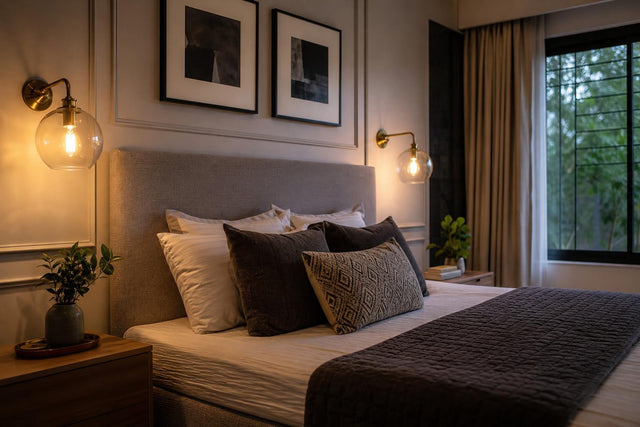
Two identical wall lights flanking the headboard is the most reliable bedroom wall lights idea for a reason. It looks balanced, provides task lighting on both sides, and eliminates the need for bedside table lamps that crowd your surfaces.
Key specs:
- CCT: 2700K to 3000K (warm white)
- Wattage: 5 to 8W per fixture
- Lumens: 300 to 500 per fixture
- Mounting height: Center the fixture 30 to 36 inches (76 to 91 cm) above the mattress top
Placement rule that most guides miss: Measure from the centerline of the headboard, not from the nearest wall. Indian rooms aren’t always perfectly square, so wall-to-wall measurements can throw off your symmetry. Place each fixture 24 to 30 inches from the headboard center, which puts the light just past the pillow edge.
Tradeoff: Requires two hardwired electrical points. In Indian masonry homes, this means planning conduit runs during construction or renovation. Retrofitting into plastered walls is possible but messier and more expensive. For a deeper walkthrough, read this wall light installation guide.
Practitioners on Reddit’s home improvement forums frequently note that matched pairs “live or die on symmetry,” and that even a 2-inch offset between the two fixtures is noticeable once the lights are on.
2. Swing-Arm / Adjustable Reading Wall Lamp
Best for: Avid readers and anyone sharing a bed who doesn’t want to disturb their partner.
A swing-arm wall lamp is active lighting. The adjustable arm directs a focused beam exactly where you’re reading, journaling, or winding down, without flooding the whole room. The wall-mounted format frees the tabletop entirely.
Key specs:
- Wattage: 8 to 12W for comfortable reading
- Beam angle: Under 60 degrees for focused throw
- CRI: 90+ (this matters; low CRI makes text look washed out)
- CCT: 2700 to 3000K
Why CRI matters here: A sconce with a fabric shade will diffuse light into a warm glow, pleasant for ambiance. But for reading, you want a flexible gooseneck or swing arm with a narrower beam and high CRI so colors and text look natural, not yellowish.
Tradeoff: Swing-arm fixtures project further from the wall than flat sconces, so they’re not ideal for tight bedside gaps. Also, the mechanical arm can feel industrial if your bedroom leans traditional. Choose finishes carefully.
If wall mounting isn’t possible in your room layout, a quality floor lamp like the Qena can serve the same reading-light purpose beside an armchair or bed corner.
3. LED Strip Behind the Headboard (Floating Bed Effect)
Best for: Modern and contemporary bedrooms, especially small rooms where you want to create a sense of depth.
Concealed LED strips behind the headboard produce a soft halo that makes the bed appear to float. The adhesive backing makes installation straightforward, and the consistent line of light frames the bed without dark spots.
Key specs:
- Voltage: Always 12V or 24V for safety near sleeping areas
- CCT: 2700K
- CRI: 90+ for natural skin tones and realistic room colors
- Power supply: Keep the LED driver accessible but hidden (inside a nearby wardrobe or behind the headboard)
Safety note: This is non-negotiable. Mains voltage (230V) LED strips near a bed are a fire and shock risk. Low-voltage strips with proper drivers are the only responsible choice.
Tradeoff: LED strips are ambient only. They won’t work as a reading light. You’ll need a separate task layer (a swing-arm sconce or bedside lamp like the Stello Lamp) to complement them.
Practitioner insight: Several YouTube lighting installers emphasize that high CRI strips (90+) make a dramatic difference in bedrooms because you see your own skin under this light constantly. Cheap 70-CRI strips make everything look sickly yellow.
4. Up-Down Wall Washer / Linear Wall Light
Best for: Feature walls, hallways leading to bedrooms, and compact rooms that need the illusion of height.
These slim, geometric fixtures throw light both upward and downward along the wall surface. The bidirectional beam creates architectural drama and makes walls look taller. In contemporary Indian interiors, the up-down wall washer has become one of the most popular bedroom wall lights ideas, especially in matte black or brushed gold finishes.
Key specs:
- Wattage: 5 to 12W
- Beam: Bidirectional (up + down)
- CCT: 2700 to 3000K
- Finish: Matte black and gold are the most requested in India
The Hefei Wall Light is a strong example of this category, with clean geometric lines that suit both bedrooms and adjacent corridors.
Tradeoff: Up-down washers are accent and ambient lights. They’re beautiful on a feature wall beside the bed, but they don’t focus light on a book or workspace. Pair them with a task light.
5. Decorative Halo / Sculptural Wall Light
Best for: Bedrooms with minimal wall decor where you want a single piece that doubles as art and illumination.
Sculptural wall lights function as focal points. A well-chosen halo or disc fixture elevates the mood and sophistication of the room without requiring any other wall art. These are the “Instagram wall” lights: one piece replaces both a frame and a fixture.
Key specs:
- Wattage: 8 to 15W
- CCT: 2700 to 3000K
- Mounting: Typically hardwired, centered on the feature wall or above the headboard
Where this idea shines: If your bedroom has a textured wall (exposed brick, stone cladding, or a dark paint accent), a halo light creates a dramatic interplay of shadow and glow. Interior designers on forums frequently call this the highest-impact, lowest-effort bedroom wall lights idea.
Tradeoff: Statement pieces can overwhelm small bedrooms. Measure the fixture diameter against your wall area. A general rule: the fixture should be no wider than one-third of the wall section it occupies.
6. Picture Light / Art-Accent Wall Lamp
Best for: Bedrooms with framed art, gallery walls, or a reading nook with prints.
Picture lights are directional fixtures mounted just above artwork or mirrors, typically 6 to 12 inches above the frame. They focus a narrow beam downward to illuminate the piece without spilling light across the room.
Key specs:
- Wattage: 5 to 8W
- CCT: 3000K (slightly warmer than neutral, which flatters most art)
- Beam angle: Narrow (under 40 degrees)
- CRI: 95+ if you’re serious about color accuracy on artwork
Tradeoff: Picture lights are accent-only. They can’t serve as bedside task lights due to their narrow beam and high mounting position. Treat them as the third layer in your lighting plan, not the first.
7. Cove / Recessed Niche Lighting
Best for: Bedrooms with false ceilings, which are extremely common in urban Indian homes.
In Indian interiors, the false-ceiling cove is the classic ambient layer. A hidden LED strip washes the ceiling with an indirect glow that fills the room softly without any visible fixture. This is one of the fastest-growing bedroom ceiling light trends in India right now.
Key specs:
- Same as LED strip (12V/24V, 2700K, CRI 90+)
- Linear output: Choose strips rated at 300 to 500 lumens per meter for bedroom coves
- Driver placement: Inside the false ceiling, accessible through an inspection panel
Tradeoff: Cove lighting must be planned during construction. Retrofitting a cove into an existing false ceiling means cutting into gypsum, running new wiring, and repainting. It’s doable but expensive and disruptive. If you’re at the planning stage, this is the time to specify it.
8. Wall-Mounted Pendant (Boutique Hotel Look)
Best for: Homeowners who want that polished, five-star hotel bedroom aesthetic.
Instead of a traditional sconce, hang a pendant light from a wall bracket or short ceiling arm beside the bed. This creates the boutique hotel look that’s become highly aspirational in Indian bedroom design.
Key specs:
- Wattage: 5 to 10W
- CCT: 2700K
- Mounting: Ceiling bracket near the wall, or a dedicated wall arm
- Cord/chain length: Adjust so the pendant hangs 20 to 24 inches above the nightstand surface
Why it works: The pendant hangs in space, creating visual lightness that a wall-mounted fixture can’t replicate. It’s particularly effective in bedrooms with high ceilings where sconces would look too small.
For guidance on choosing the right pendant style and proportions, ALC Studio’s lamp selection guide covers sizing, CCT, and finish considerations in detail.
Tradeoff: Pendants swing slightly, which can bother light sleepers. In earthquake-prone zones, secure them with a safety cable. They also require a ceiling or wall junction box at a specific height, so plan this during construction.
9. Plug-In Wall Sconce (Renter-Friendly)
Best for: Rented apartments, PG accommodations, and anyone who wants bedroom wall lights without permanent modifications.
Plug-in sconces draw power from a standard outlet and mount with screws or adhesive brackets. No concealed wiring, no electrician, no landlord drama.
Key specs:
- Wattage: 5 to 8W
- CCT: 2700K
- Mounting: Wall bracket with screws or heavy-duty adhesive; cord runs to the nearest outlet
India-specific context: In rented Indian flats, modifying walls (chasing conduits, adding junction boxes) typically violates the lease agreement. Plug-in sconces are the practical workaround. The visible cord can be managed with adhesive cord channels that match the wall paint.
If you’d rather skip wall mounting entirely, a bedside table lamp like the Stello Lamp delivers a similar warm glow with zero installation.
Tradeoff: The cord is visible. No getting around it entirely, even with channels. The aesthetic is never as clean as a hardwired fixture. Also, your outlet placement dictates where you can put the sconce, which limits design freedom.
10. Warm-Glow Night Light / Low-Level Wall Lamp
Best for: Bedrooms with children, elderly family members, or anyone who wakes frequently at night.
An ultra-low output wall fixture provides just enough light for nighttime navigation without disrupting sleep cycles. At under 3 watts and 2200 to 2700K, these lights sit below the threshold that suppresses melatonin production.
Key specs:
- Wattage: Under 3W
- CCT: 2200 to 2700K (extra warm)
- Sensor: Motion-activated models are ideal (light turns on only when needed)
- Mounting height: 12 to 18 inches above the floor, along the path between bed and bathroom
Why it matters: Falls in the dark are a serious risk for elderly household members. A motion-sensor night light along the bedroom-to-bathroom path costs almost nothing to run and prevents accidents.
Tradeoff: These are purely navigational. They don’t contribute to ambiance or task lighting. Think of them as the fourth, optional layer in your bedroom lighting plan.
How to Layer Wall Lights in Your Bedroom
Most competitor guides list bedroom wall lights ideas in isolation, as if you’d pick just one. That’s not how lighting works. Every good bedroom uses multiple sources across distinct layers.
Here’s the framework:
| Layer | Purpose | Wall Light Type |
|---|---|---|
| Ambient | General room glow, safe movement | Cove lighting, up-down washers |
| Task | Reading, grooming, dressing | Swing-arm sconces, matched bedside pairs |
| Accent | Mood, drama, focal points | Halo/sculptural lights, picture lights |
| Night | Nighttime navigation without sleep disruption | Low-level warm-glow wall lights |
The target is 3 to 5 light sources total. A common and effective setup: cove lighting (ambient), a pair of bedside sconces (task), and one halo or picture light (accent). Add a night light if the household needs it.
If you’re building a layered plan from scratch and want to understand how fixtures work together, that guide walks through the decision process room by room.
Placement and Height Rules for Indian Bedrooms
Getting the height wrong is the fastest way to ruin a good wall light. Here are the numbers:
Bedside wall sconces:
- Mount the center of the fixture 30 to 36 inches (76 to 91 cm) above the mattress top
- Adjust based on how you sit up to read: if you prop yourself on pillows, go toward 36 inches
- Indian standard bed heights (including mattress) typically range from 20 to 24 inches off the floor, meaning the fixture center lands at roughly 50 to 60 inches from the floor
Horizontal positioning:
- Measure 24 to 30 inches from the centerline of the headboard to each side
- This places the light just past the pillow edge, ideal for reading without blinding your partner
Picture lights:
- 6 to 12 inches above the frame’s top edge
Night lights:
- 12 to 18 inches above floor level, along the walk path
For a complete room-by-room height reference, ALC Studio’s wall light height guide covers bedrooms, living rooms, hallways, and bathrooms.
Warm White vs. Cool White: What the Sleep Science Says
Every bedroom wall lights idea in this guide specifies 2700K to 3000K. That’s not just an aesthetic preference. It’s backed by research.
Harvard researchers found that participants exposed to warm light in the evening fell asleep 19 minutes faster than those exposed to cool light. Cool white light (4000K+) suppresses melatonin production, the hormone that tells your body it’s time to sleep.
The practical recommendation: bedrooms should always use warm white at 2700K to 3000K. This applies to every light source in the room, not just wall lights. One cool-white ceiling fixture can undo the benefits of warm bedside sconces.
Quick specs cheat sheet for bedroom wall lights:
| Spec | Recommended Value |
|---|---|
| CCT | 2700K–3000K |
| Lumens (bedside) | 300–500 lm |
| Wattage (ambient) | 5–12W |
| Wattage (task/reading) | 8–15W |
| CRI | 90+ |
| Dimmer | Strongly recommended |
A dimmer is particularly valuable in bedrooms. It lets you shift the same fixture from bright task mode (reading at 9 PM) to low ambient mode (winding down at 11 PM) without changing the bulb or installing separate circuits.
Wiring Tips for Indian Masonry Homes
This is the section most bedroom wall lights guides skip entirely, because they’re written for Western markets where walls are hollow stud frames. Indian homes are different.
In India, walls are typically brick, concrete block, or plastered masonry. The standard wiring method runs cables inside PVC conduits that are chased (grooved) into the wall and then plastered over. This concealed approach keeps wiring hidden, protected from moisture, and safe from tampering.
If you’re building or renovating:
Decide wall light positions, wiring routes, driver locations, and switch placements before the walls are plastered. Retrofitting into finished walls means cutting through plaster, chasing new channels, re-plastering, and repainting. It’s always more expensive and messier.
A complete wiring run with materials typically costs ₹700 to ₹1,400 per point. Factor this into your budget when planning multiple bedroom wall light positions.
If you’re in a rented apartment:
Plug-in sconces (Idea #9) or battery-operated options are the realistic path. Don’t chase conduits in a wall you don’t own.
For a step-by-step installation walkthrough specific to Indian construction, this sconce installation guide covers tools, wiring, and finishing in detail.
How to Choose the Right Bedroom Wall Light
With 10 ideas on the table, here’s a simple decision framework:
Step 1: Define the room context
- Building new or renovating? You have full flexibility. Go hardwired.
- Rented flat? Plug-in or freestanding only.
- Small bedroom (<120 sq ft)? Avoid oversized sculptural pieces. Stick to slim sconces and LED strips.
Step 2: Define the purpose
- Reading? Swing-arm or focused sconce (8 to 15W, high CRI).
- Ambiance? Cove lighting, LED strip behind headboard, or up-down washer.
- Statement decor? Halo or sculptural wall light.
- Nighttime safety? Low-level warm-glow night light.
Step 3: Choose the finish
Indian bedrooms trend toward warm neutrals. Matte black, brushed gold, and antique brass are the most popular wall light finishes right now. Match the finish to your hardware (door handles, wardrobe pulls) for a cohesive look.
Step 4: Lock in the specs
Always 2700K to 3000K. CRI 90+. Dimmer-compatible. These three non-negotiables apply to every bedroom wall light regardless of style.
The Indian Lighting Market Context
These bedroom wall lights ideas sit within a rapidly growing market. The Indian LED lighting market was valued at USD 6.00 billion in 2025 and is projected to reach USD 27.81 billion by 2034, growing at a CAGR of 18.58%. LED technology now commands a 72.4% share of the market, and indoor applications account for 61.7% of demand.
For homeowners, this growth translates to better products at lower prices. Large-scale procurement initiatives have reduced average LED lamp prices by nearly 80% since 2014, making premium wall lighting accessible to a much wider audience than even five years ago.
Start Planning Your Bedroom Wall Lights
The best bedroom wall lights ideas are the ones that match your room, your habits, and your budget. Whether that’s a matched pair of minimalist sconces for a master bedroom or a plug-in option for a rented PG room, the principles stay the same: warm white, layered sources, and proper height.
ALC Studio offers free design consultations (virtual or at showrooms in Delhi’s Kirti Nagar and Lucknow’s Vipul Khand) to help you choose the right fixture, finish, and placement for your specific bedroom. Browse the full wall light collection to see what fits your space.
FAQ
What is the best color temperature for bedroom wall lights?
2700K to 3000K (warm white) is the recommended range for bedrooms. Harvard research shows that warm light in the evening helps you fall asleep faster by not suppressing melatonin production. Avoid anything above 4000K in sleeping spaces.
How high should I mount bedroom wall lights above the bed?
Center the fixture 30 to 36 inches (76 to 91 cm) above the top of the mattress. If you tend to sit up on pillows to read, lean toward the higher end. Horizontally, place each sconce 24 to 30 inches from the centerline of the headboard.
Can I install wall lights in a rented apartment in India?
Yes, but stick to plug-in wall sconces or battery-operated models. Chasing conduits into masonry walls you don’t own violates most lease agreements and will cost you the security deposit. Cord channels can help manage the visible cable from a plug-in fixture.
How many lumens do I need for a bedroom wall light?
For bedside wall sconces, 300 to 500 lumens per fixture provides a comfortable soft glow. For task-focused reading lights, aim for the higher end of that range or up to 600 lumens with a focused beam angle under 60 degrees.
What is the difference between hardwired and plug-in wall sconces?
Hardwired sconces connect directly to your home’s electrical system through concealed wiring, delivering a clean, permanent look. Plug-in sconces draw power from a standard outlet. Hardwired is best for new construction or renovations; plug-in works for existing homes and renters who can’t modify walls.
How much does it cost to add a wall light point in an Indian home?
A complete wiring run with materials (PVC conduit, cable, junction box) typically costs ₹700 to ₹1,400 per point. This assumes the work is done before plastering. Retrofitting into finished walls adds re-plastering and painting costs on top.
Should I use a dimmer with bedroom wall lights?
Strongly recommended. A dimmer lets you use the same fixture at full brightness for reading and at low output for winding down before sleep. It extends the versatility of every wall light and supports your natural sleep cycle by allowing gradual light reduction in the evening.
How many light sources does a bedroom need?
The ideal bedroom setup uses 3 to 5 light sources: one ambient (cove or overhead), one or two task (bedside sconces or reading lamps), and one or two accent (halo lights, picture lights). This creates balanced, warm illumination instead of the flat harshness of a single ceiling fixture.
0 Comments
There are no comments for this article. Be the first one to leave a message!