
Top 16 Bathroom Lighting Ideas for Indian Homes (2026)
TL;DR
Most Indian bathrooms rely on a single overhead bulb, which creates unflattering shadows and leaves corners dim. The fix is layered lighting: combine ambient ceiling lights, task lights at the mirror, and accent strips for depth. This guide covers 16 specific bathroom lighting ideas with placement dimensions, color temperature recommendations, IP safety ratings, and lumen targets sized for Indian apartments. Whether you have a 40 sq ft wash closet or a 100 sq ft master bath, you’ll find actionable ideas here.
At-a-Glance Comparison: Bathroom Lighting Types
| Lighting Type | Best For | CCT Range | Where to Place | Min IP Rating | Price Range (India) |
|---|---|---|---|---|---|
| Backlit LED Mirror | Master bath vanity | 3000K–6000K (tunable) | Above basin | IP44 | ₹8,000–₹25,000+ |
| Wall Sconces (pair) | Flattering face light | 3000K–4000K | Flanking mirror, 60–70" high | IP44 in Zone 2 | ₹5,000–₹15,000/pair |
| Recessed Downlights | Ambient base layer | 3500K–4100K | Ceiling, evenly spaced | IP65 in shower zones | ₹500–₹2,500 each |
| LED Strip (vanity kick) | Nightlight/accent | 2700K–3000K | Under floating vanity | IP44+ | ₹500–₹3,000 |
| Cove Lighting | Spa-like ambiance | 2700K–3000K | Ceiling recess/ledge | None (dry zone) | ₹2,000–₹8,000 |
| Over-Mirror Bar Light | Classic task lighting | 3500K–4000K | 75–80" from floor | IP44 | ₹3,000–₹12,000 |
| Pendant Light | Statement piece | 3000K | Beside mirror or over tub | IP44+ | ₹5,000–₹30,000+ |
| Shower Niche LED Strip | In-shower accent | 2700K–3000K | Inside recessed niche | IP67 | ₹1,500–₹5,000 |
| Motion-Sensor Mirror | Hands-free convenience | Varies | Above basin | IP44 | ₹10,000–₹25,000+ |
| Touch-Sensor LED Mirror | Precise brightness control | 3000K–6000K | Above basin | IP44 | ₹8,000–₹25,000+ |
| Dimmable Smart Setup | Mood flexibility | 2700K–4000K | Throughout bathroom | Varies | ₹5,000–₹20,000+ |
The Foundation: Why Layered Lighting Changes Everything
Before jumping to individual ideas, understand the framework that makes bathroom lighting actually work. The best bathroom lighting combines three layers: ambient lighting (general illumination from the ceiling), task lighting (focused light at the mirror for grooming), and accent lighting (decorative touches that add depth). Each layer has a different job. When planned together, the bathroom feels more balanced, more useful, and more comfortable.
Here’s the problem: most Indian bathrooms have a single ceiling fixture doing all three jobs poorly. One overhead light may seem practical, but it creates harsh shadows and leaves areas dim, especially around mirrors and shower corners. Practitioners on Indian interior design platforms like OnGrid Design point out that compact floor plans in Indian apartments make proper lighting even more critical, because you can’t rely on natural light from large windows to fill the gaps.
For a detailed primer on how lighting layers work across rooms, see the lighting fixtures guide on ALC Studio.
The 16 ideas below are organized so you can pick from each layer and build a combination that fits your bathroom size, budget, and style.
1. Backlit LED Mirror
Best for: The single biggest upgrade in any Indian bathroom
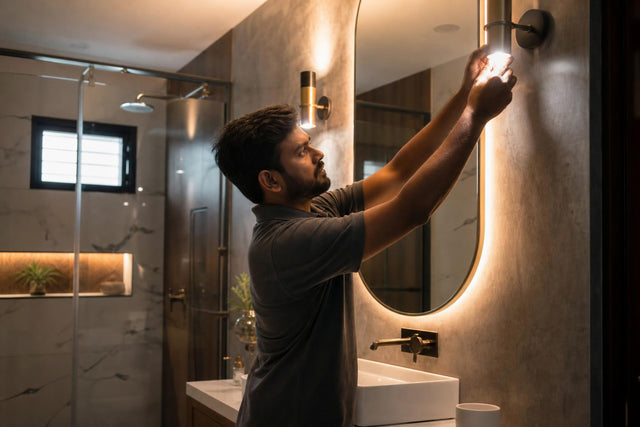
A backlit LED mirror replaces two separate purchases (mirror + mirror light) with one integrated unit. The light sits behind the mirror and wraps around the edges, creating a soft halo effect that illuminates your face evenly while making the mirror appear to float on the wall.
The best versions offer touch-sensitive controls that let you dim brightness, switch lights on and off, and change color temperature. That convenience, combined with excellent grooming light and anti-fog demisting, makes it the most impactful single upgrade you can make.
- Placement: Centered above the vanity basin
- CCT: Look for adjustable models (3000K to 6000K) so you can shift from warm evening light to neutral grooming light
- IP rating: IP44 minimum
- Energy cost: LED mirrors add only about ₹400–₹800 per year to your electricity bill. A hotel case study involving 120 LED mirrors showed just a 4% increase in energy costs.
One common anxiety surfaces repeatedly in online forums. On Slickdeals, a buyer asked, “So when the LED dies, you’re expected to throw the whole mirror away?” It’s a fair concern. This is exactly why warranty matters. ALC Studio’s lighting mirrors come with a 5-year warranty, which directly addresses that worry.
→ Explore ALC Studio’s wall lights for bathroom applications starting at ₹6,600.
2. Side-Mounted Wall Sconces Flanking the Mirror
Best for: The most flattering face lighting possible
When you want the absolute best light for grooming, side sconces are the way to go. This setup creates “cross-illumination,” casting light evenly across your face from both sides. It virtually eliminates the harsh shadows that a single overhead light is notorious for.
Placement dimensions that matter:
- Mount sconces 60 to 70 inches from the finished floor to the fixture’s center, aligned roughly at eye level
- Space them 36 to 40 inches apart (flanking the mirror edges)
- If your mirror is wider than 40 inches, mount the sconces at the mirror’s outer edges
These numbers come up consistently across lighting installation guides. For a complete walkthrough on wall sconce heights in different rooms, the sconce installation height guide covers placement and safety in detail.
Limitations:
- Requires two electrical points flanking the mirror (not always available in older Indian apartments)
- Not ideal for very narrow bathrooms where the sconces would protrude into the movement path
- Adds visual bulk compared to a single integrated mirror light
3. Recessed Ceiling Downlights
Best for: The invisible ambient base layer
In many bathrooms, ambient lighting comes from recessed downlights. They work well because they provide plenty of light without taking up visual space. A smaller bathroom might need only one well-positioned ceiling light, while a larger bathroom may need three to four downlights spread evenly.
- CCT: 3500K–4100K for a clean, neutral base
- IP rating: IP65 for any downlight placed above or near the shower
- Key mistake to avoid: Don’t place a downlight directly above where you stand at the mirror. It throws a strong light onto your forehead and casts deep shadows below your eyes, nose, and chin. Offset it slightly toward the center of the room.
For a 50 sq ft Indian bathroom, two well-placed recessed downlights providing 1,500–2,000 lumens combined will form a solid ambient base. The remaining lumens come from your task and accent layers.
4. LED Strip Lighting Under Floating Vanities
Best for: Nighttime navigation and visual depth in compact bathrooms
Toe-kick lighting under the vanity cabinet adds a subtle glow near the floor. It serves double duty: it creates a “floating” effect that makes compact Indian bathrooms feel larger, and it works as a nightlight for late-night bathroom visits without blinding you with full overhead light.
- CCT: 2700K–3000K (warm, so it doesn’t jolt you awake at night)
- IP rating: IP44+ (it’s near the floor where water can splash)
- Installation: Adhesive-backed LED strips are the easiest; run them along the underside of the vanity front edge
- Cost: ₹500–₹3,000 depending on strip quality and length
This is one of those bathroom lighting ideas that costs almost nothing but transforms the room’s feel, especially in the 35–50 sq ft bathrooms common in Indian 2BHK apartments.
5. Cove Lighting in Ceiling Recesses
Best for: Spa-like ambiance without visible fixtures
Cove lighting, tucked into a ceiling ledge, sends a soft glow upward and creates gentle, indirect illumination that bounces off the ceiling. The result is a diffused, even light with no visible source, which is precisely why high-end spas and hotels use it.
Indirect lighting has become one of the defining bathroom lighting trends of 2026. LED strips hidden within ceiling recesses, behind mirrors, or under vanity units create a soft, floating effect that makes even small bathrooms feel serene.
- CCT: 2700K–3000K for warmth
- IP rating: None required if the cove is in a dry zone (away from the shower)
- Important note: Cove lighting alone isn’t enough. It’s an accent layer. You still need task lighting at the mirror and some ambient light for general visibility.
6. Over-Mirror Vanity Bar Light
Best for: Classic task lighting when side sconces aren’t feasible
Not every bathroom has the wall space or electrical points for flanking sconces. An over-mirror vanity bar is the traditional alternative, and it works well when installed correctly.
Placement rules:
- Mount the fixture 75 to 80 inches above the finished floor
- Choose a bar that’s approximately 75% of your mirror’s width (a 30-inch mirror pairs with a 22–24 inch bar light)
- Avoid positioning the light directly on top of the mirror’s edge, where it would aim straight down. A few inches above, angled slightly forward, distributes light better.
The Stealth wall light from ALC Studio works well in this role, offering a sleek, modern profile that complements contemporary Indian bathrooms.
Limitations:
- Even the best over-mirror light creates some under-eye shadow (side sconces are superior for shadow elimination)
- Shorter household members may find the light angle less flattering if mounted at the standard 78-inch height
7. Pendant Lights Beside or Above the Mirror
Best for: Statement-making in larger bathrooms with high ceilings
Suspending sculptural pendant lamps near a freestanding tub or flanking a vanity mirror is a hallmark of luxury bathroom design in 2026. Crafted from organic glass shapes or brushed brass, these pendants inject drama and softness simultaneously.
This is part of a broader trend that designers are calling the “living room-ification” of bathrooms. According to Decorilla and House Digest, table lamps, cordless sconces, and portable lights are replacing harsh overheads with atmospheric glow, borrowing styles traditionally reserved for bedrooms.
- IP rating: Must be IP44+ and installed outside Zone 1 (more than 2.25m above the bath or shower floor, or beyond 0.6m from the bath perimeter)
- CCT: 3000K for a warm, inviting glow
- Practical limit: This idea only works if your ceiling is at least 9 feet high. In standard 8-foot Indian apartment bathrooms, pendants hang too low and become a hazard.
8. Shower Niche LED Strip
Best for: Functional accent lighting inside the shower
A recessed niche in the shower is already a popular feature in Indian bathrooms for holding shampoo bottles and soap. Adding a waterproof LED strip inside the niche turns a utility shelf into an architectural detail.
- IP rating: IP67 minimum (Zone 0 requirements apply inside the shower). Any lighting within this area must be low voltage, maximum 12V.
- CCT: 2700K–3000K works well here; you want warmth, not clinical brightness
- Safety note: This is not a DIY project. Hire a licensed electrician familiar with bathroom zone regulations. The electrical supply must be separated from your main bathroom circuit with appropriate protection.
9. Motion-Sensor LED Mirror
Best for: Hands-free convenience in high-traffic bathrooms
Motion sensors are excellent for mirrors in bathrooms where hands are often wet or soapy. Walk up to the vanity, and the light activates automatically. Walk away, and it turns off after a set interval.
- Advantage: No need to touch anything with wet or dirty hands
- Disadvantage: Motion sensors can be triggered by pets, a swinging shower curtain, or movement elsewhere in the room. Practitioners on forums report occasional false triggers, especially in small bathrooms where everything is within sensor range.
If your bathroom is shared by multiple family members (common in Indian households), motion sensors reduce the “who left the light on?” problem entirely.
10. Touch-Sensor LED Mirror with Adjustable CCT
Best for: Precise control over brightness and color temperature
Touch-sensor mirrors let you tap the mirror surface to adjust brightness and switch between warm, neutral, and cool light. Compared to motion sensors, touch sensors are more precise since users have full control over when lights activate and deactivate, with no false triggers.
LED mirrors with adjustable CCT let you shift from a warm 3000K for a relaxing bath to a neutral 4000K for shaving or makeup application. This flexibility is especially valuable in Indian homes where one bathroom serves multiple purposes throughout the day.
For guidance on installing LED mirrors properly, ALC Studio’s LED mirror installation guide walks through the process step by step.
11. Dual-CCT Setup (Warm Ambient + Neutral Task)
Best for: Getting the color temperature question right once and for all
This isn’t a fixture; it’s an approach. The most frequently asked question on Quora threads and lighting forums about bathroom lighting is: warm white or cool white? The answer is both, but in different layers.
- Ambient layer (ceiling cove, downlights): 3000K–3500K for a warm, welcoming base
- Task layer (mirror lights, sconces): 4000K for accurate skin-tone rendering
As one Indian lighting consultant on Econstru explains, 4000K works best for task areas because it renders skin tones accurately and gives a clean, fresh feel without the harshness of 6500K. Warm white alone in bathrooms can make white and cream tiles look yellowish and reduce the feeling of cleanliness.
This is particularly relevant for Indian homes where light-colored tiles (white, beige, cream) dominate. A Quora contributor put it simply: “If you want your bathroom to look bright and clean, cool white light creates a crisp look, especially if the tiles are white.” But cool white everywhere feels sterile. The dual-CCT approach gives you the best of both.
12. Backlit Mirror with Halo Edge Glow
Best for: A modern, minimalist aesthetic in contemporary bathrooms
Different from front-lit mirrors, a halo-edge mirror projects light backward onto the wall, creating a soft glow behind the mirror rather than on your face. This makes the mirror appear to float, which is visually striking in a minimalist bathroom.
- Trade-off: Halo mirrors provide less task lighting than front-lit or backlit versions. You may need a supplementary sconce or bar light for grooming.
- Works well as: The primary decorative element in powder rooms and guest bathrooms where extended grooming isn’t the priority.
13. Statement Wall Lamp as Bathroom Art
Best for: Powder rooms and guest bathrooms where personality matters most
For those looking to add personality, statement wall lights are making a comeback. A sculptural wall lamp in brushed brass or matte black can function as both lighting and wall art, eliminating the need for a separate decorative piece in a small bathroom.
Options like the Troy wall light or Memphis wall light from ALC Studio bring design-forward presence to a bathroom without requiring the space that a framed artwork would.
Limitations:
- Statement pieces prioritize form over function. Don’t rely on one as your only light source.
- Keep fabric shades out of bathrooms entirely. Small bathrooms with limited ventilation encourage mildew growth on fabric. Stick to metal, glass, or acrylic shades.
14. Dimmable Lighting with Smart Controls
Best for: Families who need one bathroom to serve many moods
Without dimmers, you’re locked into a single brightness level, making it impossible to shift from bright morning grooming light to soft evening bath light. Interior designer Phoenix Grey demonstrated this in a TikTok walkthrough, showing how putting all bathroom lights on dimmers (including a cove light in the shower) completely transformed the mood of a condo bathroom.
Smart dimming systems in 2026 go beyond a simple dial on the wall. Modern bathroom lighting can now be controlled through smartphone apps, voice commands, and scheduled routines. Set your lights to gradually warm and dim after 9 PM, and you’ve built a circadian-friendly bathroom without any daily effort.
- Cost: A basic smart dimmer switch starts around ₹2,000–₹5,000. Full smart systems with app control range from ₹10,000–₹20,000+.
- Compatibility note: Make sure your LED fixtures are explicitly rated as “dimmable.” Non-dimmable LEDs on a dimmer circuit flicker, buzz, or fail prematurely.
15. Circadian/Tunable White LED System
Best for: Wellness-focused homeowners willing to invest in premium lighting
Imagine walking into your bathroom at 7 AM and being greeted by an energizing, crisp 4000K light. Then, when you draw a bath at 10 PM, the system shifts to a warm, dim 2700K amber glow that supports melatonin production and helps you wind down.
Tunable white systems automate this shift throughout the day. They’re the premium tier of bathroom lighting ideas, and they represent the cutting edge of what’s possible in 2026.
- Cost: ₹15,000–₹40,000+ for a full bathroom setup (fixtures + controller)
- Realistic take: For most Indian households, a simpler approach, like a dual-CCT LED mirror paired with a warm-toned ambient layer, gets you 80% of the circadian benefit at 30% of the cost.
16. Coordinated Finishes Across All Fixtures
Best for: Making a bathroom feel intentionally designed rather than assembled
This is the finishing move. Match the metal finish of your mirror light, wall sconces, and ceiling fixture to your taps, shower frame, and cabinet handles. Chrome fixtures suit contemporary spaces. Matte black or brushed nickel complements modern and industrial bathrooms. Brass or gold tones pair with warm, traditional interiors.
A coordinated finish scheme is what separates a “we picked nice lights” bathroom from a “this was designed” bathroom. It costs nothing extra if you plan it from the start.
For broader guidance on choosing fixtures that work together, the how to choose lighting fixtures guide covers sizing, finish matching, and style coordination across rooms.
Bathroom Lighting Mistakes to Avoid
Before wrapping up the bathroom lighting ideas, here are the errors that undo even the best fixture choices:
-
Relying on a single overhead light. Even the best ceiling fixture placed centrally can’t serve as ambient, task, and accent light simultaneously. You need at least two layers.
-
Ignoring color temperature. Mixing a 6500K daylight bulb with a 2700K warm bulb in the same sightline creates a jarring, incoherent look. Plan your CCT by layer.
-
Skipping dimmers. A fixed-brightness bathroom light works fine at 7 AM. At 11 PM, it’s an assault on your eyes.
-
Placing downlights directly above the mirror. This is the single most common placement error. It lights your forehead and casts everything below your brow into shadow.
-
Choosing the wrong IP rating. A gorgeous pendant with no IP rating installed above a bathtub is a safety hazard. Zone regulations exist for a reason.
-
Using fabric shades. Mildew is inevitable in humid Indian bathrooms with limited ventilation. Metal, glass, or plastic only.
-
Forgetting dark corners. Common in L-shaped or alcove bathrooms. Walk through your bathroom mentally and identify any spot where light doesn’t reach.
IP Ratings: What’s Safe Where in Your Bathroom
Bathroom light fittings need IP (Ingress Protection) ratings based on their proximity to water. The room is divided into zones:
- Zone 0 (inside the bath or shower tray): Fittings must be low voltage (max 12V) and rated IP67 minimum
- Zone 1 (above the bath/shower to a height of 2.25m from the floor): IP44 minimum, IP65 recommended
- Zone 2 (0.6m outside the bath/shower perimeter, extending to 2.25m height): IP44 minimum
- Outside all zones: No IP requirement, but IP44 is recommended for general bathroom humidity
If you’re unsure which zone a particular fixture will sit in, consult a licensed electrician before purchase. This is not an area where approximation is acceptable.
How Many Lumens Does Your Indian Bathroom Need?
For a standard bathroom, aim for 70 to 80 lumens per square foot across all light layers combined.
| Bathroom Size | Total Lumens Needed |
|---|---|
| Small (35–50 sq ft, typical Indian 2BHK) | 2,500–4,000 lumens |
| Medium (50–80 sq ft) | 3,500–6,400 lumens |
| Large master bath (80–100+ sq ft) | 5,600–8,000 lumens |
These aren’t all from one fixture. Distribute lumens across your ambient, task, and accent layers. A pair of sconces might contribute 800–1,200 lumens, a recessed downlight adds 600–1,000, and an LED mirror provides 400–800. Add them up and check against your target.
Bringing It All Together
The best bathroom lighting ideas share a common thread: they treat lighting as a system, not a single purchase. Start with the framework (ambient + task + accent), pick ideas from each layer that fit your space and budget, match your finishes, and get the color temperature right. That’s it. No single fixture will solve bathroom lighting, but three well-chosen ones will.
For Indian apartments with compact bathrooms, the highest-impact combination is a backlit LED mirror with adjustable CCT (handles task lighting beautifully), one or two recessed downlights (ambient base), and an LED strip under the vanity or in a ceiling cove (accent and nightlight). This three-fixture setup works in bathrooms as small as 35 sq ft and costs between ₹12,000 and ₹30,000 total.
If the process feels overwhelming, ALC Studio offers free design consultations (virtual or at their showrooms in Delhi’s Kirti Nagar and Lucknow’s Vipul Khand) where you can discuss your bathroom dimensions, tile colors, and electrical points with a lighting specialist. Orders on ready products dispatch within 3 working days, and lighting mirrors carry a 5-year warranty.
→ Browse ALC Studio’s collection to see illuminated mirrors and wall lights for your bathroom.
Frequently Asked Questions
What is the best color temperature for bathroom lighting in India?
For task areas like the vanity mirror, 4000K (neutral white) is optimal. It renders skin tones accurately and keeps white or cream tiles looking clean rather than yellowish. For ambient and accent layers (ceiling coves, under-vanity strips), 2700K–3000K warm white creates a relaxing atmosphere. Using both temperatures in different layers gives you the best of both worlds.
How many lights does a small Indian bathroom need?
A typical 35–50 sq ft bathroom needs a minimum of two light sources: one ambient ceiling light and one task light at the mirror. Adding an accent layer (like an LED strip under the vanity) is optional but transforms the space. Aim for 2,500–4,000 total lumens distributed across these layers.
What IP rating do I need for bathroom lights?
It depends on the zone. Inside the shower or bath (Zone 0), you need IP67 and low voltage (max 12V). Above the shower to 2.25m height (Zone 1), IP44 minimum. Within 0.6m of the bath perimeter (Zone 2), IP44 minimum. Outside these zones, no rating is technically required, but IP44 is recommended because of general bathroom humidity.
Are LED mirrors worth it for Indian bathrooms?
Yes. An LED mirror combines a mirror and task light into one unit, saves wall space (critical in compact Indian bathrooms), and uses very little electricity, adding roughly ₹400–₹800 per year to your bill. Models with adjustable CCT and anti-fog demisting are particularly practical for Indian climates. Look for a 5-year warranty to protect against LED failure.
Should I use warm white or cool white in the bathroom?
Neither exclusively. Warm white (2700K–3000K) alone can make light-colored tiles look yellow. Cool white (5000K–6500K) alone feels clinical and harsh. The recommended approach for Indian homes is 4000K at the mirror for task lighting and 3000K in ambient/accent layers for warmth. This dual-CCT setup is the most common professional recommendation.
How high should bathroom wall sconces be mounted?
Mount sconces 60 to 70 inches from the finished floor to the fixture’s center. If flanking a mirror, space them 36 to 40 inches apart. For a comprehensive room-by-room breakdown, see the wall light height guide.
What is the biggest bathroom lighting mistake?
Using just one ceiling light. Even the best single fixture can’t provide balanced illumination for grooming, ambiance, and accent. The shadows it creates at the mirror make shaving, skincare, and makeup application frustrating. At minimum, add a dedicated task light at the mirror to supplement your ceiling fixture.
What are the top bathroom lighting trends for 2026?
Smart controls (app-based dimming, voice commands, scheduling), circadian/tunable white systems that shift color temperature throughout the day, and the “living room-ification” of bathrooms where decorative pendants and sculptural wall lamps replace purely functional fixtures. Indirect lighting through coves and hidden LED strips continues to grow as the dominant aesthetic.
0 Comments
There are no comments for this article. Be the first one to leave a message!