
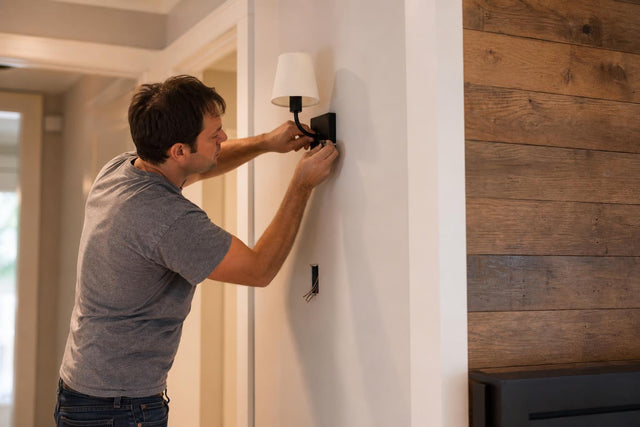
Wall Sconce Installation 2026: Height, Placement, Safety
TLDR
Wall sconce installation is the process of placing, mounting, and powering a wall light so it looks balanced, works properly, and stays safe. Standard mounting height starts around 150 to 168 cm (60 to 66 inches) from the floor to the fixture center, but the right number depends on the room, furniture, and how you actually use the light. For Indian homes, always have a qualified electrician verify earthing and circuit condition before hardwiring any wall sconce.
What Is Wall Sconce Installation?
Wall sconce installation means securely mounting a wall light fixture on a vertical surface and connecting it to a suitable power source. It includes choosing the correct height and spacing, confirming the wall can support the fixture, planning the switch or dimmer, and (for hardwired fixtures) having the wiring connected safely through an electrical point or junction box by a qualified electrician.
Put simply, a good wall sconce installation answers three questions before the fixture goes up. Where should the light sit? How will it get power? Will it be safe and easy to use every day?
Most people searching for this term already have a fixture in mind or are about to buy one. The goal is not to become an electrician. It is to understand what correct installation looks like so you can plan placement, choose the right fixture type, and communicate clearly with the professional who will do the work.
If you are already shopping for wall lights suited to Indian interiors, the Caral Wall Light is one hardwired decorative sconce option at Rs. 6,600.
What Does Wall Sconce Installation Include?
Think of installation as a four-part decision, not just drilling two holes and flipping a switch.
1. Position. Height from the floor, distance from furniture, spacing between multiple fixtures, beam direction, and glare angle. This is where most guides spend all their time, and for good reason. Wrong height means wrong light.
2. Power. Hardwired into in-wall wiring, plugged into an outlet, or battery/cordless. The power choice determines whether you need an electrician, a visible cord, or rechargeable batteries.
3. Support. Wall material (brick, plaster, drywall, concrete), mounting plate or bracket, junction box, anchors, and whether the wall can handle the fixture weight. A heavy brass sconce needs different support than a lightweight LED puck.
4. Safety. Earthing, circuit breaker capacity, rated fixtures for bathrooms or outdoors, correct bulb wattage, and qualified electrician sign-off for hardwired work.
A typical hardwired installation involves selecting a location, checking for studs or cavities, shutting off the circuit breaker, testing for voltage, cutting or preparing a wall opening for the junction box, running wire, mounting hardware, and connecting fixture wires per manufacturer instructions source. For a detailed walkthrough of each step in an Indian context, read ALC Studio’s sconce installation guide.
Standard Wall Sconce Installation Height
A common starting range is 150 to 168 cm (60 to 66 inches) from the finished floor to the center of the fixture. This works as a planning baseline for living rooms, entries, bedrooms, and bathrooms. Some guides extend the range to 183 cm (72 inches) for living rooms or high-ceilinged spaces source.
But treating any single number as a rule is a mistake. Bed height, ceiling height, fixture size, seated eye level, and beam direction can all shift the correct mark up or down by 10 to 15 cm. The better approach: start within the recommended range, then adjust for glare, switch reach, and how the light interacts with furniture.
Lighting practitioners on LinkedIn frame sconces as part of a vertical illumination layer, recommending around 150 cm for corridors and hospitality spaces with 180 to 240 cm (6 to 8 feet) spacing to create rhythm without dark gaps.
Here are the most commonly cited height ranges, drawn from multiple industry sources:
| Location | Height range (floor to fixture center) | Notes |
|---|---|---|
| General / living room | 152 to 183 cm (60 to 72 in) | Adjust for ceiling height and fixture scale |
| Bedroom / bedside | 150 to 165 cm (59 to 65 in) | Test from seated posture in bed |
| Bathroom vanity (side) | 152 to 168 cm (60 to 66 in) | Near face/eye level for grooming |
| Above bathroom mirror | 191 to 203 cm (75 to 80 in) | When side placement is not possible |
| Kitchen counter | 152 cm from floor or min 60 cm above counter | Keep above eye level to reduce glare |
| Hallway / corridor | 152 to 183 cm (60 to 72 in) | Space fixtures 180 to 300 cm apart |
| Picture / mirror light | 5 to 13 cm above top edge of art or mirror | Fixture width at least half the mirror width |
Wall Sconce Placement by Room
Bedroom and Bedside Sconces
This is where wall sconce installation goes wrong most often. Builders and electricians frequently place the electrical point too high because it looks symmetrical on an empty wall. Then the bed arrives, and the sconce sits 30 cm above the user’s head, unreachable and glaring into their eyes.
Practitioners on Reddit report exactly this problem. One 2026 HomeDecorating thread describes builder-installed bedside sconces that looked too high and were not functional. Commenters recommended about 127 to 165 cm (50 to 65 inches) above the finished floor, or roughly 50 cm above mattress height, and pointed out that if the on/off control is on the fixture itself, installing it too high means getting out of bed to turn it off.
The recommended starting range for bedside sconces is 150 to 165 cm to the fixture center, or a few inches above shoulder height when sitting in bed source. Place the fixture 15 to 30 cm from the bed edge horizontally.
The bedside test. Before drilling, run through five checks.
- Reach test. Can the person turn the light off from a normal lying or sitting position?
- Glare test. Is the bulb or LED source visible when sitting, reclining, or lying down?
- Page test. Does the light actually hit the book, phone, or laptop, or does it just wash the wall decoratively?
- Pillow clearance. Will pillows, a headboard cushion, or someone’s head bump the shade or arm?
- Doorway composition. Does the pair look balanced when viewed from the room entrance?
This test matters more than any fixed number. Houzz forum discussions repeatedly emphasize relating bedside lamp height to pillow position, reading posture, and switch reach rather than to the nightstand or headboard alone. Schoolhouse, a lighting brand that ranks well for placement advice, recommends getting into bed and measuring from your normal resting posture rather than blindly following a universal height.
For light quality, a warm colour temperature around 2700K with 400 to 600 lumens works well for bedside reading. Dimmable LEDs are worth the small premium because they let you shift from reading mode to ambient mode without switching fixtures.
Bathroom Vanity Sconces
Vanity sconces should be positioned for face lighting, not mirror decoration. Side-mounted sconces at face level provide more even cross-illumination and reduce shadows under the eyes, nose, and chin. Lighting designers on LinkedIn consistently recommend front-facing side sconces over overhead-only downlights, which cast harsh shadows that make grooming difficult.
Place side vanity sconces at roughly 152 to 168 cm (60 to 66 inches) from the floor, which puts them near face height for most adults. Keep them about 5 to 15 cm from the mirror edge. If side sconces are not possible, a single fixture above the mirror should sit at around 191 to 203 cm (75 to 80 inches) from the floor source.
One more consideration: bathroom sconces need moisture-appropriate ratings. Check whether the fixture is rated for damp or wet locations, and have an electrician confirm the circuit and earthing before installing near water sources.
If you are also planning a bathroom mirror with integrated lighting, the wall mounting approach is related. ALC Studio covers the electrical and support requirements for that fixture type in a separate LED mirror installation guide.
Hallways and Foyers
Hallway sconces create rhythm along a corridor. Space them about 180 to 300 cm apart (6 to 10 feet), adjusting for wall length and architectural features like doorways, arches, or artwork. Mount them at 152 to 183 cm from the floor. The wider range reflects that hallways with higher ceilings can carry sconces a bit higher without looking odd.
For double-height foyers or stairwells, sconce placement gets trickier because the vertical scale changes everything. If your space has tall ceilings, review these double-height ceiling lighting ideas for guidance on balancing fixtures across large walls.
Kitchen Counter Sconces
Mount kitchen sconces at roughly 152 cm from the floor or a minimum of 60 cm (24 inches) above the countertop. The goal is to keep the light source above eye level to reduce glare while still providing useful task illumination. If placing multiple sconces along a kitchen wall, space them 60 to 90 cm apart, centered on the features they serve such as the sink, prep area, or open shelving.
Picture and Mirror Lights
Picture lights should sit 5 to 13 cm (2 to 5 inches) above the top edge of the artwork or mirror. The fixture should be at least half the width of the piece it illuminates but not wider than the piece itself. Undersized picture lights look accidental. Oversized ones compete with the art.
Hardwired vs Plug-in vs Battery Wall Sconces
This is one of the most confusing parts of wall sconce installation, especially for renters and homeowners in older apartments. Community forums are full of questions about grounding, junction boxes, visible cords, and whether a hardwired fixture can be converted to plug-in.
Here is how the three main types compare:
| Type | What it means | Best for | Trade-offs |
|---|---|---|---|
| Hardwired | Connects to in-wall wiring through a junction box, controlled by a wall switch or dimmer | New builds, renovations, premium interiors | Clean look, no cord; requires an electrician and a proper wall point |
| Plug-in | Mounts to wall but plugs into an existing outlet | Renters, quick upgrades, apartments without wiring points | Visible cord unless managed with a cord cover; outlet position limits placement |
| Battery / cordless | Rechargeable or battery-powered, no wiring | Temporary styling, accent lighting, rental apartments | Lower output, limited runtime, not ideal as primary task light |
| Retrofit from existing outlet | Electrician runs building wire from an existing power source to a new wall box | Renovations where an outlet nearby is accessible | Cleaner than plug-in, less invasive than full rewiring |
Manufacturer instructions for convertible plug-in/hardwired sconces typically state that hardwired installation requires an electrical junction box sufficient to support the fixture and that power must be turned off at the circuit breaker source. This is not optional.
Two things to never do.
First, do not route a plug-in lamp cord through the inside of a wall. Practitioners on Reddit’s HomeImprovement community flag this as a fire hazard because standard lamp cord sheathing is not rated for in-wall use. If you want a cord-free look, the right solution is proper hardwiring by an electrician, not hiding an unrated cord behind plaster.
Second, do not convert a fixture from plug-in to hardwired (or vice versa) unless the manufacturer explicitly supports that conversion and you have a qualified electrician do the work. A HomeImprovement user installing plug-in sconces on masonry asked what to do with a ground screw when there was no junction box. Responses clarified that the ground screw was for the hardwired installation, not the plug-in use case. This kind of confusion between installation modes is extremely common.
Planning wall sconces for a bedroom, passage, or vanity wall? Book a free consultation with ALC Studio to confirm height, finish, and fixture scale before your electrician marks the wall.
Wall Sconce Installation Safety in Indian Homes
This is where generic international guides fall short. Indian homes, especially older ones, have specific electrical realities that change how wall sconce installation should be approached.
India’s Central Electricity Authority (CEA) regulations define earthing as connecting exposed conductive and extraneous parts of an installation to the main earthing terminal or to the general mass of earth source. In plain language, earthing is the protective connection that helps keep you safe during an electrical fault.
The Government of India’s 2026 Electrical Safety Day release identified short circuits, overloading, loose connections, poor maintenance, substandard equipment, aging wiring, and unauthorized modifications as leading causes of electrical fires. It emphasized that many of these fires are preventable through regular safety checks, proper earthing, and adherence to safety standards source.
Indian Reddit threads reflect this reality at ground level. Users describe homes where the third earth pin is functionally useless, older houses without any grounding infrastructure, and electricians who skip the earth wire entirely. These are not rare edge cases. They are common enough that multiple threads in r/india discuss the problem.
For anyone installing a hardwired wall sconce in India:
- Have an electrician verify circuit condition, earthing, and switchboard quality before work begins.
- Do not assume an existing wall point is safe just because another fixture was there before.
- Use ISI-marked or BIS-certified electrical components where possible.
- For bathroom or outdoor sconces, confirm the fixture has an appropriate IP (ingress protection) rating.
- Avoid overloading a circuit by adding multiple fixtures to a single line without checking capacity.
- Never skip earthing on a metal-body fixture.
The safest approach for Indian homeowners is to finalize the sconce position and style first, then bring in a qualified electrician before any cutting, drilling, or wiring happens.
Key Wall Sconce Installation Terms
Understanding these terms makes it easier to communicate with electricians, read product specs, and avoid buying the wrong fixture.
Wall sconce. A light fixture mounted to a wall instead of a ceiling, table, or floor.
Installation height. Distance from the finished floor to the fixture center. Some guides measure to the bulb center or backplate center, so always clarify the reference point when reading specs.
Centerline. The vertical or horizontal line used to align the fixture visually. Important when installing sconces in pairs or flanking a mirror.
Backplate / wall plate. The visible plate that sits against the wall surface and covers mounting hardware or wiring. Check that the backplate is large enough to cover the junction box behind it.
Mounting plate / bracket. Hidden or semi-hidden hardware fixed to the wall or junction box that holds the fixture in place. Usually included in the box with the sconce.
Junction box / electrical box. A protective enclosure in the wall where hardwired electrical connections are housed. The fixture’s mounting hardware typically attaches to this box. If it is missing, loose, or not rated to support the fixture, an electrician should correct it before installation. Users on DIY forums regularly report discovering missing or mismatched junction boxes when replacing old sconces.
Cord cover. A channel used to conceal a visible plug-in cord running from the fixture down to the outlet. A practical solution for plug-in sconces in rentals.
Earthing / grounding. The protective connection that routes fault current safely to earth, reducing shock risk. Critical in Indian homes where earthing infrastructure may be incomplete.
MCB / circuit breaker. A protective switching device that interrupts abnormal current. Always shut off the relevant MCB before any electrical work on a hardwired fixture.
CCT (correlated colour temperature). The warm or cool appearance of light, measured in Kelvin. The U.S. Department of Energy describes 2700K as warm, 3000K as soft/warm, 3500K as neutral, and 4100K as cool source. For most home sconces, 2700K to 3000K is the comfortable range.
Lumens. Total visible light output from a source. More useful than wattage when comparing LED fixtures. A 450-lumen LED uses roughly 4.5 to 7 watts, while an 800-lumen LED uses about 6 to 10.5 watts.
CRI (colour rendering index). How accurately a light source renders colours, on a scale of 0 to 100. Especially relevant for vanity and grooming sconces where skin tone accuracy matters. Look for CRI 80 or above.
IP rating. Ingress protection rating indicating resistance to solids (first digit) and water (second digit). A bathroom sconce should have an appropriate IP rating for its zone. Outdoor sconces need protection against rain and dust.
Common Wall Sconce Installation Mistakes
These are the problems that show up repeatedly in forums, contractor discussions, and homeowner complaints. Avoiding them is cheaper than fixing them later.
1. Installing bedside sconces too high. This is the single most common complaint on Reddit and Houzz. If the switch is on the fixture body, a sconce installed at 180 cm means reaching up awkwardly or getting out of bed entirely. Test from the mattress before marking the wall.
2. Following “60 inches” without thinking. That number is a starting point, not a law. A tall headboard, a low-profile platform bed, or a room with 3.6-metre ceilings can all push the ideal height up or down by 10 to 20 cm.
3. Hiding a plug-in cord inside the wall. Lamp cord sheathing is typically not rated for in-wall use. If you want invisible wiring, get proper hardwiring done instead. Surface-mounted cord covers are the safe alternative for plug-in fixtures.
4. Ignoring the junction box. Hardwired fixtures need a properly rated and secured junction box behind the backplate. Without one, wiring connections are exposed and unsupported, which is both a safety problem and a code issue.
5. Assuming a decorative sconce provides reading light. A beautiful frosted-globe sconce might produce pleasant ambient glow but nowhere near enough directed light for reading in bed. Check lumen output and beam direction before committing to a fixture for task use.
6. Using cool-white bulbs in bedrooms. A 4100K bulb in a bedroom sconce creates an office-like atmosphere that clashes with the room’s purpose. For bedrooms and living areas, stick with 2700K to 3000K.
7. Skipping earthing verification in older Indian homes. If the home’s earthing is incomplete or non-functional, a metal-body hardwired sconce becomes a shock risk during a fault. This is a preventable danger. Verify before installing.
Wall Sconce Installation Checklist
Before anyone picks up a drill, run through this list. It takes ten minutes and prevents the most common regrets.
- What is the fixture’s role: ambient, reading, vanity, accent, outdoor?
- Is it hardwired, plug-in, battery, or convertible?
- What are the backplate dimensions, and will the backplate cover the junction box?
- Is there an existing electrical point, or does a new one need to be created?
- Can the wall material (brick, plaster, hollow drywall, concrete) support the fixture weight with the right anchors?
- Is the switch reachable from the position where you will use the light most often?
- Is the bulb or LED source visible from normal sitting, standing, or lying positions? (If yes, expect glare.)
- Is the CCT appropriate for the room?
- Does a vanity or grooming sconce need high CRI?
- Is IP/damp suitability needed for a bathroom or outdoor wall?
- Has the exact fixture outline been traced on paper and taped to the wall for a visual check?
- Has an electrician confirmed wiring, earthing, and circuit capacity for any hardwired fixture?
The paper template method is worth the effort. Trace the fixture’s backplate or mounting plate on paper, tape it to the wall at the planned height, step back, view it from different positions in the room, and live with it for a day before committing.
Questions to Ask Before Buying a Wall Sconce
These questions save you from returns, compatibility surprises, and installation delays.
- Is the fixture hardwired, plug-in, battery, or convertible?
- What voltage and lamp type does it require?
- Is a bulb included, or must it be purchased separately?
- What is the maximum recommended wattage?
- What are the total height, width, projection from wall, and backplate dimensions?
- Does the backplate cover a standard junction box?
- Is a mounting bracket included in the box?
- Is the fixture dimmable, and with which type of dimmer?
- What is the CCT and lumen output?
- What is the CRI?
- Is it rated for bathroom, damp, or outdoor use?
- Does the manufacturer recommend professional electrician installation?
- What hardware is included: screws, anchors, cord cover, plug, driver, adapter, remote?
If any of these details are unclear on the product listing, ask the seller’s support team before ordering. Lighting specialists advise verifying exact dimensions and specifications directly with customer support, especially when online listings are vague about voltage, included components, or mounting compatibility.
Browse ALC Studio’s lighting range, including designs like the Troy, to compare fixture specs and find options suited to your space.
Frequently Asked Questions
What is wall sconce installation?
Wall sconce installation is the process of mounting a wall light securely and connecting or positioning its power source. It covers choosing height and spacing, checking wall support, planning switch access, and using safe wiring practices for hardwired fixtures. It is both a design decision and an electrical one.
How high should wall sconces be installed?
Start at 150 to 168 cm (60 to 66 inches) from the floor to the fixture center for most rooms. Adjust based on ceiling height, furniture height, fixture size, beam direction, and glare. Living rooms and foyers can go higher, up to 183 cm (72 inches). Bedside sconces often sit lower, closer to shoulder height when seated.
Do wall sconces need an electrician?
Plug-in and battery sconces can usually be wall-mounted without an electrician, though you still need appropriate anchors for your wall type. Hardwired sconces should always be installed by a qualified electrician who will handle the junction box, wiring connections, switch, and earthing.
Can I install a wall sconce without existing wiring?
Yes, but the method changes. You can choose a plug-in sconce with a cord running to a nearby outlet, a battery or cordless sconce for accent use, or have an electrician create a new hardwired point. The best method depends on whether you own or rent, how permanent you want the installation, and your budget.
What is a junction box, and why does it matter for sconces?
A junction box is the protective enclosure inside the wall where hardwired electrical connections are housed. The fixture’s mounting hardware attaches to it, and it keeps wire connections safely enclosed. If there is no box, or if the existing one is loose or improperly sized, hardwired installation should not proceed until an electrician corrects it.
What colour temperature works best for wall sconces at home?
For bedrooms and living spaces, 2700K (warm) to 3000K (soft warm) creates a comfortable, relaxed atmosphere. Cool white at 4100K and above works in task-heavy or commercial spaces but tends to feel harsh in a bedroom or hallway setting.
Is it safe to hide a plug-in sconce cord inside the wall?
No. Standard lamp cord is not rated for in-wall use. Running it through the wall creates a fire hazard. Use a surface-mounted cord cover instead, or have an electrician convert the installation to proper hardwired in-wall cabling.
What should I check before installing a wall sconce in an older Indian home?
Have an electrician verify earthing, circuit condition, switch functionality, and junction box status. Older Indian homes frequently have incomplete earthing, aging wiring, or overloaded circuits. Address these before adding any hardwired fixture, especially a metal-body sconce in a damp area like a bathroom.
0 Comments
There are no comments for this article. Be the first one to leave a message!