
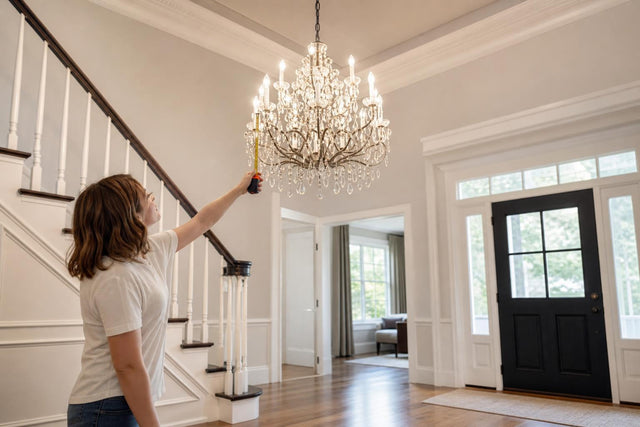
How to Choose the Right Size Chandelier for Foyer (2026)
TL;DR
To choose the right size chandelier for your foyer, add the room’s length and width in feet, then convert that number to inches for the ideal diameter. For fixture body height, multiply your ceiling height in feet by 2.5 to 3 inches. The bottom of the chandelier should hang at least 7 feet above the floor. For double-height foyers (common in Indian villas), the chandelier should fill roughly one-third of the vertical space, and you should increase the diameter by 20 to 30 percent beyond the standard formula.
A foyer chandelier is the first thing guests notice when they walk through your door. Get the size wrong, and everything feels off. Too small, and the fixture looks like an afterthought floating in empty space. Too large, and the room feels cramped before anyone takes a step inside.
The good news: choosing the right size chandelier for your foyer comes down to a handful of formulas and a few smart adjustments. This guide covers all of them, with worked examples for typical Indian foyer sizes (apartments, villas, and duplexes), metric conversions, and practical tips drawn from real homeowners who learned the hard way.
If you’d rather skip the math and get personalized advice, ALC Studio’s chandelier collection pairs with free design consultations to help you nail the size on the first try.
Glossary of Key Chandelier Sizing Terms
Before running any formulas, it helps to speak the same language as lighting professionals. These terms appear throughout this guide and on most product specification sheets.
Chandelier Diameter (Width): The widest horizontal measurement of the fixture, edge to edge. This is the single most important sizing number for your foyer.
Fixture Body Height: The vertical measurement of the chandelier itself, from the top of the frame to the bottom of the lowest element. This excludes the chain, rod, or cable above it.
Drop Length: The total distance from ceiling to the chandelier’s lowest point. It includes the chain or rod plus the fixture body height. This is what determines your floor clearance.
Floor Clearance: The distance between the finished floor and the chandelier’s lowest point. Getting this wrong means someone will bump their head, or the fixture will hang awkwardly high.
Visual Weight: How heavy or substantial a fixture appears, regardless of its actual weight in kilograms. A dense crystal chandelier has far more visual weight than an open geometric frame at the same diameter.
Tier: One horizontal level of a chandelier. Multi-tier designs stack two or three rings or rows of lights vertically.
Cascade: Multiple drops hanging at different lengths, creating a waterfall-like effect. Common in double-height foyers.
Canopy: The decorative plate that mounts flush against the ceiling, covering the electrical box and wiring.
CCT (Correlated Colour Temperature): Measured in Kelvin (K). Lower numbers (2700K) produce warm, yellowish light. Higher numbers (4000K+) produce cool, bluish-white light.
Lumens: The total light output of a fixture. Unlike watts, lumens measure actual brightness. A 100-watt incandescent bulb produces roughly 1,600 lumens, but a 15-watt LED can match that output.
The Diameter Formula: Your Starting Point
This is the formula that every interior designer and lighting specialist uses, and every top-ranking guide on the internet leads with it. Here it is:
Add the length and width of your foyer in feet. That sum, converted to inches, gives you the ideal chandelier diameter.
A foyer measuring 10 feet by 12 feet: 10 + 12 = 22. Your target chandelier diameter is approximately 22 inches.
Simple. But the formula alone doesn’t account for ceiling height, room openness, or the quirks of Indian home layouts. That’s where adjustments matter.
Adjustments to the Base Formula
High ceilings (above 8 feet): For every additional foot of ceiling height above 8 feet, add 2.5 to 3 inches to your chandelier diameter. A 10 × 12 ft foyer with a 12-foot ceiling would shift from 22 inches to roughly 32 to 34 inches.
Open foyers: If your foyer flows directly into a living room or hallway without walls, increase the diameter by 10 to 20 percent. The chandelier needs to anchor a larger visual zone.
Enclosed or narrow foyers: Reduce by 10 to 15 percent. And here’s a critical rule most guides miss: cap your chandelier diameter at 60 to 70 percent of the foyer’s narrower dimension. Even if the formula says 22 inches, a foyer that’s only 6 feet wide should top out at about 43 to 50 inches (roughly 17 to 20 inches in this example). Overshooting this makes the space feel choked.
Narrow foyer alternative: For very long, narrow foyers (say, 6 × 16 feet), consider two smaller pendant lights for compact foyers spaced along the length instead of one round chandelier. Two 12-inch pendants often look more balanced than a single 22-inch fixture centered in a corridor-like space.
Metric Conversion Table for Indian Homeowners
Indian buyers typically measure rooms in metres, but all the formulas use feet. This table bridges the gap for the most common Indian foyer sizes:
| Foyer Size (metres) | Foyer Size (feet) | Formula Result (inches) | Formula Result (cm) |
|---|---|---|---|
| 1.8 × 2.4 m | 6 × 8 ft | 14" | 36 cm |
| 2.4 × 3 m | 8 × 10 ft | 18" | 46 cm |
| 3 × 3.6 m | 10 × 12 ft | 22" | 56 cm |
| 3.6 × 4.2 m | 12 × 14 ft | 26" | 66 cm |
| 4.2 × 4.9 m | 14 × 16 ft | 30" | 76 cm |
Keep these numbers handy when you’re measuring your foyer and browsing fixture specs.
The Height Formula: Sizing the Fixture Body
Diameter handles the horizontal proportion. Fixture body height handles the vertical one. The rule:
Multiply your ceiling height in feet by 2.5 to 3. That gives you the ideal fixture body height in inches.
Here’s how this plays out across common ceiling types:
- 8-foot ceiling: 20 to 24 inches of fixture body height
- 9 to 10-foot ceiling (standard Indian apartment): 22 to 30 inches
- 12-foot ceiling: 30 to 36 inches
- 18 to 20-foot ceiling (double-height foyer): 45 to 60 inches
That last range is worth pausing on. A 60-inch chandelier is 5 feet tall, which sounds enormous. But in a 20-foot void, it fills the space proportionally. If your chandelier is very tall (3+ feet in fixture height), you can stay on the lower end of the diameter range. Flatter, wider designs should aim higher on diameter.
The Double-Height Rule of Thirds
For two-story foyers (typically 16 to 22 feet), the chandelier should occupy approximately one-third of the vertical space. An 18-foot ceiling calls for a fixture spanning roughly 6 feet of vertical space, including the drop from the ceiling.
If your foyer has 12 to 14-foot ceilings, it can feel double-height without technically being two stories. Use the two-story guidelines but scale slightly smaller. Under 12 feet, stick with standard foyer rules.
For more on navigating these tall spaces, our double-height chandelier sizing guide covers everything from cascading designs to staircase-adjacent placement.
Hanging Height and Floor Clearance Rules
Getting diameter and fixture height right means nothing if the chandelier hangs at the wrong level. These clearance rules are non-negotiable.
Standard foyer (single story): The bottom of the chandelier should hang at least 7 feet above the floor. If guests regularly walk directly beneath it, aim for 7.5 feet. This applies to most Indian apartment foyers with 9 to 10-foot ceilings.
Two-story foyer: Don’t hang the chandelier below the second-story line. The fixture should be visible and dramatic from the ground floor but shouldn’t intrude into the upper landing’s sightline or walkway. Also make sure the bottom hangs at least 6 inches above the top of your front door when it’s open.
Above a staircase: Maintain 84 to 90 inches of clearance above the stair treads directly below the fixture.
Low ceilings (8 feet or under): A hanging chandelier may not work at all. Consider flush-mount or semi-flush ceiling lights for compact foyers that sit close to the ceiling while still providing a focal point.
The Cable-Cutting Warning
On Reddit, one homeowner described the frustration of having a cord cut too short during installation, leaving the chandelier permanently higher than intended. There’s no fix for this short of buying a new chain or rod.
The rule: approve the final hanging height before the installer trims any cable, chain, or rod. Stand in the foyer, look at it from the entrance, the stairs, and the upper landing if you have one. Only then give the go-ahead to cut.
Visual Weight Adjustments: Why Inches Don’t Tell the Whole Story
Two chandeliers can share the exact same diameter and look completely different in your foyer. This is visual weight, and it’s the sizing factor that most guides either skip or barely mention.
A 24-inch crystal chandelier with multiple tiers of glass can feel larger than a 26-inch modern chandelier with open geometric arms. The crystal fixture reflects light, catches the eye, and fills visual space. The minimalist one lets you see through it.
How to Adjust for Visual Weight
Crystal, dense, or multi-tier designs: Size down 1 to 2 inches from the formula result. The ornamentation makes up the difference.
Open-frame, minimalist, or single-tier designs: Size up 1 to 2 inches. The airiness means the fixture reads smaller than its actual measurements.
Dark finishes (matte black, oil-rubbed bronze, dark brass): These absorb light and appear larger than they are. Stick to the lower end of your size range. A black-frame fixture should also be paired with higher-lumen LEDs to compensate for the light absorption.
Light finishes (brushed nickel, white, polished chrome, gold): These reflect light and appear slightly smaller. You can push toward the upper end of the range.
Multi-tier vs. single-tier: A three-tier chandelier with cascading arms commands more attention at any given diameter than a single-ring design. Factor this into your decision.
For a look at how sculptural and oversized designs are shaping current interiors, our piece on luxury lighting trends is worth a read.
Lumens and Colour Temperature: Getting the Light Right
Sizing a chandelier isn’t just about visual proportion. It’s also about whether the fixture actually lights the space properly. This is a gap in almost every competing guide on this topic, and it matters.
How Many Lumens Does Your Foyer Need?
Plan for 20 to 30 lumens per square foot in a foyer. A 10 × 12 ft foyer (120 sq ft) needs 2,400 to 3,600 lumens of total light output. For double-height foyers, aim for the higher end because light disperses more in tall spaces. Most two-story foyer fixtures use 6 to 20 bulbs, but check the total lumen output rather than just counting bulbs.
What Colour Temperature Works Best?
Stick with warm white, between 2700K and 3000K. This range produces the inviting, golden tone that makes a foyer feel welcoming. Going above 4000K creates a clinical, commercial feel that works in offices but not at your front door.
Layer Your Foyer Lighting
A single chandelier rarely covers all the lighting needs of a foyer. The best approach: use the chandelier as the focal point, add recessed lights near the door for practical illumination, and install wall lights for staircase layering along adjacent walls or stairs. This gives you flexibility for different times of day and occasions.
Always install dimmable bulbs with compatible dimmer switches. A chandelier that’s perfect at 30% brightness for a quiet evening becomes functional task lighting at full power when you’re welcoming guests.
For a deeper look at building these layers, our ambient lighting guide walks through the process room by room.
The Cardboard Mockup Test: A Practitioner Tip That Saves Thousands
Formulas give you a number. But numbers on paper and fixtures in three-dimensional space don’t always match. One contributor on the Houzz forums put it bluntly: “I don’t use ‘rules’ for things like this, but use my eyes. Making mock-ups with cardboard and hanging them up there is the easiest way to ‘see’ how a size will look in the space.”
Here’s how to do it:
- Mark the diameter on the floor using painter’s tape. This shows the horizontal footprint.
- Create a cardboard cutout or box roughly matching the fixture’s height and width. It doesn’t need to be pretty.
- Hang it at the proposed drop length using string, wire, or a makeshift support.
- View it from every angle: the front door, the staircase, the upper landing (if you have one), and through windows from outside.
- Adjust height and size until it looks right from all viewpoints.
This five-minute exercise has saved countless homeowners from expensive returns. Another Houzz user shared their cautionary tale: they bought a 42-inch chandelier for a 17 × 19-foot foyer with 18-foot ceilings, and it still looked tiny after installation. The standard formula suggested 36 inches, and even overshooting it by 6 inches wasn’t enough. Their double-height ceiling demanded something closer to 48 to 54 inches once they factored in the height adjustment.
The mockup would have caught this before the purchase.
India-Specific Sizing Considerations
Most chandelier sizing guides are written for American homes. Indian foyers present different challenges.
Typical Indian Foyer Dimensions
Compact apartment foyer (2 BHK): 1.8 × 2.4 m (6 × 8 ft), with 9 to 10-foot ceilings. Formula gives 14 inches. This is a small fixture, so choose something with some visual weight (crystal or textured glass) to make it feel intentional, not like a leftover pendant from the kitchen.
Mid-range apartment foyer (3 BHK): 2.4 × 3 m (8 × 10 ft), with 9 to 10-foot ceilings. Formula gives 18 inches. A solid sweet spot for most chandeliers in the market.
Large independent home foyer: 3.6 × 4.2 m (12 × 14 ft), with 12-foot ceilings. Formula gives 26 inches before high-ceiling adjustment, pushing closer to 36 inches.
Duplex staircase void or villa double-height: 3.6 × 4.2 m (12 × 14 ft) or larger, with 18 to 22-foot ceilings. This is where the formula result jumps dramatically. You’re looking at 32 to 45-inch diameters and 45 to 60-inch fixture heights. A cascading design works particularly well in these vertical spaces. For more on this, see our guide on two-story foyer chandelier ideas.
Maintenance Access in Tall Foyers
This is something American guides rarely discuss because many Western homes have chandelier-lowering mechanisms. Indian homes almost never do. Before finalizing a fixture for a double-height foyer, ask yourself: how will you change bulbs and clean the chandelier?
Options include scaffolding (expensive to arrange repeatedly), a tall extension ladder (risky in a stairwell), or choosing LED fixtures with rated lifespans of 25,000+ hours to minimize maintenance visits. Some homeowners invest in a pulley or winch system during construction, which is far cheaper to install before the ceiling is finished.
Think about this before you buy, not after the chandelier is hanging 18 feet above your floor.
Foyer Chandelier Sizing Cheat Sheet
This table combines all the formulas into a quick reference. It covers the most common Indian foyer configurations with both metric and imperial measurements.
| Foyer Size (ft) | Foyer Size (m) | Ceiling Height | Recommended Diameter | Fixture Body Height | Min. Floor Clearance |
|---|---|---|---|---|---|
| 6 × 8 | 1.8 × 2.4 | 9 ft / 2.7 m | 14" / 36 cm | 22–27" / 56–69 cm | 7 ft / 2.1 m |
| 8 × 10 | 2.4 × 3 | 10 ft / 3 m | 18–20" / 46–51 cm | 25–30" / 64–76 cm | 7 ft / 2.1 m |
| 10 × 12 | 3 × 3.6 | 10 ft / 3 m | 22–24" / 56–61 cm | 25–30" / 64–76 cm | 7 ft / 2.1 m |
| 12 × 14 | 3.6 × 4.2 | 12 ft / 3.7 m | 26–30" / 66–76 cm | 30–36" / 76–91 cm | 7.5 ft / 2.3 m |
| 12 × 14 | 3.6 × 4.2 | 18 ft / 5.5 m | 32–38" / 81–97 cm | 45–54" / 114–137 cm | 8–9 ft / 2.4–2.7 m |
| 14 × 16 | 4.2 × 4.9 | 20 ft / 6 m | 38–45" / 97–114 cm | 50–60" / 127–152 cm | 8–9 ft / 2.4–2.7 m |
Use this table as a starting point, then adjust for visual weight, room openness, and finish colour as described in the sections above.
Common Mistakes to Avoid
1. Buying too small. This is the single most common foyer chandelier mistake. Interior designers confirm it, forum users complain about it, and it’s almost always the result of people eyeballing the fixture in a showroom (where high ceilings make everything look smaller) or trusting the formula without applying ceiling-height adjustments.
2. Ignoring visual weight. A 24-inch crystal chandelier and a 24-inch wire-frame pendant are not the same presence. Treat the formula result as a starting point and adjust based on the fixture’s density.
3. Forgetting maintenance access. Especially in double-height Indian foyers. If you can’t reach the chandelier without hiring scaffolding, factor that cost and inconvenience into your decision.
4. Skipping the dimmer. A foyer chandelier without a dimmer is either too bright during the day or too dim at night. Dimmers cost a few hundred rupees and transform the fixture’s usefulness.
5. Cutting the chain or cable prematurely. As mentioned earlier, get the height right before any permanent cuts. View from every angle first.
6. Centering on the ceiling instead of the visual zone. If your foyer has an off-center ceiling box but a visually obvious center point (like the midpoint between the door and the staircase), the chandelier should align with where the eye naturally goes. This sometimes means relocating the electrical box during renovation.
When to Get Expert Help
The formulas in this guide work well for standard rectangular foyers with predictable ceiling heights. But some situations genuinely need a professional eye:
- L-shaped foyers where the “length + width” formula doesn’t apply neatly
- Curved staircases that create asymmetric sight lines
- Double-height voids with mezzanines where the chandelier must look right from two distinct floor levels
- Custom fixtures where you need a specific size, finish, or configuration that doesn’t exist off the shelf
ALC Studio offers free design consultations (virtual or at showrooms in Delhi’s Kirti Nagar and Lucknow’s Vipul Khand) for exactly these scenarios. If you’re working with non-standard dimensions or want to validate your sizing calculations before committing, this is the simplest way to get it right.
Browse ALC Studio’s chandeliers to explore fixtures with detailed specs, multiple size options, and pan-India delivery.
Frequently Asked Questions
What is the standard formula for choosing the right size chandelier for a foyer?
Add the length and width of your foyer in feet. That sum, expressed in inches, gives you the ideal chandelier diameter. For example, a 10 × 12 ft foyer calls for a 22-inch diameter chandelier. Adjust upward for high ceilings (add 2.5 to 3 inches per foot above 8 feet) and downward for narrow or enclosed spaces.
How low should a foyer chandelier hang?
The bottom of the chandelier should be at least 7 feet above the floor in a standard single-story foyer, or 7.5 feet if people regularly walk underneath it. In a two-story foyer, never hang the fixture below the second-story floor line, and keep the bottom at least 6 inches above the top of the front door.
How do I choose the right size chandelier for a double-height foyer?
The chandelier should fill roughly one-third of the vertical space. For an 18-foot ceiling, that means around 6 feet of combined drop and fixture height. Increase the diameter by 20 to 30 percent beyond what the standard formula suggests, because the extra vertical space makes fixtures appear smaller than expected.
Does the chandelier’s finish affect how big it looks?
Yes. Dark finishes like matte black or oil-rubbed bronze absorb light and appear larger than identically sized fixtures in brushed nickel or white. If you choose a dark finish, stay at the lower end of your calculated size range. Light or reflective finishes let you push toward the upper end.
How many lumens does a foyer chandelier need?
Aim for 20 to 30 lumens per square foot. A 120-square-foot foyer needs 2,400 to 3,600 total lumens. For double-height foyers, push toward the higher end because light disperses more in tall spaces. Pair the chandelier with recessed lights and wall sconces for layered, even illumination.
What colour temperature is best for a foyer chandelier?
Warm white, between 2700K and 3000K. This range produces a golden, welcoming tone that sets the right mood the moment someone enters your home. Avoid anything above 4000K in a residential foyer, as it will feel cold and commercial.
Can I use a pendant light instead of a chandelier in a small foyer?
Absolutely. In compact apartment foyers (under 8 × 6 feet), a single pendant light or a semi-flush ceiling fixture often works better than a chandelier. The sizing principles are the same: use the diameter formula and hanging-height rules. For very narrow foyers, two smaller pendants spaced along the length can look more intentional than one centered fixture.
How do I test chandelier size before buying?
Use the cardboard mockup method. Mark the chandelier’s diameter on the floor with painter’s tape, then hang a cardboard box or cutout at the proposed drop height. View it from the front door, the staircase, the upper landing, and through exterior windows. This takes minutes and prevents costly sizing mistakes.
0 Comments
There are no comments for this article. Be the first one to leave a message!