
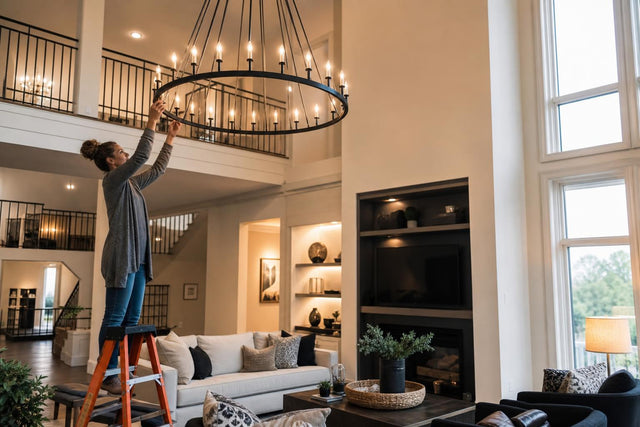
How to Choose a Chandelier for a Double Height Living Room
TL;DR
To choose a chandelier for a double-height living room, start by measuring ceiling height, room width, and the seating zone below. Use the diameter formula (room length + width in feet = diameter in inches) as a baseline, then scale up 10 to 30 percent for tall voids. Calculate fixture body height using ceiling height in feet × 2.5 to 3 inches. Keep the chandelier’s lowest point at least 7 to 9 feet above the floor, and always verify structural support before ordering.
A double-height living room is one of the most dramatic spaces in any Indian home. It is also one of the easiest spaces to get wrong when it comes to lighting. The chandelier that looked enormous in the showroom can appear oddly small once it is hanging 18 feet above your sofa. The crystal piece that seemed perfect in a product photo can turn into a maintenance nightmare without a cleaning plan.
This guide covers every term, formula, and safety consideration you need to understand before you spend a single rupee. The goal is simple: give you the vocabulary and numbers to confidently brief your interior designer, architect, or lighting vendor.
If your home is still under construction or you are working with unusual void dimensions, ALC Studio offers free consultations to help validate sizing and placement before you commit.
What Makes a Double-Height Living Room Different
A double-height living room has a ceiling that extends across roughly two standard floors instead of one. Where a typical Indian room has a 9 to 10 foot ceiling, a double-height space runs 16 to 22 feet or taller. Architecture publications describe these rooms as significantly taller than standard spaces, often close to double standard room height.
That extra vertical volume changes everything about chandelier selection. A fixture designed for a 10-foot ceiling will look like a speck in a 20-foot void. The room demands more diameter, more body height, and a carefully planned drop length to connect the ceiling to the living zone below.
This is the core challenge when choosing a chandelier for a double-height living room: you are filling volume, not just lighting a floor.
Glossary of Key Chandelier Terms
Most guides throw around terms like “drop length” and “fixture height” without defining them clearly. Competitors blur these concepts, and that confusion leads to expensive mistakes. Here is what each term actually means and why it matters for double-height spaces.
Chandelier Diameter (Width)
The widest horizontal measurement of the chandelier. This determines whether the fixture feels proportional when viewed from the floor and the upper-floor balcony or landing. In double-height rooms, airy open-frame chandeliers can go wider than dense crystal ones without overwhelming the space.
Fixture Height (Body Height)
The actual top-to-bottom height of the chandelier itself, not including the chain, rod, or cable. This is different from how far the chandelier hangs from the ceiling. Competitors constantly confuse these two numbers, and the difference matters enormously in tall rooms.
Drop Length (Suspension Length)
The total distance from the ceiling to the chandelier’s lowest point. This includes the chain, rod, or cable plus the fixture body. In a 20-foot room, a 5-foot chandelier body might still need several additional feet of suspension to bring it into visual relationship with the seating zone below.
Bottom Clearance
Height from finished floor to the lowest point of the chandelier. Kichler’s chandelier planning guide recommends at least 7 feet of clearance where people walk. In double-height living rooms, 8 to 9 feet often looks better while still keeping the fixture connected to the living area.
Visual Weight
How heavy or light a fixture appears, regardless of its actual weight in kilograms. A dense multi-tier crystal chandelier feels visually heavier than an open ring chandelier of the same diameter. This affects whether you should size up or stay closer to the formula baseline.
Tier
One horizontal level or layer of a chandelier. Double-height spaces often benefit from 2 to 3 tiers or cascading levels to fill vertical height. Samrat Traders’ double-height guide recommends multi-tier designs for most 18 to 22 foot living rooms.
Cascade (Waterfall Chandelier)
A chandelier with multiple drops descending at different lengths. These work well in voids and staircase-adjacent rooms because they occupy height without blocking the entire view.
Canopy (Ceiling Rose)
The visible ceiling plate that covers wiring and suspension points. In high ceilings, the canopy is visible from below and sometimes from upper-floor landings, so finish and proportion matter.
False Ceiling
A secondary ceiling below the structural slab. A false ceiling can frame the chandelier visually and hide wiring, but it should never be the sole structural support for a heavy fixture.
Lumens
Total visible light output from a source. Modern LED chandeliers vary widely in efficiency, so wattage alone tells you very little. The U.S. Department of Energy explains that lumens are the correct measure of light output, not watts.
CCT (Colour Temperature)
The warmth or coolness of white light, measured in Kelvin. For most Indian living rooms, 2700 to 3000 K produces a warm, inviting glow. Going above 5000 K in a luxury interior will make everything feel harsh and clinical.
CRI (Colour Rendering Index)
How accurately a light source reveals the true colours of surfaces. In a room with Italian marble, teak paneling, silk upholstery, and art, CRI 80 is the minimum. Premium interiors should aim for CRI 90 or above.
Dimmable Driver
The electronic component that lets an LED fixture dim smoothly. Poor dimmer-driver compatibility causes flicker, buzzing, or a limited dimming range. If you want scene control in your living room (and you should), confirm compatibility before purchase.
Safety Cable
A secondary cable that holds the chandelier if the primary suspension fails. Critical for heavy fixtures hanging over spaces where people sit and walk.
Chandelier Lift
A motorised system that lowers a chandelier for cleaning and servicing. Some models support up to 1,000 pounds, making regular maintenance practical even in 20-foot-plus voids.
Measure Before You Browse
Product photos hide scale. The most common regret practitioners on Reddit report is choosing a fixture that looked substantial in a catalogue but appeared tiny once installed under a tall ceiling. One user on r/InteriorDesign described their chandelier looking “visually unbalanced” because the high ceiling shrank the perceived fixture size.
Before you open a single product page, measure and record these seven numbers:
Ceiling height: finished floor to finished ceiling.
Room footprint: full length × width.
Seating zone dimensions: the sofa, coffee table, and conversation area, which is often smaller than the full room.
Void width: the open double-height area specifically.
Balcony or landing sightlines: where the chandelier will be seen from the upper floor.
Walk paths below: where people move under the chandelier.
Electrical point location: check whether it is centered on the room, the seating area, or the void.
A key point from Houzz professional discussions: your electrician should not just “center” the junction box on the ceiling grid. The chandelier point should align with the design plan, which usually means centering on the void and seating composition.
If the home is under construction, finalise the chandelier point before closing the false ceiling and running conduit.
Chandelier Size Formula for Double-Height Living Rooms
Step 1: Calculate Diameter
The standard starting formula, used by both Houzz and Kichler, is straightforward:
Room length in feet + room width in feet = chandelier diameter in inches
Examples:
14 × 16 ft living zone → 30-inch diameter baseline
18 × 20 ft living zone → 38-inch diameter baseline
20 × 24 ft double-height lounge → 44-inch diameter baseline
For double-height rooms, treat that number as a minimum. Fixtures that are airy, open-frame, or ring-based can be upsized 10 to 20 percent. For very tall voids where the chandelier is the primary focal point, going 20 to 30 percent larger often works. Do not oversize if the chandelier is dense crystal or dark metal, as these carry more visual weight at any given diameter.
Step 2: Calculate Fixture Body Height
The classic body-height formula:
Ceiling height in feet × 2.5 to 3 = fixture body height in inches
Ceiling Height |
Suggested Body Height |
|---|---|
12 ft |
30 to 36 inches |
15 ft |
38 to 45 inches |
18 ft |
45 to 54 inches |
20 ft |
50 to 60 inches |
22 ft |
55 to 66 inches |
Taller rooms can lean toward the higher end of the range.
Step 3: Calculate Total Drop
This is where most guides fail. They give the body-height formula but never explain the total drop calculation:
Ceiling height minus desired bottom clearance = total drop from ceiling to chandelier’s lowest point
Example for a 20-foot ceiling:
Desired bottom clearance: 8.5 feet
Total drop: 20 minus 8.5 = 11.5 feet
If the fixture body is 5 feet tall, the chain or rod needs to cover the remaining distance
This distinction is the single biggest gap in competitor content. Many buyers order a chandelier that is tall enough as an object but end up hanging it too high because they never calculated the total drop separately.
Example Calculations
Example 1: 18 × 20 ft room, 20 ft ceiling
Diameter baseline: 18 + 20 = 38 inches. With double-height adjustment for an airy fixture: 42 to 50 inches.
Fixture body height: 20 × 2.5 to 3 = 50 to 60 inches.
Bottom clearance: 8.5 feet.
Total drop: 20 minus 8.5 = 11.5 feet from ceiling to lowest point.
Good fit: a multi-tier cascade, stacked ring, or custom vertical chandelier with layered wall and cove lighting.
For a space like this, a vertical cascade design like the Dew Drops chandelier fills height gracefully without blocking sightlines.
Example 2: 14 × 16 ft seating zone, 18 ft ceiling
Diameter baseline: 14 + 16 = 30 inches. Adjusted for visual lightness: 34 to 40 inches.
Fixture body height: 18 × 2.5 to 3 = 45 to 54 inches.
Total drop at 8 ft clearance: 18 minus 8 = 10 feet.
Good fit: a ring chandelier or mid-size crystal fixture.
For a statement crystal piece in this kind of space, the Crysta chandelier is worth exploring.
Best Chandelier Styles for Double-Height Living Rooms
Choosing the right chandelier for a double-height living room is not just about size. The fixture type should match the room’s proportions, architectural character, and your tolerance for maintenance.
Cascade and Waterfall Chandeliers
Best for tall voids, staircase-adjacent living rooms, and modern duplexes. Multiple drops at different lengths fill vertical space without creating a single dense mass. These need accurate drop planning and a realistic cleaning strategy.
Multi-Tier Chandeliers
Best for grand, symmetrical rooms with a classic or transitional interior. Two or three tiers fill height convincingly. Watch the actual weight, as these can be heavy enough to require engineered structural support.
Ring Chandeliers (Stacked Rings)
Best for contemporary Indian villas and clean modern interiors. Rings stacked at different heights read well from both the ground floor and the upper landing. Ensure enough vertical separation between rings so the fixture does not look flat from below.
Pendant Clusters
Best for artistic, less formal spaces or rooms where a single large chandelier feels too traditional. Multiple pendants grouped from one or more ceiling roses create a sculptural vertical composition. A clustered option like the LumaCloud pendant works well in contemporary double-height interiors.
Practitioners on Houzz UK forums mention that multi-point ceiling roses with varied pendant drops can fill double-height cathedral areas effectively, especially when a single chandelier would be too formal.
Linear Chandeliers
Best for rectangular living/dining zones or long seating arrangements. A linear chandelier may not fill vertical height on its own, so consider layering with tiers or companion lighting.
Custom Chandeliers
Best for unusual voids, non-standard ceiling heights, bespoke finishes, and architect-designed homes. Standard fixtures often come in limited sizes that do not match the proportions of Indian duplex villas. Custom lighting firms on LinkedIn note that bespoke work involves recalculating structural load, adjusting proportions to ceiling height and viewing angles, and coordinating installation logistics.
For unusual Indian duplex or villa proportions, custom sizing is often more practical than forcing an off-the-shelf chandelier to work.
Visual Weight: A Framework Most Guides Skip
Competitors give formulas but rarely explain why the same diameter can look right in one fixture and wrong in another. The answer is visual weight.
Fixture Style |
Visual Weight |
Sizing Implication |
|---|---|---|
Open metal ring |
Light |
Can size up 10 to 20% |
Glass globe cluster |
Medium |
Size to formula or slightly above |
Dense crystal tier |
Heavy |
Avoid excessive diameter; use height and tiers instead |
Black or dark metal |
Heavy |
Can dominate; size carefully |
Minimal linear |
Light horizontally, weak vertically |
Needs tiers or companion lighting for double-height rooms |
Custom cascade |
Adjustable |
Best for odd voids when designed to room dimensions |
A dense crystal chandelier at 38 inches can fill a room the same way an open ring chandelier at 48 inches does. Always factor in visual weight before deciding the final size.
How Much Light Should the Chandelier Provide?
The chandelier is the hero layer, not the only light source. This is one of the most common mistakes in double-height living rooms.
A lighting designer from Prism Lighting Design notes on LinkedIn that high-ceiling spaces can feel distant or cold if lighting is not brought down to human scale. The fix is layered lighting:
Chandelier: focal point and ambient glow.
Wall lights or sconces: bring light to eye level. The Caral wall light is one example of a fixture that works well at this layer.
Cove or indirect lighting: softens the ceiling and reduces the “cave” effect common in tall rooms.
Floor and table lamps: near seating, for reading and relaxed evening light.
Accent lighting: for art, textured walls, stone cladding, and curtains.
Practitioners on Reddit’s r/Lighting forum, discussing a 20-foot living room, recommended layers of wall washers, sconces, and a dimmable chandelier rather than relying on one overhead source.
Estimating Lumens
For a rough ambient light estimate:
Room area in square feet × target foot-candles = approximate lumens needed
One foot-candle equals one lumen distributed over one square foot. Living rooms are commonly planned around 10 to 20 foot-candles for general lighting.
Example for an 18 × 20 ft room (360 sq ft):
At 10 to 20 foot-candles: 3,600 to 7,200 lumens total
The chandelier does not need to provide all of this; split across your layered sources
Colour Temperature and CRI
For most Indian living rooms, 2700 to 3000 K (warm white) creates the right atmosphere. If the interiors lean modern with cooler marble and metal finishes, 3000 to 3500 K can work. Avoid anything above 5000 K in a living room.
The DOE recommends 2700 to 3600 K for most indoor general and task lighting, and CRI 80 or above for residential applications.
For premium interiors with wood, stone, art, and upholstery, push for CRI 90 or higher. The difference is visible.
The 15-Minute Mockup Method
This step alone can save you from the two most common regrets: “it’s too small” and “it’s too high.”
Mark the chandelier’s diameter on the floor with painter’s tape.
Hang a weighted string or temporary object (a cardboard box works) at the proposed lowest point.
View from the entrance, the sofa, the upper balcony, the staircase, and the dining area.
Check if the mockup blocks any view, feels too high, or looks too small from any angle.
Approve the final hanging height before the installer trims any cable or rod.
A Houzz professional shared that for an 18-foot ceiling, a 52 × 32 inch chandelier was hung with the bottom at 8 feet 3 inches above the floor, and they advise keeping extra wire or chain until the height is confirmed from multiple viewpoints. On Reddit, one homeowner described their frustration after a cord was cut too short during installation, leaving the chandelier permanently higher than intended.
Never cut cable before final approval.
Installation and Safety Checklist
A double-height chandelier is a suspended object over people. Treating installation as an afterthought is a real safety risk, not just a design problem.
Structural Support
Heavy chandeliers need to hang from the structural slab, beam, or engineered support, not from a false ceiling. Samrat Traders’ guide explicitly warns: never hang from a false ceiling for double-height chandeliers.
Under US NEC-based guidance, standard luminaire outlet boxes support up to roughly 50 pounds unless rated for more. Heavier fixtures need independent support. In India, electrical installations should comply with relevant standards such as BIS IS 732:2019 for design, erection, and verification.
Pre-Purchase Safety Checklist
Before you order, confirm these five facts about your site:
Ceiling height (measured, not assumed from plans)
Chandelier weight (listed in the product specification)
Structural support point (slab, beam, or engineered bracket, not just false ceiling framing)
Access for installation (ladder reach, scaffolding requirement, scissor lift availability)
Access for future servicing (how will you change a driver, clean glass, or replace a bulb?)
Installation Costs in India
Installation is not just “hang it and connect the wires.” Reddit discussions from homeowners and electricians repeatedly mention that high-ceiling work requires scaffolding or scissor lifts and experienced tradespeople. One Indian vendor estimates total double-height chandelier installation costs between ₹1.2 lakh and ₹5 lakh or more, depending on structural assessment, reinforcement, electrical work, labour, and lift or crane rental. Treat vendor estimates as directional, not universal.
Your budget should include the fixture, structural support, installation equipment, electrician labour, dimmer and driver compatibility, and future cleaning costs.
Maintenance: Plan It Before You Buy
High chandeliers create service problems that homeowners rarely consider until they are living with the consequences.
Practitioners on Reddit’s r/HomeImprovement describe the challenge of changing bulbs in 20-foot-plus ceilings. Some coordinate bulb changes with lift or window-cleaning visits just to justify the access cost.
Practical Maintenance Tips
Choose long-life LED products (rated 30,000 to 50,000 hours or longer) to minimize bulb access needs.
Ask whether the LED driver is replaceable and where it is located: in the canopy, a remote ceiling pocket, or inside the fixture body.
For crystal or glass chandeliers, regular dusting and occasional deep cleaning are necessary. Budget for this.
Consider a motorised chandelier lift system for very high or heavy installations. Some models support up to 1,000 pounds.
If the driver fails in an integrated LED chandelier, can it be replaced without dismantling the entire fixture or erecting scaffolding? Ask before buying.
If you cannot clean or service it, you have not finished choosing it.
Ten Common Mistakes
Buying by product photo, not dimensions. A chandelier that looks grand on screen may be 24 inches wide, which is tiny in a 20-foot void.
Confusing fixture height with drop length. These are different numbers, and mixing them up causes ordering errors.
Choosing a fixture that looks too small from the balcony. Always check proportions from both floors.
Hanging the chandelier too high. “High ceiling” does not mean “high chandelier.” The fixture should visually anchor the living zone, not float near the ceiling.
Cutting cable before final height approval. Leave extra length until you have viewed the mockup from every angle.
Relying only on chandelier light. Layer with wall lights like the Troy wall light, cove lighting, and floor lamps.
Ignoring false ceiling support limits. Gypsum and POP cannot hold a 40-kilogram chandelier.
Forgetting driver and bulb access. A sealed LED fixture 20 feet up becomes a problem when the driver fails.
Choosing cool white light for a warm living room. Stick to 2700 to 3000 K for most living spaces.
Not testing dimmer compatibility. Poor dimmer-driver pairing causes flicker and buzz that will drive you crazy.
India-Focused Buying Checklist
When selecting a double-height living room chandelier in India, run through these questions before you place an order:
Is the fixture rated for 230V Indian electrical supply?
Is the chandelier weight clearly listed?
Are dimensions specified separately: diameter, body height, total drop, chain or rod length?
Is the finish suited to the room’s style and your maintenance expectations?
Are bulbs included or sold separately?
Is the LED driver replaceable?
Is dimming supported, and with which protocol?
Is custom size or finish available?
What is the production or dispatch lead time?
Who installs it, and what site access is needed?
What happens if glass or crystal arrives damaged?
Is a design consultation available?
For materials and finish exploration, browsing options like the Kobe light can give you a sense of how different materials read in person.
Frequently Asked Questions
What size chandelier fits a double-height living room?
Start with the formula: room length + room width in feet equals chandelier diameter in inches. For double-height rooms, scale that baseline up by 10 to 30 percent depending on ceiling height, void size, and the fixture’s visual weight. A 20 × 18 foot room suggests a 38-inch baseline, which often becomes 42 to 50 inches in a tall space.
How low should a chandelier hang in a double-height living room?
Keep the lowest point at least 7 feet above walkable floor. In most double-height living rooms, 8 to 9 feet feels better because it connects the fixture to the seating zone without blocking movement or sightlines from the upper floor.
What chandelier body height works for a 20-foot ceiling?
The common formula is ceiling height in feet × 2.5 to 3 inches, so a 20-foot ceiling suggests a body height around 50 to 60 inches. The total drop (including chain or rod) will be much longer, depending on your desired bottom clearance.
Is a chandelier enough to light a double-height living room?
No. A chandelier should be the focal point of a layered lighting plan that includes wall lights, cove lighting, floor lamps, and accent lighting. High-ceiling rooms feel cold and cavernous when all the light comes from a single overhead source.
Which colour temperature is best for a living room chandelier?
Warm white at 2700 to 3000 K suits most living rooms. If your interiors are modern with cool-toned stone and metal, 3000 to 3500 K can work. Avoid anything above 5000 K unless there is a specific design reason.
Can I hang a heavy chandelier from a false ceiling?
Do not rely on the false ceiling alone. The chandelier’s weight must transfer to a structural slab, beam, or engineered support. The false ceiling can hide wiring and frame the opening, but it is not designed to bear the load of a heavy fixture.
When should I consider a custom chandelier?
Choose custom when your room has an unusual void, a non-standard ceiling height, special finish requirements, or when standard products are either too small or too large for the proportions. For Indian duplex villas and bungalows with odd staircase-adjacent voids, custom sizing is often the most practical path.
How do I maintain a chandelier in a double-height room?
Use long-life LEDs, confirm the driver is replaceable, budget for periodic professional cleaning, and consider installing a motorised chandelier lift if the ceiling exceeds 16 to 18 feet. Some homeowners time cleaning with other high-access maintenance to share scaffolding costs.
Choosing a chandelier for a double-height living room is a decision about volume, structure, and long-term livability, not just aesthetics. The formulas give you a starting point. The mockup tells you if the proportions work. The safety and service checklist keeps the choice practical years after installation.
If your space has non-standard dimensions or you want to validate size, drop, and placement before ordering, explore ALC Studio’s range and book a free design consultation to match the chandelier to the actual room, not just a product photo.
0 Comments
There are no comments for this article. Be the first one to leave a message!