
How to Choose a Chandelier for Dining Room (2026 Guide)
TL;DR
To choose a chandelier for your dining room, add the room’s length and width in feet to get the ideal diameter in inches, then confirm it falls between half and two-thirds of your table’s width. Hang it 30 to 36 inches above the table surface for standard 8- to 9-foot ceilings. Stick to warm white bulbs (2700 to 3000K) with a CRI of 80 or higher so food and faces look their best. Always verify that the mounting point anchors into the concrete slab, not just the false ceiling.
Choosing the wrong chandelier is an expensive problem. Too small and it floats above your table like an afterthought. Too large and it dominates the room like a prop from a period drama. Wrong color temperature and your carefully prepared dinner looks washed out under clinical light.
This guide covers every term, formula, and practical detail you need to choose a dining room chandelier with confidence, written specifically for Indian homes where 9- to 10-foot ceilings, false ceiling construction, and warm-white preferences shape the decision. If you are also exploring chandeliers for your home more broadly, that companion guide covers living rooms, foyers, and bedrooms.
Browse the full chandelier collection →
Sizing and Proportion: The Numbers That Matter
Getting the size right is the single most important step. Everything else (style, finish, light quality) becomes secondary if the chandelier looks out of scale. Here are the key terms and formulas.
Chandelier Diameter
The widest horizontal measurement of the fixture, from one edge to the opposite edge. This is the number that determines whether your chandelier looks proportional or awkward.
Room-based formula: Add the room’s length and width in feet. That number, converted to inches, gives you the minimum diameter. A 12 × 14 foot dining room calls for a chandelier at least 26 inches wide.
Table-based formula: The chandelier’s diameter should measure half to two-thirds the width of your dining table. For a standard Indian 6-seater table that’s about 36 inches (90 cm) wide, aim for 18 to 24 inches. For a 48-inch (120 cm) wide table, the range becomes 24 to 32 inches.
Use both formulas and pick the number that falls in the overlapping range. If your room formula says 26 inches and your table formula says 18 to 24 inches, a 24-inch chandelier is the sweet spot.
The most common mistake people make is choosing a chandelier that is too small. When in doubt, size up. A slightly larger chandelier almost always looks better than one that barely registers.
Fixture Body Height
This is the top-to-bottom measurement of the chandelier itself, excluding the chain, rod, or cord above it. Think of it as the chandelier’s vertical footprint.
Formula: Multiply the ceiling height in feet by 2.5 to 3 inches. For a standard Indian apartment with 9-foot ceilings, the fixture body should be roughly 22 to 27 inches tall. For a 10-foot ceiling, 25 to 30 inches.
This ensures the chandelier has enough visual presence without eating into the space between the fixture and your table.
Drop Length
The total distance from the ceiling to the lowest point of the chandelier, including the chain, rod, and fixture body combined. This is different from fixture body height because it accounts for the suspension hardware.
Why it matters: if your ceiling is 9 feet and the table surface sits at 30 inches off the floor, you have roughly 78 inches of vertical space. Subtract 30 to 36 inches for the gap between chandelier and table, and you are left with 42 to 48 inches of maximum drop length. Exceed that and your chandelier hangs too low.
Hanging Height Above the Table
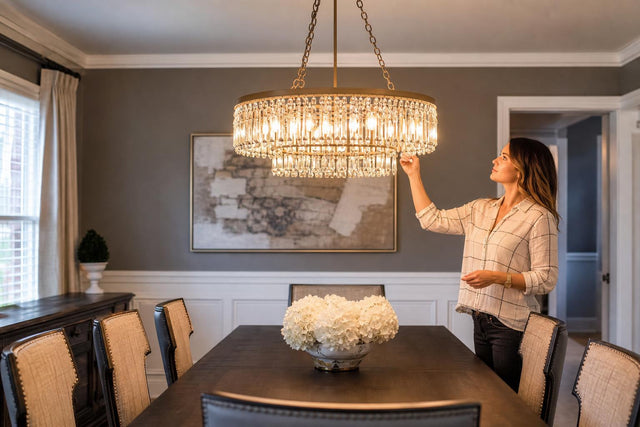
For a standard 8- to 9-foot ceiling, hang the chandelier 30 to 36 inches above the table surface. This range puts light where it belongs (on the food, the plates, and the faces around the table) without forcing anyone to duck or peer around the fixture.
A lighting specialist on Houzz India put it well: there is no reason to buy a chandelier if you hang it so far above the table that no one sees it. Hanging it lower does a better job of illuminating the table, casts a glow on faces, and adds sparkle.
Higher Ceiling Adjustment
For ceilings taller than 8 feet, add 3 inches of hanging distance for every additional foot of ceiling height. In a room with 10-foot ceilings, hang the chandelier 36 to 42 inches above the table. For 12-foot ceilings, 42 to 48 inches. If you have truly dramatic double-height ceilings, the calculations change significantly, and our guide on double-height living room chandeliers covers that scenario in detail.
Floor Clearance
The minimum distance from the floor to the lowest point of the fixture. In open areas without a table beneath, maintain at least 7 feet (213 cm) of clearance so people can walk underneath comfortably. Over a dining table this is less of a concern because the table itself creates a buffer, but it matters if the chandelier is positioned in a passage or near the entry to the dining area.
Multiple Fixture Formula for Long Tables
If your dining table is longer than 6 feet, a single chandelier may not distribute light evenly across all seats. Two or three smaller fixtures often work better.
Formula: Divide the table length by 5. This gives you the spacing and sizing. For a 10-foot table, divide by 5 to get 2 feet. Use that as both the gap between fixtures and the approximate diameter of each fixture (about 24 inches each). Alternatively, pendant lights can serve the same purpose over long tables, especially in modern or minimalist setups.
Light Quality: Why the Bulb Matters as Much as the Frame
A beautiful chandelier fitted with the wrong bulbs will disappoint you every single evening. These terms help you specify the right light.
Color Temperature (CCT)
Measured in Kelvin (K), color temperature describes whether light appears warm (yellowish) or cool (bluish-white). For dining rooms, warm white between 2700K and 3000K is the clear recommendation. This range mimics candlelight, flatters skin tones across Indian complexions, and makes food look appetizing.
Cool white (4000K and above) is too harsh for dining. It belongs in kitchens, offices, and hospitals. If your current dining room feels cold and sterile, the bulb’s color temperature is almost certainly the problem.
For deeper context on how ambient lighting shapes a room’s atmosphere, that guide walks through the principles.
CCT Range |
Feel |
Dining Room Suitability |
|---|---|---|
2200-2700K |
Warm, candlelight-like |
Excellent for intimate dinners |
2700-3000K |
Warm white |
Best all-round choice for Indian dining rooms |
3000-3500K |
Neutral white |
Can work in very modern, cool-toned spaces |
4000K+ |
Cool daylight |
Too clinical for dining |
Lumens
A measure of total light output, or brightness. Unlike watts (which measure energy consumption), lumens tell you how much light you actually get.
For a typical Indian dining room, aim for 3,000 to 6,000 lumens across all light sources combined, depending on room size. A useful rule of thumb: target 20 to 30 lumens per square foot. A 12 × 15 foot dining room (180 square feet) needs roughly 3,600 to 5,400 lumens total.
Your chandelier does not need to provide all of this. If you have wall sconces or recessed lights supplementing the chandelier, the fixture itself might only need to deliver 2,000 to 3,000 lumens.
Foot-Candle
One lumen per square foot. This is the measurement standard used by the Illuminating Engineering Society (IES). For dining rooms, the IES recommends 10 to 20 foot-candles of measured light. This translates directly to the 20 to 30 lumens per square foot target above (accounting for light loss and distribution patterns).
CRI (Color Rendering Index)
CRI measures how accurately a light source reveals the true colors of objects compared to natural sunlight. The scale runs from 0 to 100, with 100 being perfect.
For dining rooms, insist on a CRI of 80 or higher. At CRI 80+, the reds of your tomato salad, the green of your chutney, and the warm browns of a roti all look true to life. Below CRI 80, colors start to look flat and muted. Many cheap LED bulbs have CRI in the 70s. Check the packaging or spec sheet before buying.
No competitor page ranking for this keyword in India covers CRI. But it is one of the most practical specs you can check when buying bulbs for your chandelier.
Dimmer Switch
A control device that lets you adjust the brightness of your chandelier. This is essential for dining rooms, not optional.
At full brightness, your chandelier lights up a weeknight family dinner where the kids are doing homework between courses. Dimmed to 40%, it creates the mood for a dinner party. Dimmed further, it provides background glow for late-night conversation. One chandelier, multiple moods.
Check that the bulbs you choose are dimmer-compatible (not all LEDs are) and that the dimmer is rated for LED loads. Standard incandescent dimmers can cause flickering with LED bulbs.
Style and Shape: Matching the Chandelier to Your Space
Getting the style right means your chandelier feels intentional, not random. These terms help you navigate the options.
Linear Chandelier
An elongated fixture designed for rectangular or oval tables. Instead of radiating outward from a center point, a linear chandelier stretches along the table’s length, distributing light evenly across all seats.
A Singapore-based lighting article makes the point clearly: hanging a round chandelier above a long rectangular table creates a disconnect, leaving half your guests in dim, uninviting lighting. Linear fixtures solve this.
Round and Globe Chandeliers
Circular fixtures that radiate light evenly in all directions. Best suited for round and square dining tables where the geometry naturally complements the chandelier’s shape.
The shape-matching rule is simple: round tables get round chandeliers, rectangular tables get linear chandeliers. Following this principle alone eliminates a large category of mistakes.
Visual Weight
How heavy or light a fixture appears, regardless of its actual physical weight. This concept explains why two chandeliers with identical 24-inch diameters can create completely different impressions in a room.
An open-frame or ring-style chandelier allows light and sightlines to pass through, giving it a lighter visual presence even at a large diameter. A dense, multi-tier crystal chandelier of the same size feels much more substantial and dominant.
When choosing a chandelier for your dining room, consider visual weight alongside the sizing formulas. If you pick an open, airy design, you can comfortably go toward the upper end of the diameter range. If you pick something dense and ornate, stay closer to the lower end.
Tiers
A tier is one horizontal level within a multi-level chandelier. A single-tier chandelier has all its arms or lights on one plane. A two-tier has a smaller ring above or below the main ring. Three-tier designs create a cascading, dramatic effect.
More tiers mean more vertical presence, which suits taller ceilings. For standard 9-foot Indian apartment ceilings, one or two tiers is usually the right call. Three-tier fixtures start to make sense at 12 feet and above, the kind of situation covered in our guide on lighting for double-height ceilings.
Cascade Chandelier
A variant where multiple drops hang at varying lengths from a single canopy. Cascades create a waterfall-like visual and work especially well in stairwells, double-height spaces, or above round tables where the varying lengths add depth.
Finish and Material Selection
The frame’s finish affects both style and how the chandelier interacts with your room’s color palette.
Gold and brass: Warm, pairs naturally with warm white light and wood-toned Indian furniture. Works in traditional, transitional, and even modern spaces depending on the design’s geometry.
Matte black: Contemporary, clean. Creates contrast against light walls and lets the bulbs or shades become the focal point. Popular in modern Indian apartments.
Chrome and polished nickel: Cool-toned, crisp. Best in spaces with grey, white, or blue-toned decor. Can feel cold in warm-toned rooms.
Crystal: Adds sparkle and refracts light, creating prismatic patterns on walls and ceiling. High visual weight even at modest sizes.
Glass and marble: Translucent or opaque shades that soften light distribution. Glass globes create a diffused, even glow. Marble-effect shades add texture and warmth.
For a broader look at what is trending in finishes and forms, luxury lighting trends for 2025 covers the latest directions.
Installation and Safety Terms (India-Specific)
This section matters more than most people realize, especially in Indian apartment construction where false ceilings are standard and structural assumptions can be wrong.
Canopy
The decorative ceiling plate that covers the wiring, junction box, and suspension hardware where the chandelier meets the ceiling. Canopies come in various shapes (round, square, rectangular) and finishes. Make sure the canopy is large enough to cover your ceiling’s electrical box completely.
False Ceiling and POP Ceiling Constraints
This is critical. Gypsum board and POP (Plaster of Paris) false ceilings cannot bear chandelier weight. A chandelier weighing even 10 to 15 kilograms will, over time, pull free from a false ceiling and crash onto your dining table.
The mounting point must anchor into the concrete slab or beam above the false ceiling. As practitioners on NoBroker forums confirm, chandeliers cannot be fixed directly to the false ceiling. An electrician or contractor needs to drill a heavy-duty anchor hook into the structural ceiling. The false ceiling can hide wiring and provide a clean visual, but it must not bear the load.
If your chandelier weighs more than 20 kilograms, discuss the installation with a structural expert before purchasing. For lighter fixtures (under 5 kg), some reinforced false ceiling grids may suffice, but it is always safer to go to the slab.
Structural Support and Junction Box
The electrical junction box in the ceiling must be weight-rated for your chandelier. Standard plastic junction boxes are designed for lightweight fixtures. A chandelier may need a fan-rated or chandelier-rated metal box secured directly to a joist or slab.
In Indian apartment construction, the junction box is typically embedded in the concrete slab during construction. If you are retrofitting a chandelier where a simpler light existed, have an electrician verify the box’s load rating before installation.
230V Electrical Compatibility
India runs on 230V, 50Hz power. If you are importing a chandelier or buying from an international seller, confirm the fixture is rated for 230V. Fixtures designed for the US market run on 110V and will need a transformer, which adds cost, complexity, and a potential failure point. All fixtures sold by Indian retailers, including ALC Studio’s chandelier collection, are compatible with Indian electrical standards.
What to Check When Your Chandelier Arrives
Before installation, inspect the fixture for transit damage, verify all parts are included, and confirm the canopy matches your ceiling box. If something is off, knowing the returns and replacements process ahead of time saves frustration.
Layered Lighting: Why One Chandelier Is Rarely Enough
A chandelier provides the dining room’s primary light, but relying on it as the only source creates harsh shadows and limits flexibility. Layered lighting solves this.
Ambient Lighting
The base layer of general illumination that fills the room evenly. Your chandelier serves as the primary ambient source. It should provide enough light for comfortable dining without supplementation, while allowing other layers to enhance the overall effect.
Task Lighting
Focused light for specific activities. In a dining room, task lighting is less prominent than in a kitchen, but it applies in areas like a sideboard where you might plate food, or a bar cart where you mix drinks. A small pendant or adjustable spotlight handles this.
Accent Lighting
Lighting that highlights specific features: artwork on the wall, a textured accent wall, or a display cabinet with china. Wall lights are the most common accent layer in Indian dining rooms and can also contribute to ambient light levels.
Layered Lighting Plan
Combining all three layers lets you control the room’s mood completely. Chandelier on full with wall sconces off for a bright family meal. Chandelier dimmed to 30% with wall sconces on for a dinner party. Chandelier off with only accent lighting for background ambiance during a late evening.
Quick Decision Checklist
Use this step-by-step sequence when you are ready to choose. It pulls together every term and formula from this guide into a practical workflow.
Step 1: Measure the room. Add length and width in feet. Convert to inches for minimum chandelier diameter. (Example: 12 × 14 ft room = 26-inch minimum)
Step 2: Measure the table. Calculate half to two-thirds of the table width. Cross-reference with the room-based number. Pick the overlapping range.
Step 3: Check ceiling height. Calculate fixture body height (ceiling height in feet × 2.5 to 3 inches). Determine hanging height (30 to 36 inches above table for 8- to 9-foot ceilings, add 3 inches per additional foot).
Step 4: Specify light quality. Choose 2700 to 3000K color temperature. Calculate total lumens needed (room square footage × 20 to 30). Require CRI 80 or above. Plan for a dimmer switch.
Step 5: Match shape to table. Round table = round chandelier. Rectangular table = linear chandelier. Long table (6+ feet) = consider two fixtures or pendants.
Step 6: Verify installation. Confirm the mounting anchors into the concrete slab, not just the false ceiling. Check that the junction box is weight-rated. Confirm 230V compatibility.
One practical tip from the design community that is surprisingly helpful: tie an inflated balloon to a string at the planned drop length and tape it to the ceiling. It gives you a rough but immediate sense of how the chandelier will occupy the space before you commit to buying.
Book a free design consultation →
Frequently Asked Questions
Can a chandelier be the only light source in a dining room?
Technically yes, but it is not ideal. A single chandelier creates a pool of light over the table while leaving corners and walls in relative shadow. Adding wall sconces or recessed lights gives you flexibility and fills the room more evenly. At minimum, put the chandelier on a dimmer so you can adjust brightness for different occasions.
What size chandelier works for a 6-seater dining table?
A standard 6-seater table is roughly 72 inches (180 cm) long and 36 inches (90 cm) wide. Using the half-to-two-thirds rule on the width, a round chandelier should be 18 to 24 inches in diameter. If the table is rectangular and you want a linear fixture, it should span about half to two-thirds of the table length, roughly 36 to 48 inches.
Is warm white or cool white better for Indian dining rooms?
Warm white, without question. The 2700 to 3000K range flatters Indian skin tones, makes food look vibrant (think the reds and yellows of Indian cuisine), and creates the cozy atmosphere most families want at dinner. Cool white (4000K+) is better suited for kitchens, bathrooms, and workspaces.
Can I hang a chandelier on a false ceiling?
The false ceiling can frame the chandelier visually, but it must not bear the weight. The chandelier’s mounting hardware needs to anchor into the concrete slab or structural beam above. A qualified electrician will cut an opening in the false ceiling, run the wiring through it, and secure the heavy-duty hook or bracket into the structural ceiling above. Gypsum board and POP are not designed to hold sustained loads.
How do I know if my chandelier is too small?
If the chandelier’s diameter is less than half the table width, it will almost certainly look undersized. Another test: if the chandelier does not create a visible pool of light that covers most of the table surface, it is too small or hung too high. Run the sizing formulas from this guide and compare them to your current or intended fixture.
Does the chandelier need to be centered over the table or the room?
Over the table. The dining table is the visual anchor of the room, and the chandelier should align with it, not the room’s geometric center. If your table is offset from the center of the room, the chandelier should follow the table. This sometimes means relocating the electrical junction box, which is a straightforward job for an electrician.
What is the ideal chandelier weight for residential installation?
There is no single ideal weight, but anything over 20 kilograms demands careful structural planning. Most decorative chandeliers for residential dining rooms fall between 5 and 15 kilograms. If you are drawn to a heavier fixture (crystal, multi-tier, or oversized metal designs), discuss load-bearing requirements with your contractor before ordering.
0 Comments
There are no comments for this article. Be the first one to leave a message!