
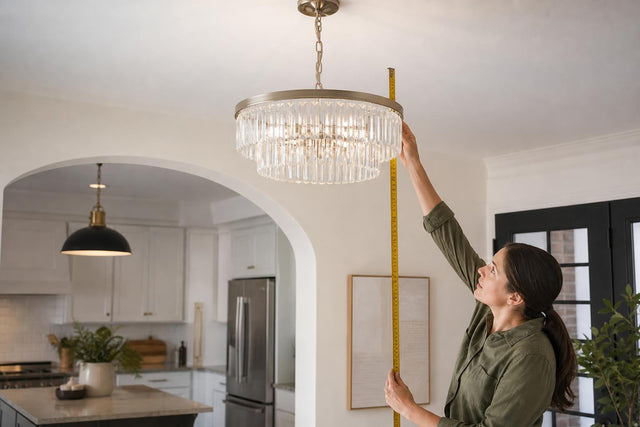
How to Determine What Size Chandelier for a Room (2026)
TL;DR
Add your room’s length and width in feet to get the ideal chandelier diameter in inches (a 12 × 14 ft room needs a 26-inch chandelier). For dining tables, the fixture should be half to two-thirds the table’s width. Allow 2.5 to 3 inches of chandelier body height per foot of ceiling height. When hanging over a dining table, keep 30 to 36 inches between the tabletop and the bottom of the fixture.
Picking a chandelier that looks right in your space isn’t guesswork. It’s arithmetic, with a bit of taste layered on top. The problem is that nearly 60% of homeowners choose the wrong chandelier size for their room, and the overwhelming majority of them buy too small. A chandelier that’s undersized for its room looks like an afterthought. One that’s properly proportioned transforms the entire space.
This guide covers the three formulas you need, room-by-room specifics, and the practical considerations that matter most in Indian homes, from false ceiling anchors to ceiling fan placement.
Browse chandeliers sized for Indian rooms to see how diameter and height specs translate into real fixtures.
What “Chandelier Size” Actually Means
Before running any formula, you need to understand what you’re measuring. Chandelier “size” involves three distinct dimensions that product listings often blur together:
Diameter (width): The horizontal measurement from one side to the other. This is what determines whether the chandelier feels proportional to your room or table.
Fixture height (body height): The vertical measurement of the chandelier itself, from the top of the frame to the lowest hanging element. This does NOT include the chain, rod, or canopy.
Drop length: The total distance from the ceiling to the very bottom of the chandelier, including the suspension hardware. This is what determines clearance.
Getting the diameter right but the height wrong (or vice versa) is a common trap. A chandelier can be the perfect width for your dining room but hang so low it blocks sightlines across the table, or sit so high it looks disconnected from the space below. You need to calculate both.
For a broader look at material choices, color temperatures, and style decisions beyond sizing, read our guide on choosing the perfect chandelier for Indian living spaces.
The Room Diameter Formula: Your Starting Point
This is the foundational rule for how to determine what size chandelier for a room. Every major lighting resource, from Lightopia to Kichler, uses some version of it:
Room length (ft) + Room width (ft) = Ideal chandelier diameter (inches)
So a standard Indian living room measuring 12 × 14 feet calls for a chandelier about 26 inches (66 cm) in diameter. Simple.
Quick-Reference Table: Indian Room Sizes
Room Type |
Typical Size |
Formula Result |
Recommended Diameter |
|---|---|---|---|
Compact bedroom |
10 × 12 ft |
22 inches |
50 to 56 cm |
Standard living room |
12 × 14 ft |
26 inches |
65 to 70 cm |
Large living room |
14 × 16 ft |
30 inches |
75 to 80 cm |
Dining room (6-seater) |
12 × 12 ft |
24 inches |
60 to 65 cm |
Grand living room |
15 × 20 ft |
35 inches |
85 to 90 cm |
Foyer |
8 × 8 ft |
16 inches |
40 to 45 cm |
Double-height villa |
20 × 18 ft |
38 inches baseline |
105 to 125 cm (scaled up) |
Two Modifiers That Change the Math
The formula is a starting point, not a rigid rule. Two factors can push you above or below the baseline number.
Visual weight. An open-frame or minimalist ring chandelier appears lighter than its actual diameter suggests. You can safely go 10 to 15% wider with airy designs. A dense crystal cascade, on the other hand, commands more visual space than its measurements imply. Stay at or slightly below the formula number for heavy-looking fixtures. As Kathy Kuo Home notes, for smaller chandeliers you should lean visually heavy, while large chandeliers that require more bulbs benefit from a lighter, airier design.
Furniture density. A room packed with large sofas, bookshelves, and cabinets already has a lot of visual activity. Going one size down prevents the room from feeling cluttered. A sparsely furnished room with high ceilings can handle a chandelier slightly larger than the formula suggests.
To see how this works with real fixtures, the Prism chandelier comes in D600mm, D800mm, and D1000mm, which maps neatly to compact bedrooms, standard living rooms, and large formal spaces.
The Table Formula: Sizing for Dining Rooms
Dining rooms are the one space where you need a second formula. The room formula tells you what the space can handle; the table formula tells you what looks right hovering over your meals.
Chandelier diameter = ½ to ⅔ of the dining table’s width (or diameter)
For round tables specifically, keep the chandelier diameter at no more than half the table’s diameter. A 48-inch round table means a fixture no wider than 24 inches.
Dining Table Sizing Chart
Table Type |
Table Dimensions |
Recommended Chandelier Size |
|---|---|---|
4-seater round |
90 to 100 cm diameter |
45 to 65 cm diameter |
6-seater rectangular |
160 to 180 × 90 cm |
80 to 120 cm (linear) or 60 to 65 cm (round) |
8-seater rectangular |
200 to 220 × 100 cm |
100 to 110 cm (linear) |
10 to 12-seater |
260 to 300 × 110 cm |
120 to 150 cm (linear) |
Linear Chandeliers for Rectangular Tables
If you’re considering a linear chandelier (increasingly popular over long dining tables), the length should be one-third to one-half the length of the table. A 180 cm table pairs well with a linear fixture between 60 and 90 cm long. This keeps the chandelier from overwhelming the table while maintaining visual balance with the room.
Extendable Dining Tables
For extendable tables, center the chandelier over the table at its most-used length. If you regularly use it in both the compact and extended positions, center the fixture over the midpoint. No ranking article in India addresses this, but it’s a real-world scenario in countless apartments where a 4-seater extends to seat 6 during gatherings.
Center Over the Table, Not the Room
This mistake is more common than you’d think. Center the chandelier over the dining table, even if the table isn’t centered in the room. If the electrical box sits at the room’s geometric center but your table is offset toward one wall, the fixture will look misaligned with the table. A swag kit can relocate the drop point 6 to 18 inches without rewiring.
For smaller dining zones where a full chandelier might overwhelm the space, pendant lights offer a scaled-down alternative that follows the same sizing principles.
The Chandelier Height Formula
Width gets all the attention, but height mistakes are actually more common and harder to fix after installation. Here’s the formula:
Ceiling height (ft) × 2.5 to 3 = Fixture body height (inches)
Ceiling Height |
Recommended Body Height |
|---|---|
9 ft (standard Indian apartment) |
22 to 27 inches (56 to 69 cm) |
10 ft |
25 to 30 inches (64 to 76 cm) |
12 ft |
30 to 36 inches (76 to 91 cm) |
16 to 20 ft (double-height) |
48 to 60 inches (122 to 152 cm) |
Clearance Rules You Cannot Ignore
Two non-negotiable clearance numbers apply to every chandelier installation:
In traffic areas: The bottom of the chandelier must hang at least 7 feet (213 cm) from the floor. This applies to foyers, hallways, and any room where people walk underneath the fixture.
Over dining tables: Maintain 30 to 36 inches (70 to 80 cm) between the tabletop and the bottom of the chandelier. This height provides focused, flattering light on the table without blocking sightlines for seated guests.
The Math for Standard Indian Ceilings
With a 9-foot ceiling (the norm in most newer Indian apartments), subtract 7 feet of walking clearance. That leaves roughly 2 feet for the entire fixture, including chain or rod. This means you need a compact chandelier body and a shortened chain. For ceilings this height, flush-mount or semi-flush chandeliers are often the smartest choice.
For every additional foot of ceiling height above 8 feet, you can add about 3 inches to the chandelier’s overall height.
Room-by-Room Sizing Guide
How to determine what size chandelier for a room depends partly on which room you’re working with. The formulas above provide the math, but each space has its own practical considerations.
Living Room
Use the room diameter formula. Anchor the chandelier over the primary seating area, not the geometric center of the room. A standard Indian living room of 12 × 14 feet works well with a chandelier around 65 to 70 cm (approximately 26 inches) in diameter, which is close to the 800mm benchmark that lighting specialists recommend for Indian rooms of this proportion.
Layer the chandelier with wall lights for ambient depth rather than relying on a single overhead source. The chandelier provides the room’s visual anchor; wall sconces fill in the shadows.
Dining Room
Apply the table formula first, then verify it against the room formula. If the two numbers conflict (the table formula suggests 24 inches but the room formula says 20), prioritize the table formula. The table is the focal point; the chandelier serves it.
Foyer and Entryway
The room formula applies here, but foyers are where you can be bolder. This is the first fixture guests see. A foyer chandelier can sit at the top of your formula range or even slightly above it. For a compact 8 × 8 ft foyer, that means 16 inches or roughly 40 to 45 cm.
Bedroom
Go slightly smaller than the formula suggests. Bedrooms are intimate spaces, and an oversized chandelier can feel oppressive overhead. For a standard 10 × 12 ft bedroom, a 22-inch (50 to 56 cm) diameter chandelier works well. Center the fixture over the bed or in the middle of the room. Flush and semi-flush styles work best with standard 9-foot ceilings.
Bathroom
Small bathrooms (5 × 8 ft) can handle mini chandeliers around 13 inches in diameter. The critical requirement here is a moisture-rated fixture, especially if it’s installed near a shower or tub. Center over the tub or vanity area and maintain the standard 7-foot floor clearance.
Double-Height and Stairwell Spaces
Double-height ceilings (typically 18 to 24 feet in Indian duplex villas) demand a different approach. Start with the room diameter formula, then scale up 10 to 30% depending on the ceiling height and the fixture’s visual weight. A 20 × 18 ft room with a 20-foot ceiling produces a 38-inch baseline that often becomes 42 to 50 inches in practice.
For body height in double-height spaces, the chandelier should be one-third to one-half of the total ceiling height. A 20-foot ceiling can accommodate a chandelier body of 5 to 7 feet tall. Always maintain at least 7 feet (preferably 8 to 9 feet) of clearance from the floor.
Cascading and tiered designs work particularly well in vertical spaces. The Volver chandelier is one example of a statement fixture designed to fill dramatic vertical volumes.
For more detailed guidance on tall spaces, our double-height ceiling lighting guide and two-story foyer chandelier ideas cover installation specifics and safety considerations.
Indian Home Considerations
Figuring out what size chandelier works for a room gets more nuanced when you factor in the realities of Indian construction and living patterns.
Standard Ceiling Heights
Most newer Indian apartments have 9 to 10-foot ceilings. Duplex villas and independent houses may run 16 to 22 feet in double-height sections. This means the majority of Indian homeowners are working with relatively tight vertical clearance, which makes the height formula and clearance rules even more important.
False Ceiling Structural Anchors
This is the single most overlooked installation detail in Indian homes. Most Indian residences have POP (plaster of Paris) or gypsum false ceilings. These materials cannot bear the weight of a chandelier on their own, especially crystal or metal fixtures that can weigh 10 to 20 kg or more.
Before installing any chandelier, a structural anchor must be installed through the false ceiling into the concrete slab above. Ask your electrician or contractor to confirm this before purchasing the fixture. Skipping this step risks the chandelier pulling away from the ceiling, which is both a safety hazard and a costly repair.
Ceiling Fan and Chandelier Coexistence
In most Indian homes, the ceiling fan isn’t optional. The question isn’t whether to have a fan, but how to make it coexist with a chandelier.
The practical solution: place the chandelier over the dining table or a specific seating zone, and keep the ceiling fan in the main living area with adequate clearance from the fan blades. For rooms with 8 to 9-foot ceilings where both a fan and a decorative light compete for space, use semi-flush or low-profile chandelier designs that sit close to the ceiling.
Open-Plan Layouts
For L-shaped or open-plan living-dining areas, calculate the chandelier size for the primary zone (seating area or dining table), not the total floor area. Sizing for the entire open-plan space will give you an absurdly large number. Instead, consider two separate fixtures, one for the living zone and one for the dining zone, each sized to its own area.
Metric Conversions
Indian buyers tend to think in both feet and centimeters depending on context. Rooms are discussed in feet, furniture dimensions in centimeters, and product specs vary between brands. The tables throughout this guide include both systems to eliminate conversion errors.
230V Electrical Compatibility
If you’re sourcing a chandelier internationally or from a marketplace with mixed listings, verify that the fixture is rated for 230V, which is standard in India. Chandeliers designed for 110V markets (like the US) will require a step-down transformer and may void warranties.
Common Chandelier Sizing Mistakes
1. Buying Too Small
This is the number one error. According to industry data, nearly 60% of homeowners choose the wrong size, and the vast majority go too small. Professional lighting specifiers at Hammerton Studio confirm that undersized fixtures are among the most common specification mistakes, particularly in large interiors where an undersized chandelier feels disconnected from the architecture.
The practical rule: if your calculations put you between two sizes, go with the larger one. It almost always creates a more impactful result.
2. Getting the Width Right but the Height Wrong
Plenty of buyers nail the diameter formula but forget to check whether the fixture’s body height works with their ceiling. A 26-inch-wide chandelier with a 36-inch body and another 12 inches of chain won’t fit comfortably in a 9-foot ceiling room.
3. Centering Over the Room Instead of the Table
Already covered above, but worth repeating as a mistake. The chandelier follows the table, not the ceiling junction box.
4. Skipping the False Ceiling Structural Check
Especially dangerous with heavy crystal chandeliers. No POP or gypsum surface can support significant weight without anchoring into the concrete slab.
5. Trusting Showroom Impressions
Lighting showrooms typically have 12 to 16-foot ceilings with carefully designed ambient lighting. A chandelier that looked “just right” in the showroom may look undersized in your living room with a 9-foot ceiling, or overwhelm a compact bedroom. Always run the formulas before visiting a showroom.
6. Ignoring Visual Weight Differences
Two chandeliers with identical 30-inch diameters can look completely different in the same room if one is a skeletal open ring and the other is a multi-tier crystal cascade. Factor in how dense or airy the design looks, not just the spec sheet dimensions.
How to Validate Before You Buy
Formulas give you a target number. But before committing to a purchase, validate that number in your actual space.
The Tape-and-Cardboard Mockup
Cut a piece of cardboard to the chandelier’s diameter. Tape it to a string at the planned drop length and hold it in position. Step back. Look at it from the doorway, from the sofa, from a dining chair. Does it feel right? This 10-minute exercise has saved countless returns.
Check the Full Spec Sheet
Before ordering, verify both the diameter and fixture body height on the product page. Confirm the chain or rod length and whether it’s adjustable. Many chandeliers ship with excess chain that can be shortened during installation.
Dimmer Compatibility
If the chandelier uses LED bulbs, confirm the fixture is compatible with a dimmer switch. Not all LED drivers work with standard dimmers, and a non-compatible pairing can cause flickering or buzzing.
Lighting Metrics Worth Checking
Beyond size, a few specs affect how the chandelier performs:
Lumens: Plan 20 to 30 lumens per square foot for living and dining rooms. A 168 sq ft living room needs roughly 3,400 to 5,000 lumens total across all light sources.
CRI (Color Rendering Index): A CRI of 90 or higher makes food, fabrics, and art look true to life. Lower CRI bulbs wash out colors.
Color temperature: 2700K to 3000K provides the warm, welcoming tone that works best in most Indian residential settings. Pair with dimmers for flexibility between bright task lighting and soft ambient glow.
Book a Free Consultation
If you want expert guidance on sizing, placement, or layering before making a decision, ALC Studio offers free design consultations (virtual or in-store at showrooms in Delhi and Lucknow).
Explore all lighting collections to browse fixtures with full size specifications.
Frequently Asked Questions
What is the formula to determine what size chandelier for a room?
Add the room’s length and width in feet. The sum, converted to inches, is your ideal chandelier diameter. For a 12 × 14 ft room, that’s 26 inches (about 66 cm). Adjust slightly based on furniture density and the chandelier’s visual weight.
How low should a chandelier hang over a dining table?
The bottom of the chandelier should be 30 to 36 inches (70 to 80 cm) above the table surface. This ensures comfortable sightlines across the table while keeping the light focused on the dining area.
What size chandelier do I need for a 10 × 12 ft bedroom?
The formula gives you 22 inches (about 56 cm). For bedrooms, this is a good ceiling to stick to rather than sizing up. Flush-mount or semi-flush styles work best with standard 9 to 10-foot Indian ceilings.
Can I hang a chandelier in a room with a ceiling fan?
Yes, but you need to treat them as serving different zones. Place the chandelier over the dining table or a specific seating area and keep the fan in the main living area. For ceilings below 9 feet, choose semi-flush or low-profile chandelier designs to avoid crowding.
How do I size a chandelier for a double-height room?
Start with the standard room formula (length + width = diameter in inches), then scale up by 10 to 30%. For body height, aim for one-third to one-half of the total ceiling height. A 20-foot ceiling can handle a fixture body of 5 to 7 feet. Our double-height chandelier guide covers this in detail.
Should I size the chandelier to the room or the dining table?
For dining rooms, size to the table first, then verify against the room formula. The table formula (half to two-thirds the table width) takes priority because the chandelier’s visual relationship with the table is what people notice most.
What if my chandelier calculations fall between two available sizes?
Go with the larger size. Undersized chandeliers are the most common mistake in home lighting. A slightly larger fixture almost always looks more intentional and polished than one that’s a touch too small.
Do I need a structural anchor for a chandelier on a false ceiling?
Absolutely. POP and gypsum false ceilings cannot support chandelier weight on their own. A structural anchor must pass through the false ceiling into the concrete slab above. Have your electrician confirm this before installation, not after you’ve already bought the fixture. If something goes wrong, check ALC Studio’s returns and replacements guide for next steps.
0 Comments
There are no comments for this article. Be the first one to leave a message!