
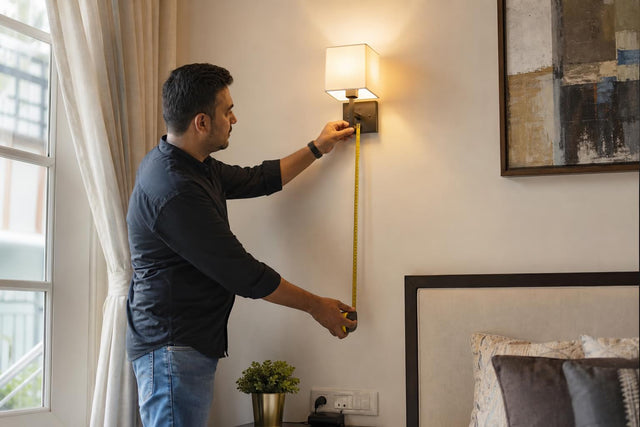
Wall Light Installation Height 2026: Room-by-Room Guide
TL;DR
The standard wall light installation height is 150 to 168 cm (60 to 66 inches) from the floor to the center of the fixture. Bedside reading lights are the major exception, sitting much lower at 90 to 110 cm (35 to 43 inches). Indian homes with 9 to 10 foot ceilings should add 5 to 8 cm above the standard Western baseline. Always measure to the fixture’s center point, not its top or bottom edge.
Getting wall light installation height right is one of those details that separates a room that feels polished from one that feels slightly off. Mount a sconce too high and it washes light uselessly toward the ceiling. Mount it too low and it throws glare directly into your eyes. The difference between “correct” and “wrong” is often just a few inches, which makes this one of the most important measurements in any lighting plan.
This guide gives you the exact numbers for every room, calibrated for Indian ceiling heights rather than the 8-foot Western defaults that most guides assume.
Browse wall lights at ALC Studio to see how different fixture shapes affect your placement decisions.
What “Wall Light Installation Height” Actually Means
Wall light installation height refers to the vertical distance from the finished floor to the center of the wall-mounted fixture. Not the top. Not the bottom. The center.
This distinction matters more than most people realize. A tall vertical sconce, for example, could be 40 cm or more from top to bottom. If you measure to the top edge and mark 66 inches, the actual light source might end up at 58 inches, changing how the fixture performs in the space. Multiple practitioner guides and electrician forums flag this as one of the most common measurement errors homeowners make.
The universal default, agreed upon across virtually every lighting guide and electrical code reference, is 150 to 168 cm (60 to 66 inches) from the floor to the fixture center. This range places the light roughly at eye level for most adults, balancing illumination quality with glare prevention.
The broader acceptable range stretches to 183 cm (72 inches), particularly in rooms with taller ceilings or in hallways where you want light spread higher up the wall.
If you’re planning to handle the full installation yourself, our step-by-step sconce installation guide walks through the wiring and mounting process for Indian homes.
Why Installation Height Matters So Much
Three things go wrong when wall light height is off:
Glare. A fixture mounted too low puts the light source directly in the sightline as you walk through a room or sit on a sofa. Modern LED wall lights can be particularly harsh because they produce concentrated, directional light rather than the diffused glow of older incandescent bulbs. Practitioners on electrical forums note that with today’s LED brightness, mounting slightly higher (around 72 inches) often prevents glare better than the old 60-inch standard.
Unflattering shadows. This is most obvious in bathrooms, where a poorly placed wall light casts shadows under the eyes, nose, and chin. But it happens in living rooms too. A wall light mounted too high creates a pool of light on the ceiling and leaves the lower half of the room in relative darkness.
Visual proportion. A wall light is a visible design element, not just a light source. Mounted at the wrong height, it throws off the visual balance of the wall, making furniture look squat or ceilings look lower than they are. The height at which a wall light sits directly affects whether it reads as intentional or accidental.
Light Direction Changes the Equation
One nuance that most guides skip: the type of fixture affects the ideal wall light installation height.
- Uplighters (directing light toward the ceiling) can sit slightly lower, around 150 to 165 cm. Since the light goes up, there’s minimal glare risk even at lower mounting points.
- Downlighters should sit higher, around 170 to 183 cm, to keep the directed beam out of the direct sightline.
- Bidirectional fixtures (light both up and down) work best at about 170 cm (5.6 feet), which balances the two light outputs.
Understanding how wall lights fit into a broader ambient lighting plan makes these placement decisions much easier.
Room-by-Room Wall Light Installation Height Guide
This is where the general rule starts to fracture. Every room has different furniture, different activities, and different lighting needs. Here are the specific numbers.
Bedroom: Bedside Reading Lights
This is the single biggest mistake people make with wall light installation height. They take the 60 to 66 inch hallway rule and apply it to their bedside sconces, ending up with a reading light that sits far above their head when they’re propped up in bed.
Bedside reading sconces should be mounted 90 to 110 cm (35 to 43 inches) from the floor. A more intuitive way to think about it: the fixture center should sit roughly 15 to 30 cm (6 to 12 inches) above the top of your mattress. This places the light just above shoulder height when you’re sitting up, keeping the beam useful for reading without shining directly into your eyes or your partner’s.
The exact number depends on your headboard and mattress height. Measure the distance from the floor to the top of your pillow stack, then add about 15 cm. That’s your target.
Bedroom: Ambient or Decorative Wall Lights
If the wall light isn’t next to the bed and serves a purely decorative or ambient purpose, the standard 165 to 178 cm (65 to 70 inches) applies. These are typically placed flanking a mirror, artwork, or a dresser.
Living Room
The optimal height for living room wall sconces is 150 to 183 cm (60 to 72 inches). The critical test: neither the top of the sconce nor the bare bulb should be visible to someone seated on the sofa. If you can see the light source from your usual sitting position, the fixture is too low.
For living rooms with artwork or architectural features, align the sconce center with the artwork’s midpoint or slightly above it. This creates a visual connection between the light and what it’s illuminating.
Hallway and Entryway
Mount hallway sconces at 168 to 183 cm (66 to 72 inches) from the floor. This is deliberately higher than the living room range because people are standing and walking in hallways. A higher mounting point spreads light more broadly and avoids the problem of glare at close range as someone walks past.
For spacing, place wall lights approximately 1.8 to 2.4 metres (6 to 8 feet) apart along the hallway. Consistent spacing creates rhythm and prevents dark spots between fixtures.
For grand foyers with high ceilings, you can push up to 198 cm (78 inches). If you’re pairing wall sconces with a statement chandelier in a two-story foyer, our guide to 2-story foyer chandelier ideas covers how to layer the two fixture types.
Bathroom: Beside the Mirror
Bathroom wall light placement is less forgiving than any other room because it directly affects how faces look in the mirror.
Side sconces flanking a vanity mirror should be mounted at 150 to 178 cm (60 to 70 inches), approximately at eye level. The ideal spacing between two side sconces is 91 to 102 cm (36 to 40 inches) center to center. This arrangement minimizes facial shadows by lighting both sides of the face evenly.
For details on the mounting hardware itself, the vanity light mounting plate guide covers bracket types and installation steps.
Bathroom: Above the Mirror
When mounting a light fixture above the mirror (instead of flanking it), the standard height is 190 to 203 cm (75 to 80 inches) from the finished floor. Leave a gap of roughly 5 to 10 cm between the top of the mirror frame and the bottom of the fixture.
One important note for bathroom installations: fixtures must carry an appropriate IP rating for wet or damp locations. IP44 is the minimum for most bathroom zones in India.
Staircase
Staircase wall light installation height follows the general 150 to 168 cm (60 to 66 inches) rule, but with a critical difference: measure from the stair tread directly below the fixture, not from the ground floor. Every fixture on the staircase wall references its own tread, which means each sconce sits at a different absolute height from the building’s floor level but maintains consistent visual height relative to someone standing on that step.
Space staircase sconces 1.8 to 2.4 metres apart along the wall. For fixtures that direct light both upward and downward, installing at around 170 cm (5.6 feet) above the tread provides the best balance.
Double-Height Spaces
Indian apartments and villas increasingly feature double-height living rooms where standard height rules produce undersized results. For these spaces, use 183 to 198 cm (72 to 78 inches) as the baseline. The extra height maintains visual proportion with the taller walls while keeping light at a useful level rather than losing it into the void above.
For a deeper look at lighting these challenging spaces, see our double-height ceiling lighting ideas guide.
Adjusting for Indian Ceiling Heights
Most wall light installation height guides originate from the US or UK, where the standard residential ceiling is 8 feet (244 cm). Indian homes are different. As per the National Building Code (NBC) of India, the minimum clear height for habitable rooms should not be less than 9 feet. Ground floors in many Indian homes sit at 9 to 10 feet, with upper floors typically at 8 to 9 feet.
This matters. A 60-inch sconce height that looks proportional against an 8-foot ceiling will look slightly low against a 10-foot ceiling, creating a visual gap between the fixture and the ceiling that makes the room feel unbalanced.
Indian Ceiling Height Adjustment Table
| Ceiling Height | Standard Range | Adjusted Range | Notes |
|---|---|---|---|
| 8 ft (244 cm) | 150–168 cm / 60–66" | No adjustment needed | Common on upper floors |
| 9 ft (274 cm) | 150–168 cm | 155–175 cm / 61–69" | NBC minimum for habitable rooms |
| 10 ft (305 cm) | 150–168 cm | 160–180 cm / 63–71" | Common ground floor height |
| Double-height (18–20 ft) | N/A | 183–198 cm / 72–78" | Layer with ceiling fixtures |
The rule of thumb: add 5 to 8 cm (2 to 3 inches) for every foot of ceiling height above the 8-foot baseline.
The False Ceiling Factor
Many Indian homes have false ceilings (drop ceilings) that reduce effective room height by 10 to 15 cm (4 to 6 inches). When calculating wall light height in a room with a false ceiling, measure from the finished floor to the bottom of the false ceiling, not the structural slab. If a 10-foot room has a 15 cm false ceiling drop, you’re working with an effective height of about 290 cm, and your sconce height should be calibrated accordingly.
This is a point that no competing guide addresses, yet it’s common enough in Indian interiors to affect thousands of installations.
Indian Electrical Context
Indian homes run on 220 to 240V, which is different from the 110V systems that many US-based installation guides assume. Wire colour codes also differ. For any hardwired wall light installation, hiring a licensed electrician is not just recommended, it’s essential for safety. The junction box, which sits behind the fixture and contains the wiring connections, is typically installed at the same height as the fixture center, so this decision needs to be made before walls are plastered or finished.
Common Mistakes to Avoid
1. Mounting too high in standard-height rooms. This is the most common error, according to multiple practitioner sources. In rooms with 8 to 9 foot ceilings, anything above 72 inches creates a “floating” effect where the light feels disconnected from the living space below.
2. Using hallway height for bedside reading lights. As discussed above, the 60 to 66 inch rule produces terrible bedside reading light. Drop to 35 to 43 inches for bedside sconces.
3. Measuring to the fixture top instead of center. The installation height always refers to the center of the fixture. For tall sconces, this difference can be 15 to 20 cm.
4. Ignoring furniture relationships. A wall light should relate visually to the furniture below it. Flanking sconces beside a bed should be centered on the headboard width. Sconces beside a mirror should align with the mirror’s vertical center. A sconce floating in empty wall space above a console table should sit about 15 to 20 cm above the tallest object on the table.
5. Not testing with a mock-up before drilling. This is one of the most repeated tips across practitioner content, and for good reason. Cut a piece of paper to the size of your chosen fixture and tape it to the wall with painter’s tape. Live with it for a day or two. Look at it from sitting and standing positions, during the day and at night. This costs nothing and prevents regret.
6. Mismatching paired sconces. When installing sconces in pairs (flanking a mirror, bed, or fireplace), even a 1 cm difference in height between the two is visible and distracting. Use a laser level, not a tape measure and eyeballing.
Quick-Reference Summary Table
| Room | Height (cm) | Height (inches) | Key Note |
|---|---|---|---|
| Bedroom (reading) | 90–110 | 35–43 | 15–30 cm above mattress top |
| Bedroom (ambient) | 165–178 | 65–70 | Standard eye-level rule |
| Living room | 150–183 | 60–72 | Bulb should not be visible from sofa |
| Hallway/entryway | 168–183 | 66–72 | Space fixtures 1.8–2.4 m apart |
| Bathroom (side of mirror) | 150–178 | 60–70 | Eye level for shadow-free lighting |
| Bathroom (above mirror) | 190–203 | 75–80 | 5–10 cm gap above mirror frame |
| Staircase | 150–168 above tread | 60–66 above tread | Measure from tread, not ground floor |
| Foyer/double-height | 183–198 | 72–78 | Layer with chandelier above |
This table covers the standard ranges. Adjust upward by 5 to 8 cm for Indian ceilings above 8 feet.
Glossary of Related Terms
Wall sconce vs. wall light: Technically, a “wall sconce” traditionally refers to a fixture with an exposed light source, while a “wall light” has the source covered (usually by glass or a shade). In practice, the terms are used interchangeably.
Junction box height: The electrical box recessed into the wall where wiring connects to the fixture. It should be positioned at the same height as the fixture center, meaning this decision must be made during the rough electrical stage, before plastering.
AFF (Above Finished Floor): The measurement convention used in architectural drawings. All heights in this guide are AFF unless stated otherwise.
Fixture center point: The vertical midpoint of the fixture body, used as the reference for all installation height measurements.
IP rating: Ingress Protection rating that indicates a fixture’s resistance to water and dust. IP44 is the minimum for most bathroom zones. IP65 or higher is needed for fixtures exposed to direct water spray.
CCT (Correlated Colour Temperature): Measured in Kelvin. For wall lights in Indian homes, 2700K to 3000K (warm white) suits bedrooms and living rooms, while 4000K (neutral white) works better for bathrooms and task areas.
Choosing the Right Fixture for Your Height
Once you know the correct wall light installation height for your room, the next step is picking a fixture that works at that height. A few considerations:
- For bedside reading: Choose a fixture with an adjustable head or directional light output so you can aim the beam at your book, not across the room.
- For hallways at 66 to 72 inches: Flat-profile sconces that project less than 10 cm from the wall prevent head-bump hazards. For accessibility contexts (commercial spaces or homes with wheelchair users), sconces above 80 inches or projecting less than 4 inches from the wall meet ADA guidelines.
- For bathrooms: Select fixtures with appropriate IP ratings and consider whether side-mounted or top-mounted placement better suits your mirror size.
Explore ALC Studio’s wall light collection to find fixtures that match your room’s height requirements and style.
Frequently Asked Questions
What is the standard wall light installation height?
The standard height is 150 to 168 cm (60 to 66 inches) from the finished floor to the center of the fixture. This range works for most rooms and places the light at approximately eye level for standing adults. For rooms with ceilings above 8 feet (common in Indian homes), add 5 to 8 cm for visual proportion.
Should bedside wall lights be at the same height as hallway sconces?
No. This is the most common installation mistake. Bedside reading wall lights should be mounted at 90 to 110 cm (35 to 43 inches) from the floor, which is roughly 15 to 30 cm above the mattress top. The standard 60 to 66 inch height puts bedside lights far too high to be useful for reading in bed.
How do I measure wall light installation height correctly?
Always measure from the finished floor to the center of the fixture, not the top or bottom edge. For tall vertical sconces, this distinction can shift the actual mounting point by 15 to 20 cm. Use a laser level for accuracy, especially when installing paired sconces.
Does ceiling height affect where I should mount wall lights?
Yes. The standard 60 to 66 inch range assumes 8-foot ceilings. Indian ground floors typically have 9 to 10 foot ceilings, which means sconces can (and should) be mounted 5 to 8 cm higher to maintain visual balance. Rooms with false ceilings should be measured from floor to the bottom of the drop ceiling, not the structural slab.
How far apart should wall lights be in a hallway?
Space hallway wall lights 1.8 to 2.4 metres (6 to 8 feet) apart. This creates even light distribution without dark spots between fixtures. In very long hallways, consistent spacing matters more than hitting an exact number.
What height should bathroom wall lights be?
For sconces flanking a vanity mirror, mount at 150 to 178 cm (60 to 70 inches), at eye level. For a fixture above the mirror, aim for 190 to 203 cm (75 to 80 inches). Side placement is generally preferred because it eliminates the harsh facial shadows that top-mounted lights create.
How do I test wall light height before drilling?
Cut a piece of paper or cardboard to match the dimensions of your chosen fixture. Tape it to the wall with painter’s tape at your planned height. Live with it for a day or two, checking how it looks from different positions, both sitting and standing, during the day and at night. Adjust as needed before committing to any holes in the wall.
Do I need an electrician to install wall lights in India?
For hardwired wall lights, yes. Indian homes operate on 220 to 240V with specific wire colour codes that differ from US and UK standards. A licensed electrician ensures safe connections at the junction box and compliance with local electrical codes. Plug-in wall lights with a cord and plug are the only type that can be safely self-installed without electrical work.
0 Comments
There are no comments for this article. Be the first one to leave a message!