
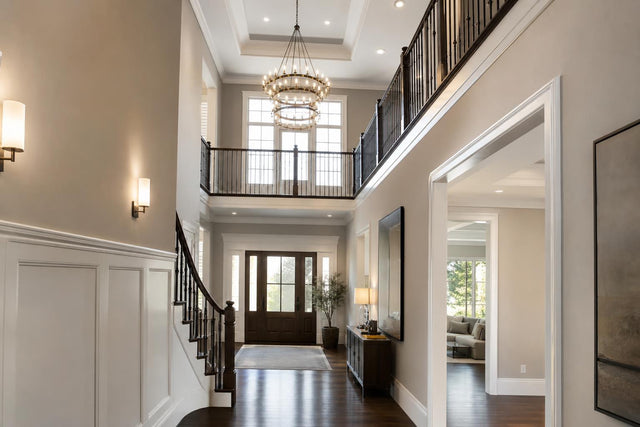
2 Story Foyer Lighting Ideas: 2026 Size, Height & Layers
TL;DR
Two-story foyers (16 to 20+ foot ceilings) need more than a single chandelier. The right approach combines a statement fixture sized using the L+W diameter formula (plus 20 to 30% for high ceilings), wall sconces at mid-height, recessed downlights, and often cove lighting around the perimeter. Warm white (2700 to 3000K) is the right color temperature, and undersizing is the most common mistake homeowners make.
A two-story foyer changes everything about how you choose lighting. The rules you followed for an 8-foot ceiling bedroom or a standard living room simply do not apply when your entryway soars to 18 feet. Light behaves differently. Proportions shift. A fixture that looked massive in the showroom can shrink to near-invisibility once it’s hanging in all that vertical space.
This guide covers every fixture type, sizing formula, and technical concept you need to confidently choose lighting for a double-height entryway, whether you’re building a new villa, renovating a duplex, or moving into one of the premium apartments with double-height entries now common across Mumbai, Delhi NCR, Bengaluru, and Hyderabad.
If you’re exploring statement fixtures for these spaces, cascade pendant designs like the Dew Drops are purpose-built for tall foyers.
Core Concepts You Need to Understand First
Before looking at specific fixtures, get these foundational ideas right. They determine whether your foyer lighting will look intentional or accidental.
What Counts as a Two-Story Foyer
A two-story foyer is an entrance hall with ceiling heights ranging from 16 to 20+ feet. Standard rooms sit at 8 to 10 feet. Some ceilings as low as 14 feet can feel double-height depending on the room’s width, but the 16 to 20 foot range is the true two-story territory.
This distinction matters because the volume of air between your fixture and the floor is enormous. Light loses intensity as it travels, fixtures appear smaller than expected, and every design choice gets amplified, both good and bad.
Double-Height Ceiling vs. Vaulted vs. Cathedral
These terms get used interchangeably, but they describe different structures. A double-height ceiling is flat (or nearly flat) at the top, simply elevated to the equivalent of two stories. A vaulted ceiling angles upward, often following the roofline. A cathedral ceiling peaks at a central ridge.
Why it matters for lighting: a flat double-height ceiling gives you a consistent mounting point and predictable fixture drop length. Vaulted or cathedral ceilings may require angled mounting hardware and change how light reflects back into the room.
Visual Weight: Why the Same Fixture Looks Different at 9 Feet vs. 18 Feet
Visual weight describes how much presence a fixture commands in a space. A 24-inch chandelier in a standard room feels substantial. Hang that same fixture in a two-story foyer, and it looks like an afterthought floating in empty space.
This is the concept behind nearly every sizing mistake homeowners make. You need fixtures with strong visual weight that can hold their own against 16 to 20 feet of vertical volume.
Dual Viewing Angles
People see your foyer lighting from three positions: standing on the entry floor looking up, midway up the staircase looking across, and from the second-story landing looking down. A fixture that looks beautiful from below but shows an ugly canopy from above fails the dual viewing angle test. Choose fixtures designed to look intentional from every sightline, not just from the front door.
Light Layering: The Non-Negotiable System
A single chandelier, no matter how grand, rarely fills a two-story foyer adequately on its own. High-ceiling foyers need multiple lighting layers working together:
- Layer 1: Central chandelier or pendant as the focal anchor
- Layer 2: Wall sconces flanking the entry door at 60 to 72 inches from the floor
- Layer 3: Additional sconces along side walls, especially for foyers wider than 12 feet
- Layer 4: Recessed downlights across the ceiling, spaced roughly 6 feet apart
For detailed guidance on where to mount sconces in tall spaces, see this wall light installation height guide.
Fixture Types That Work in Two-Story Foyers
Most guides on 2 story foyer lighting ideas focus exclusively on chandeliers. That’s a mistake. The keyword is “lighting ideas,” plural, and the best foyer designs combine multiple fixture types. Here’s what each one is, why it works, and when to use it.
Tiered / Multi-Tier Chandelier
A multi-tier chandelier stacks two or more rings or levels of lights vertically. This vertical repetition naturally fills the height of a double-height space, creating rhythm as the eye travels up. If you have the ceiling height for it (18+ feet), a three-tier design is almost always more proportional than a single-tier one.
When to use it: Traditional to transitional foyers where you want unmistakable grandeur. Also works in contemporary settings if the tiers are clean-lined.
Crystal / Rain Chandelier
Crystal drops or glass strands hang in a rain-like curtain arrangement, creating a vertical column of refracted light. These are high-drama fixtures that draw the eye upward through the full height of the foyer. The shimmer changes depending on your viewing angle, which makes them particularly effective in spaces with staircase sightlines.
When to use it: Foyers where you want maximum sparkle and a classic luxury feel. A crystal chandelier like the Crysta demonstrates how this style commands vertical attention.
Cascade / Waterfall Pendant
Multi-globe or staggered-drop fixtures distribute light sources at different heights along a vertical line. The linear vertical design is purpose-built for staircases and two-story foyers, providing illumination at multiple levels rather than concentrating all the light at one point. These differ from rain chandeliers in that each light source is individually visible rather than hidden behind a crystal curtain.
When to use it: Modern or minimalist foyers where you want vertical drama without the ornate quality of crystal.
Lantern-Style Pendant
A lantern pendant encloses light sources within a frame, usually with glass panels. Clear panels suit modern settings, while seeded or frosted glass adds texture for farmhouse or transitional entryways. Lanterns provide a sense of architectural structure that complements foyers with strong molding or stonework.
When to use it: Transitional, colonial, or farmhouse-style entries. Also surprisingly effective in modern Indian villa foyers when done in matte black or brushed brass. Pendant fixtures like the Rhode show how this form works in contemporary spaces.
Geometric / Modern Chandelier
Modern chandeliers built from geometric shapes (cubes, spheres, interlocking rings) bring visual weight without ornate detailing. The key is choosing designs substantial enough for the scale. Ultra-minimal single-ring pendants tend to disappear in double-height spaces. Look for geometric forms with enough mass and dimension.
When to use it: Contemporary and minimalist foyers. Bridging finishes like matte black or brushed brass help these work in transitional spaces too. A geometric chandelier like the Prism illustrates the right balance of simplicity and presence.
Wall Sconces (Support Layer)
In tall rooms, wall sconces serve as a critical middle layer rather than the primary light source. They break up the dark wall expanse between the floor and the high ceiling, and they provide functional light at human scale for anyone walking through or climbing the stairs.
Mount them at 60 to 72 inches from the floor. In a foyer with a staircase, you might run sconces along the stair wall at consistent intervals. Options like wall lights such as the Caral or staircase sconce options like the Troy are designed for exactly this kind of supporting role.
Recessed Downlights
Recessed lights sit flush with the ceiling and cast directed light downward. In a two-story foyer, they supplement the chandelier by ensuring no dark zones around the perimeter. Space them at roughly half the ceiling height apart, so for a 20-foot ceiling, that’s about 10 feet between fixtures, though practical spacing often tightens to 6 to 8 feet for more even coverage.
When to use them: Every two-story foyer benefits from recessed downlights, regardless of style. They’re the workhorse layer that ensures consistent ambient light when the chandelier alone can’t reach the corners.
Cove / False-Ceiling Lighting
This one is particularly relevant for Indian homes. Almost every duplex and villa uses a false ceiling with integrated cove lighting. In a double-height room, the false ceiling typically runs around the perimeter at the standard floor level (8 to 10 feet) while the center opens up to the full height. LED strip lighting hidden in the cove creates a warm glow that defines the room’s boundaries and adds ambient light without competing with the central fixture.
When to use it: Indian duplexes and villas almost universally feature this, and it’s worth planning for. It softens the transition between the double-height center and the standard-height surrounding rooms.
Ground-Level Lighting (Table and Floor Lamps)
A tall, sculptural floor lamp or a pair of table lamps on a console near the entry door adds warmth at the human level. This is especially important in foyers where the chandelier hangs high and the sconces sit at mid-height, leaving the lowest 3 to 4 feet of the room relatively dim.
When to use them: Foyers with console tables, side tables, or niche shelves near the entry.
Sizing and Placement Formulas
Getting the right size fixture is the difference between a foyer that feels designed and one that feels like the lighting was an afterthought. These formulas give you starting points, not final answers.
Chandelier Diameter Formula
Add the length and width of your foyer in feet, then convert that number directly to inches. That’s your minimum chandelier diameter.
Example: A 10 × 12 foot foyer gives you 22 inches as a starting diameter.
For two-story ceilings above 14 feet, add 20 to 30% to that number. So that 22-inch starting point becomes 26 to 29 inches minimum. For a deeper look at chandelier math, this chandelier sizing formulas guide walks through several worked examples.
Fixture Body Height Formula
Allocate 2.5 to 3 inches of fixture height for every foot of ceiling height. An 18-foot ceiling calls for a fixture body between 45 and 54 inches tall. Two-story foyers can comfortably accommodate chandeliers up to 48 inches in body height, and many go larger.
Hanging Height Rules
The bottom of your foyer chandelier should hang at least 7 feet above the floor. Add another 6 inches (7.5 feet total) if your foyer is wider than 14 feet or the fixture is purely decorative and won’t obstruct movement.
For staircase placement, ensure the chandelier doesn’t block the view from the stairs and provides safe passage light. The bottom should sit at least 8 feet above the stair treads.
The Rule of Thirds
A useful visual check: your chandelier should fill roughly one-third of the vertical space between where it hangs and the floor. In an 18-foot foyer with the fixture bottom at 7 feet, that’s about 11 feet of open space, and the fixture body should be around 3.5 to 4 feet tall. This lines up closely with the 2.5-to-3-inches-per-foot formula.
Lumen Targets for High Ceilings
Two-story foyers need more lumens than you’d expect because light intensity drops over distance. Start with 1.5 to 2 lumens per square foot, then multiply by 1.5 for 16 to 18 foot ceilings or by 2 for 20+ foot ceilings. Most two-story foyers land in the 2,000 to 4,000 lumen range total across all layers.
The Mockup Method
Before spending money, test proportions with a low-tech mockup. Tape the chandelier’s diameter on the ceiling (or have someone hold a hoop at the right height). Hang a balloon or cardboard cutout at the planned drop length. Stand at the front door, on the stairs, and on the second-floor landing to check proportions from every viewing angle.
Worked Example: Indian Villa Foyer
A typical Indian villa foyer might measure 3 × 4 meters (roughly 10 × 13 feet) with an 18-foot ceiling.
- Diameter: 10 + 13 = 23 inches minimum, plus 25% = ~29 inches
- Fixture height: 18 × 2.75 = ~50 inches
- Hanging height: Bottom at 7 feet from floor
- Lumens needed: 130 sq ft × 2 lumens × 1.5 (high ceiling multiplier) = ~390 lumens from the chandelier, supplemented by sconces and downlights to reach 2,500+ total
For a step-by-step approach to foyer fixture sizing specifically, see this guide to choosing chandelier size for foyers.
Technical Terms That Affect Your Purchase
CCT (Correlated Color Temperature)
Measured in Kelvin (K), CCT determines whether your light feels warm and inviting or cold and clinical. For foyers, 2700 to 3000K (warm white) creates the welcoming ambiance you want. Avoid anything above 4000K.
A note specific to Indian homes: the prevalence of cool white 6500K lighting is a leftover habit from the fluorescent tube era, not a deliberate design choice. Switching to warm white in a foyer is one of the single highest-impact upgrades you can make.
CRI (Color Rendering Index)
CRI measures how accurately a light source reveals colors. Aim for CRI 90 or above in your foyer so that fixture finishes (brass, gold, matte black), wall paint, and flooring materials all render correctly. Low-CRI light makes expensive finishes look flat and cheap.
Dimmable vs. Non-Dimmable
Dimming is critical in a foyer. Full brightness for greeting guests in the evening, 30% for a warm glow when the house is quiet, completely off when daylight floods through the windows. Always verify that your fixtures and bulbs are compatible with a dimmer switch before buying. Not all LED bulbs dim smoothly.
Integrated LED
Fixtures with built-in, non-replaceable LED modules eliminate the nightmare of changing bulbs at 20 feet. Practitioners on Reddit and home improvement forums raise this constantly: changing a burned-out bulb in a two-story fixture often requires scaffolding or a professional service call. Integrated LEDs rated for 50,000+ hours essentially solve this problem for a decade or more.
Smart home integration (app or voice control for on/off and dimming) becomes especially valuable when fixtures are physically out of reach.
Junction Box Weight Rating
Standard ceiling junction boxes support about 50 pounds. Many chandeliers sized for two-story foyers weigh significantly more. Before ordering, confirm your junction box can handle the weight. You may need a 75-pound brace or a 100+ pound structural mount. This is not optional. A falling chandelier is a safety hazard, not just an aesthetic failure.
Drop Length / Adjustable Rod
Verify the maximum drop length before ordering any fixture. A chandelier designed for standard ceilings might ship with a 36-inch chain or rod, but your 18-foot foyer may need 10+ feet of drop to position the fixture correctly. Many manufacturers offer extension chains or longer rods, but you need to order them upfront.
Common Mistakes (and How to Avoid Them)
Undersizing the Fixture
This is the number one error. A Houzz community member shared a telling cautionary tale: they bought a 42-inch chandelier for a 17 × 19 foot foyer with 18-foot ceilings, and it still looked tiny. The standard formula suggested 36 inches, and even overshooting by 6 inches wasn’t enough. Their double-height ceiling demanded something closer to 48 to 54 inches.
The formulas are floors, not targets. When in doubt, go one size up.
Relying on a Single Fixture
A chandelier alone, no matter how large, leaves dark zones on the walls and at floor level in a two-story foyer. Plan your layered system from the start: chandelier plus sconces plus recessed lights. This is also why a complementary pendant like the Reims at a secondary point (near a hallway opening or above a console) can balance the room.
Ignoring Color Temperature
Mixing cool white recessed lights with a warm white chandelier creates a visually jarring effect. Choose a consistent CCT (2700 to 3000K) across every fixture in the foyer.
Not Planning for Maintenance at Height
Cleaning a chandelier at 18 feet is a real project. If you go with a traditional multi-bulb fixture, factor in the cost and logistics of bulb changes and cleaning. For practical cleaning tips, this chandelier cleaning guide covers methods that work without full disassembly.
Skipping Professional Installation
Installations above 14 feet or involving fixtures heavier than 50 pounds should be handled by a licensed electrician. The combination of height, weight, and electrical work creates real risk. Most 10 to 12 foot installations are feasible for a confident DIYer, but two-story foyers are in professional territory.
The Narrow Foyer Trap
Many two-story foyers are much taller than they are wide. Interior design practitioners note that in an 8-foot-wide foyer, you need a fixture at least 16 inches wide (double the width in feet, convert to inches). But it can’t be bulky. Many manufacturers make fixtures that are 18 to 48 inches tall but deliberately narrow for exactly these proportions.
Putting It All Together: Your 2 Story Foyer Lighting Checklist
- Measure your foyer’s length, width, and ceiling height precisely
- Run the diameter and fixture height formulas (with the high-ceiling adjustment)
- Choose your hero fixture type based on your foyer’s style
- Plan your support layers: sconces, recessed lights, cove lighting
- Verify CCT (2700 to 3000K), CRI (90+), and dimmability across all fixtures
- Test proportions with the mockup method before ordering
- Confirm junction box weight rating and available drop length
- Budget for professional installation if your ceiling exceeds 14 feet
ALC Studio offers free design consultations where you can walk through these decisions with a lighting specialist. If you want to see fixture options in person, their showrooms in Delhi (Kirti Nagar) and Lucknow allow you to evaluate scale and finish before committing. You can also explore the full collection online.
Frequently Asked Questions
What ceiling height counts as a two-story foyer?
Generally 16 to 20+ feet. Ceilings as low as 14 feet can feel double-height depending on the room’s proportions, but the standard definition starts at 16 feet, which is roughly twice the height of a typical 8-foot room.
Can I use a modern chandelier in a traditional foyer?
Yes, with care. Geometric or modern chandeliers in bridging finishes (matte black, brushed brass, antique gold) can work beautifully in traditional foyers as a contemporary contrast. The key is matching scale, not style. A modern fixture that fills the vertical space appropriately will look more intentional than a traditional fixture that’s too small.
Do I need additional lighting besides the chandelier?
Almost always, yes. A single fixture rarely fills a two-story foyer adequately. Wall sconces provide human-scale light, recessed downlights eliminate dark perimeter zones, and cove lighting (especially in Indian duplexes with false ceilings) adds ambient warmth. Plan for at least two layers beyond the central fixture.
How do I clean a chandelier at 18 feet?
Three common approaches: spray-on chandelier cleaners that let drips fall onto a drop cloth below, extending cleaning tools on telescoping poles, or professional chandelier cleaning services that use scaffolding. Some homeowners install motorized chandelier lifts (winch systems) during construction that lower the fixture to a reachable height for cleaning. If you have a fixture without a lift, this cleaning guide for chandeliers covers no-removal techniques.
What’s the best color temperature for an Indian foyer?
2700 to 3000K (warm white). The 6500K cool white that remains common in many Indian homes comes from the fluorescent tube era and creates a clinical, unwelcoming feel in an entryway. Warm white makes wood, marble, stone, and metallic finishes look their best while creating the kind of inviting atmosphere a foyer should have.
How heavy can a two-story foyer chandelier be?
That depends on your ceiling structure. Standard junction boxes support about 50 pounds. For heavier fixtures (and many double-height chandeliers exceed this), you need a reinforced brace rated to 75 or 100+ pounds, installed between ceiling joists. Always verify before purchasing, and have a licensed electrician assess the mounting point.
Should I choose integrated LED or replaceable bulbs for a high foyer?
Integrated LED is the practical choice for any fixture hanging above 14 feet. Rated for 50,000+ hours (roughly 10 to 15 years of typical use), integrated LEDs eliminate the need for scaffolding or service calls to change burned-out bulbs. The trade-off is that when the LEDs eventually fade, you replace the entire module or fixture rather than just a bulb.
How do I account for a staircase in my foyer lighting plan?
Position the chandelier so it doesn’t obstruct the staircase sightline, and keep its bottom at least 8 feet above the stair treads. Add wall sconces along the stair wall at 60 to 72 inch mounting height for safe passage lighting. Test the fixture position from the stairs (use the mockup method) to confirm it looks proportional from the mid-stair and upper landing viewpoints.
0 Comments
There are no comments for this article. Be the first one to leave a message!