
Bespoke Lights Ideas: 2026 Glossary for Indian Homes
TL;DR
Bespoke lighting means fixtures designed specifically for your space, not picked off a shelf. This glossary covers every term, technique, and specification Indian homeowners need, from colour temperature and CRI to chandelier sizing rules and the difference between bespoke, custom, and semi-custom lighting. Use it as a reference before commissioning any custom fixture for your home.
Plenty of Indian homeowners hear the word “bespoke” and assume it means “unaffordable.” It doesn’t. Bespoke simply means a fixture conceived around your room, your ceiling height, your aesthetic, rather than a mass-produced design you hope will fit. The difference between a room that feels designed and one that feels decorated often comes down to lighting that was made with intention.
The problem is that most lighting guides online are either generic listicles or visual boards with no explanation. Nobody defines the terms. Nobody tells you the difference between bespoke and custom, or why a 6500K bulb in your bedroom is sabotaging your sleep. This glossary fixes that.
Whether you’re a homeowner planning a renovation, an interior designer briefing a vendor, or an architect specifying fixtures for a project, this is your reference. Every concept is defined in plain language with India-specific tips where they matter most.
Browse the full collection of designer and bespoke lighting to see these concepts in action.
Core Bespoke Lighting Concepts
Bespoke Lighting
Bespoke lighting describes fixtures shaped around a specific client and the space they will illuminate. The design starts from scratch: proportions, materials, finish, and visual weight are all determined by the room, not by a product catalogue.
Why it matters: A bespoke chandelier for a double-height foyer is designed to match the vertical scale of that exact space. An off-the-shelf chandelier in the same foyer will almost always look too small or visually wrong, because it was designed for a generic room.
Custom Lighting (vs. Bespoke)
Custom lighting emphasizes adjustable elements of an existing design: you choose the size, finish, number of arms, or shade material. Bespoke lighting emphasizes the design being conceived from the ground up around the client and the room.
Think of it this way. Custom is choosing a suit fabric and getting the tailor to adjust the fit. Bespoke is having the pattern drafted for your body from the first measurement.
India-specific note: Most Indian homeowners get excellent results from custom pieces where they select the size, finish, and configuration from a proven design. You don’t always need fully bespoke to get a fixture that feels personal.
Semi-Custom Lighting
A middle tier where you pick from a base design with modifications to size, finish, or configuration. Semi-custom costs less than fully bespoke and has shorter lead times, while still giving you meaningful control over how the fixture looks in your space.
Why it matters: For most residential projects in India, semi-custom offers the best balance of personalization and value.
Made-to-Order (MTO)
A production model where the fixture is built after you place the order, using a pre-designed template. MTO is distinct from bespoke (new design) and ready-stock (pre-built, ships immediately).
Practical tip: MTO pieces typically have explicit production timelines. Ready-stock items can dispatch in days, while MTO may take a few weeks depending on complexity. Always confirm lead times before ordering if your project has a deadline.
Off-the-Shelf Lighting
Pre-manufactured fixtures available in fixed sizes, finishes, and configurations. You buy what’s in stock. The advantage is speed and lower cost. The disadvantage is that the fixture wasn’t designed with your room in mind.
Lighting Layers and Techniques
Good lighting is never a single fixture doing all the work. It’s built in layers, each serving a different purpose.
Ambient Lighting (General Lighting)
Your base layer. Ambient lighting provides an even, overall level of illumination that lets you move safely through a space and makes the room feel open. Ceiling-mounted fixtures, cove lights, and recessed downlights typically handle this job.
Benchmark: A standard Indian living room needs roughly 1,500 to 3,000 lumens of ambient light, depending on room size and ceiling height.
Task Lighting
Focused, efficient light directed at a specific activity: reading, cooking, working at a desk, applying makeup. Pendants over a kitchen island, a table lamp beside a sofa, or a well-positioned wall light next to a bed all qualify.
The Stello table lamp is one example of a task fixture that doubles as a decorative object, which is exactly what bespoke task lighting should accomplish.
Accent Lighting
Accent lighting draws attention to specific features: artwork, textured walls, architectural details, or a display shelf. It creates depth and visual interest by playing with contrast.
A useful rule: accent lighting should be roughly three times more luminant than the ambient layer to create effective visual contrast. Anything less and the accent effect disappears.
Layered Lighting
The practice of combining ambient, task, and accent lighting so each area of a room has the right light for how it’s used. Instead of one ceiling fixture trying to do everything (and doing nothing well), you distribute light sources at different heights and intensities.
This is the single most important concept in residential lighting design. If you take away only one idea from this glossary, make it this one.
Statement Lighting / Feature Lighting
A fixture whose primary job is visual impact. It anchors a room, defines the style, and becomes the first thing guests notice. Bespoke chandeliers and sculptural pendants are the most common examples. The Prism light, with its geometric form, shows how a statement piece can double as a conversation starter.
Fixture Types in Bespoke Lighting
Bespoke Chandelier
A ceiling-mounted statement fixture custom-designed for the proportions, ceiling height, and visual weight of a specific room. A bespoke chandelier might be a generous silhouette to anchor a double-height entry, a restrained profile for a calm bedroom, or a finish matched to existing hardware.
Sizing rule: The diameter of a chandelier should not exceed one-third the width of the room. For dining applications, aim for one-half to two-thirds the width of the dining table.
For crystal chandelier options, take a look at the Crysta chandelier, sized for Indian living rooms and foyers.
If you’re working with tall ceilings, our guide on lighting ideas for double-height ceilings walks through proportions and placement in detail.
Pendant Light and Pendant Cluster
A pendant hangs from the ceiling by a cord, chain, or rod. A pendant cluster groups multiple pendants at varying heights for visual rhythm. Pendants work beautifully over dining tables, kitchen islands, and bedside areas, where they provide both task and ambient light.
Bespoke pendant clusters let you specify the number of drops, cord lengths, and finishes to match your room’s geometry. The LumaCloud pendant is a good reference for how soft forms can anchor a dining space.
Wall Sconce / Wall Light
A fixture mounted to the wall, used for corridor lighting, bedroom reading, accent purposes, or flanking a mirror. Key bespoke variables include projection depth (how far it sticks out from the wall), finish match with other fixtures, and mounting height.
For proper placement guidance, check this wall light installation height guide organized room by room.
Ceiling Light (Flush Mount / Semi-Flush)
Fixtures mounted directly to (or very close to) the ceiling surface. Flush mounts sit flat; semi-flush mounts hang a few inches below. These are practical for rooms with lower ceilings (8 to 9 feet), which is the majority of Indian apartments.
Cove Lighting
Recessed LED strips concealed in architectural ledges to create an indirect ambient wash. Heavily used in Indian false-ceiling designs, cove lighting produces a soft glow that bounces off the ceiling and fills the room without any visible fixture.
Common mistake: Mixing colour temperatures in a single cove. A warm white strip next to cool white downlights in the same false-ceiling panel looks terrible because your eye sees both simultaneously and the contrast is jarring.
LED Lighting Mirror
Illuminated mirrors with integrated LEDs around the perimeter, often featuring touch sensors, hand-wave sensors, or motion activation. This is a rapidly growing bespoke category for bathrooms and vanities.
When going bespoke, pay attention to IP rating (explained below) to ensure the mirror is rated for wet-area use. Learn how to install one correctly with this LED mirror installation guide.
Floor Lamp and Table Lamp
Portable fixtures that complete a layered lighting scheme. Bespoke options include custom shade materials, height adjustments, and base finishes. These are the easiest way to add warmth and personality to a room without any electrical work.
Profile Light / Linear Light
Slim, architectural LED channels typically recessed into ceilings or walls. Used for clean, modern lines in contemporary Indian interiors. They’re especially effective in corridors, false ceilings, and as under-cabinet kitchen lighting.
Downlight / Recessed Light
Fixtures installed into a ceiling cutout so only the light aperture is visible. The workhorse of modern Indian homes. Beam angle (see below) determines whether a downlight washes a broad area or spotlights a narrow zone.
Track Light
A system where multiple light heads mount on a single track, allowing individual repositioning. Useful for art walls, retail displays, or kitchens where task zones shift.
Technical Specifications
These are the numbers that actually determine how your lighting feels. Understanding them prevents expensive mistakes.
Colour Temperature (CCT)
Colour temperature describes the appearance of light emitted by a source, measured in Kelvin (K). Lower Kelvin values produce warmer, yellowish light. Higher values produce cooler, whiter or bluish light.
This is the single most misunderstood specification in Indian homes.
Warm White (2700K to 3000K): A soft, yellowish glow similar to traditional incandescent bulbs. Best for bedrooms, dining rooms, and living areas where relaxation matters.
Natural White (~4000K): A balanced, neutral tone. Good for kitchens, bathrooms, and home offices where you need clarity without harshness.
Cool White (4000K to 5000K) and Daylight (5000K to 6500K): A bluish-white glow. Appropriate for garages, utility rooms, and task-heavy workspaces. Not appropriate for bedrooms.
The India-specific recommendation: Practitioners on Quora who’ve tested extensively in Indian living rooms suggest soft white (approximately 3000 to 3500K) with CRI of 90 or above and dimmers. This provides a tone warm enough for evenings and guests, but neutral enough for daytime tasks and showing textiles and woodwork well.
The most common mistake in Indian homes: Builders and electricians default to 6500K cool white LEDs because they’re cheap and photograph well in empty apartments during handover. But living under 6500K every day is exhausting. If you’ve moved into a new flat and the lighting feels harsh and clinical, cool white is almost certainly the reason. This observation comes up repeatedly in Indian lighting forums and Quora discussions.
The amber glass trap: According to Sparc Lights, if your fixture has an amber or tinted glass shade, your bulb’s colour temperature will be significantly warmed by the glass itself. Even a 4000K natural white bulb will read much warmer through amber glass. Cool white through amber glass looks muddy and greenish. Always pair warm white bulbs with amber shades.
Lumens
The measure of total light output from a source. Lumens tell you how much light you’re actually getting, which is what matters for your room’s brightness.
Room-by-room benchmarks for Indian homes:
- Living room: 1,500 to 3,000 lumens
- Bedroom: 1,000 to 2,000 lumens
- Kitchen: 3,000 to 4,000 lumens (task areas need more)
- Bathroom: 1,500 to 3,000 lumens
- Home office: 2,000 to 3,000 lumens
CRI (Colour Rendering Index)
How accurately a light source reveals the true colours of objects, rated on a scale of 0 to 100. CRI 80+ is the minimum for residential use. CRI 90+ is strongly preferred for any space where colour accuracy matters: vanity mirrors, dining rooms, art display walls, wardrobes.
Why it matters for bespoke lighting: You’ve invested in beautiful materials, finishes, and textiles. A low-CRI light source makes everything look flat and washed out. High CRI lets your interiors look the way they were designed to look.
Beam Angle
The spread of light from a fixture, measured in degrees. Narrow beams (15 to 30 degrees) concentrate light on a specific spot, ideal for accent and display lighting. Wide beams (60 degrees and above) spread light broadly, suitable for ambient wash.
Practical example: A narrow-beam downlight pointed at a painting creates drama. The same narrow beam over a dining table creates an uncomfortable spotlight. Match the beam angle to the purpose.
IP Rating
Ingress Protection rating indicates how well a fixture resists dust and water. The format is “IP” followed by two digits. The first digit rates dust protection (0 to 6), the second rates water protection (0 to 8).
For bathroom fixtures and LED mirrors, look for at least IP44, which means protection against solid objects larger than 1mm and water splashes from any direction.
Wattage vs. Lumens
Wattage measures energy consumption, not brightness. A 10W LED can produce more light than a 60W incandescent bulb. Stop asking “how many watts?” and start asking “how many lumens?” This shift in thinking saves money and gets you better results.
Materials and Finishes
Finish and material choices are where bespoke lighting ideas become personal. These aren’t just aesthetic decisions; they affect durability, maintenance, and how the fixture ages in Indian conditions.
Common Metals
- Brass: Warm, timeless, develops a natural patina over time. Can be polished, brushed, or antiqued.
- Iron: Strong, often powder-coated. Suits industrial and rustic interiors.
- Stainless Steel: Modern, durable, corrosion-resistant. Works well in contemporary and minimalist spaces.
- Aluminium: Lightweight, versatile, often used in profile lights and modern fixtures.
Glass Types
- Hand-Blown Glass: Each piece is unique due to artisan production. A key differentiator in bespoke lighting because no two shades are identical.
- Frosted Glass: Diffuses light evenly, reducing glare. Common in bathroom fixtures and pendants.
- Crystal: Refracts and disperses light into prismatic patterns. The classic chandelier material.
- Tinted/Amber Glass: Warms the colour temperature of any bulb passing through it (remember the amber glass rule from the CCT section).
Finish Options
Matte black, polished brass, antique gold, chrome, brushed nickel, and powder-coated custom colours are the most requested finishes in Indian bespoke projects.
India-specific consideration: Humidity matters. Coastal cities and monsoon-heavy regions accelerate tarnishing on untreated brass and corrode cheaper chrome plating. Discuss finish durability with your designer, not just finish appearance. Powder-coated and sealed finishes hold up better in humid Indian conditions.
The Reims fixture demonstrates how a carefully chosen finish elevates a fixture from functional to sculptural.
The Bespoke Lighting Design Process
Understanding the process removes most of the anxiety around commissioning custom lighting. Here’s what to expect, step by step.
Design Consultation
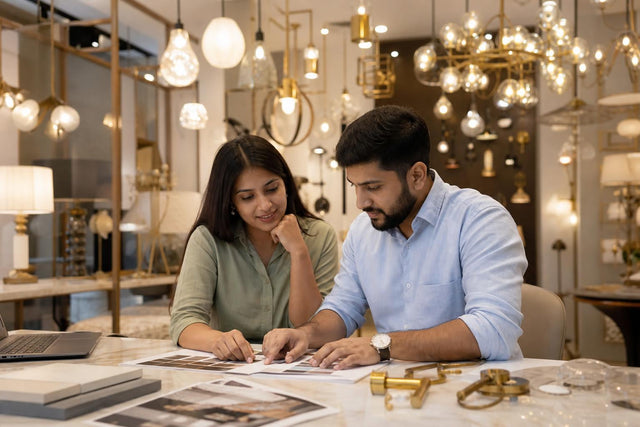
The starting point. You share space photographs, ceiling heights, your style brief, and your budget. The designer assesses proportions, existing palette, and functional requirements. A good consultation should clarify what you need before anything is made.
ALC Studio offers free design consultations (virtual or in-store at their Delhi and Lucknow showrooms) to help you define the right fixtures for your space.
Space Assessment
The designer evaluates ceiling height, room dimensions, natural light sources, existing colour palette, and furniture layout. This determines fixture proportions, mounting positions, and how different lighting layers should be distributed.
Design Brief and Mood Board
Your preferences distilled into a visual and written document. Includes style direction, material preferences, colour temperature goals, and reference images. This becomes the blueprint for the fixture design.
Prototype / 3D Visualization
For fully bespoke commissions, some designers provide sketches, 3D renders, or physical prototypes before production begins. This step prevents expensive surprises.
Lead Time
The production period from order confirmation to dispatch. Ready-stock items can ship in days. Semi-custom and bespoke pieces typically take two to six weeks depending on complexity. According to Vello Light, custom LED solutions that are pre-cut and soldered reduce on-site labour by up to 40% and last 50,000+ hours compared to 25,000 for retail kits.
Always confirm the lead time and factor in installation scheduling when planning around a housewarming or project deadline.
Fixture Sizing Rules
Two rules worth memorizing:
- Chandelier diameter should not exceed one-third the width of the room.
- Dining chandelier/pendant diameter should be one-half to two-thirds the width of the table.
For detailed formulas, read this chandelier sizing calculator guide.
Installation Considerations
Weight, ceiling structure, electrical points, and dimmer compatibility all need to be sorted before the fixture arrives. Discuss these with your electrician during the design phase, not on installation day.
Room-Specific Bespoke Lights Ideas
Here’s where concepts become concrete. Each room in an Indian home has different lighting demands.
Living Room and Double-Height Foyer
The living room needs all three layers: ambient (cove or recessed), task (reading lamps, floor lamps), and accent (spotlights on art or textured walls). For double-height spaces, standard fixtures are almost never proportioned correctly. This is where bespoke chandeliers earn their value, because the fixture needs to fill vertical space without overwhelming the room.
For foyer-specific guidance, see how to choose a chandelier for a double-height living room.
Dining Area
A pendant or chandelier centered over the table is the anchor. The bottom of the fixture should hang 75 to 85 cm above the table surface. Warm white (2700 to 3000K) with CRI 90+ is the gold standard here, because it makes food look appetizing and skin tones look warm.
Bedroom
Soft ambient light from cove lighting or a restrained ceiling fixture, paired with task lighting from wall-mounted reading lights or bedside pendants. The Caral wall light works well for this application, providing focused reading light without disturbing a sleeping partner.
Avoid cool white in bedrooms. Light at 6500K actively signals wakefulness to your brain, exactly the opposite of what you want when trying to sleep.
Bathroom and Vanity
LED mirrors with integrated lighting are the most impactful bespoke addition to an Indian bathroom. Look for IP44-rated fixtures, CRI 90+ for accurate colour rendering at the vanity, and sensor types (touch, hand-wave, motion) that match your preference.
Kitchen
Task lighting is king. Under-cabinet profile lights illuminate countertops where you actually work. A pendant or pendant cluster over an island adds visual interest and ambient warmth. Keep colour temperatures consistent across all kitchen zones at neutral to warm white (3000 to 4000K).
Staircase and Corridor
These transitional spaces benefit from wall sconces at consistent heights and, where architecture permits, a dramatic pendant or chandelier in the stairwell. Bespoke fixtures here can transform a forgettable passageway into a design moment.
Home Office
Task lighting with high CRI (90+) and neutral white (4000K) keeps you alert without the harshness of cool white. A desk lamp or adjustable wall light directed at your work surface, combined with gentle ambient light behind your screen to reduce eye strain.
Frequently Asked Questions
What is the difference between bespoke and custom lighting?
Bespoke lighting is designed from scratch for a specific space and client. Custom lighting modifies an existing design, typically adjusting size, finish, or configuration. Both are made to order, but bespoke involves a new concept while custom adapts a proven one.
How long does a bespoke light fixture take to make?
Lead times vary by complexity. Simple semi-custom modifications might ship in one to two weeks. Fully bespoke fixtures with new designs and hand-finished materials can take four to six weeks from consultation to dispatch.
Is bespoke lighting worth the cost for Indian homes?
It depends on the space. Standard rooms with 8 to 9-foot ceilings can work fine with quality off-the-shelf or semi-custom fixtures. Double-height foyers, unusually shaped rooms, or spaces with specific design requirements benefit enormously from bespoke, because off-the-shelf fixtures rarely fit those proportions correctly.
What colour temperature should I use in my Indian home?
Warm white (2700 to 3000K) for bedrooms, dining rooms, and living areas. Natural white (approximately 4000K) for kitchens, bathrooms, and home offices. Avoid 6500K cool white for any room where you relax or socialize.
How do I size a chandelier for my room?
The chandelier diameter should not exceed one-third the width of the room. For dining applications, one-half to two-thirds the width of the table. Detailed formulas are covered in our chandelier sizing guide.
What CRI should I look for in residential lighting?
CRI 80+ is the minimum for any residential space. CRI 90+ is recommended for dining areas, vanity mirrors, walk-in wardrobes, and anywhere colour accuracy matters. Bespoke fixtures from quality manufacturers typically specify CRI on the product page.
Can I get bespoke lighting delivered pan-India?
Yes. ALC Studio delivers across India with free shipping on prepaid orders. Ready-stock items dispatch within three working days, and made-to-order pieces have stated production timelines.
Where can I see bespoke lighting in person before buying?
Showroom visits are the best way to assess finish quality, scale, and light output. ALC Studio operates showrooms in Delhi (Kirti Nagar) and Lucknow (Vipul Khand), with free in-store design consultations available.
Explore the full bespoke collection to start your project.
0 Comments
There are no comments for this article. Be the first one to leave a message!