
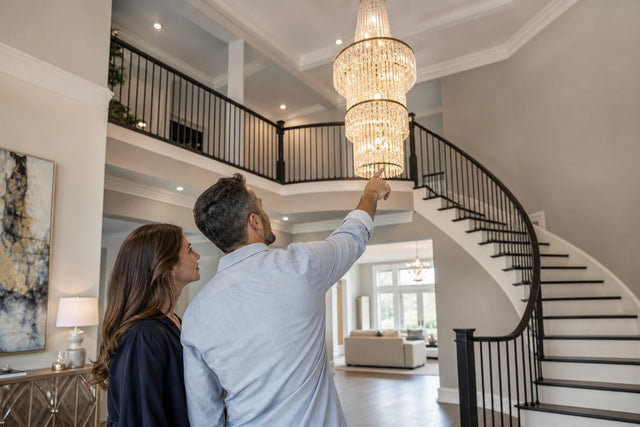
2 Story Foyer Chandelier Ideas: 2026 Size & Hanging Guide
TL;DR
A two-story foyer chandelier needs to be bigger than you think. Use the diameter formula (room length + width in feet, converted to inches, plus 20-30% for tall ceilings) and hang the fixture so its center aligns with the second floor level. The best styles for double-height entries include tiered chandeliers, cascade crystals, lantern fixtures, and modern geometric designs. Always plan for maintenance access before you commit to a fixture 18 feet above your floor.
The two-story foyer is the most dramatic space in any home, and the chandelier you place there will be the first thing every visitor sees. Get it right, and you set the tone for the entire house. Get it wrong (usually by going too small), and that beautiful double-height entry feels oddly empty.
This guide breaks down every term, formula, and style category you need to confidently choose a chandelier for a two-story foyer. Whether you’re building a new villa, renovating an apartment with double-height ceilings, or working with a designer on a client project, the concepts here will save you from costly mistakes.
Explore statement chandeliers suited for tall, dramatic spaces.
Understanding the Space: What Makes a Two-Story Foyer Different
Two-Story Foyer
A two-story foyer (also called a double-height entry) is an entrance hall with ceiling heights ranging from 16 to 20+ feet. Unlike a standard 8 to 10 foot ceiling room, the vertical volume here is enormous. That changes everything about how you select, size, and position a light fixture.
The extra height creates visual drama but also practical challenges. Sound echoes more. Light dissipates before reaching the floor. And any fixture that works at 9 feet will look comically small at 18.
Double-height living spaces are no longer limited to standalone bungalows and villas. As Outlook Luxe reports, these spaces are increasingly being integrated into contemporary Indian apartments, particularly in premium developments across Mumbai, Delhi NCR, Bengaluru, and Hyderabad. This shift means more homeowners are confronting the two-story foyer chandelier question for the first time.
Core Sizing Terms: The Math Behind Beautiful Proportions
Undersizing is the single most common foyer lighting mistake. People panic when they see the recommended dimensions, assume it will look too big, and scale down. Then the fixture arrives and disappears into the ceiling. Trust the math. Your two-story foyer has two to three times the volume of a standard room, and the chandelier must match that scale.
Chandelier Diameter Formula
Add the length and width of your foyer in feet. Convert that number directly to inches. That gives you the minimum chandelier diameter.
Example: A 10 × 12 foot foyer = 22 inches minimum diameter.
For two-story foyers specifically, add 20 to 30 percent to that number. So that 22-inch figure becomes roughly 26 to 29 inches. This accounts for the extra vertical space that would otherwise swallow a normally sized fixture.
Some designers use an alternate rule: for every foot of ceiling height above 8 feet, add 2.5 to 3 inches to the diameter. Both approaches land in a similar range.
Fixture Body Height
This refers to the height of the chandelier itself (not including the chain or rod above it). The formula: allocate 2.5 to 3 inches of fixture height for every foot of ceiling height.
An 18-foot ceiling calls for a fixture body between 45 and 54 inches tall. Two-story foyers can comfortably accommodate chandeliers up to 48 inches in body height, and in very tall spaces, even larger fixtures work well.
If you’re exploring how fixture proportions change in living rooms versus foyers, our guide on choosing a double-height chandelier covers the nuances.
Drop Length and Hanging Height
Drop length is the total distance from the ceiling to the bottom of the chandelier, including chain, rod, or cable. This determines where the fixture actually sits in your vertical space.
For two-story foyers, the standard recommendation is to position the fixture so its center aligns with the second floor level, typically 10 to 12 feet from the ground floor. This creates the best viewing angle from both levels.
The 7-Foot Rule
The bottom of the chandelier must be at least 7 feet above the floor. This ensures safe clearance for tall guests walking beneath it. In a two-story foyer, this is rarely an issue (you’ll be hanging far higher than 7 feet), but it matters if you have a lowered area near the door or transitional ceiling heights.
Viewing From Both Floors
Here’s a detail most people miss: in a two-story foyer, the chandelier needs to look good from the ground floor looking up AND from the second-floor landing or balcony looking across or down. Position the fixture so it can be viewed attractively from both levels. This is why cascade and tiered styles work so well; they present visual interest from every angle, not just from below.
Style Guide: 7 Chandelier Types That Work in Two-Story Foyers
Not every chandelier style translates to double-height spaces. The styles below are specifically suited to filling vertical volume while creating a strong focal point. These represent the most popular 2 story foyer chandelier ideas across both traditional and contemporary homes.
Tiered / Multi-Tier Chandeliers
Multiple concentric rings stacked vertically. This is the most traditional and arguably safest choice for a two-story entry because the tiers naturally fill vertical space and create visual rhythm. A three-tier design can span 40 to 50 inches in height without looking forced.
The Crysta chandelier is a good reference point for how crystal and tiered construction come together in a fixture designed for impact.
Cascade / Waterfall Chandeliers
Crystal drops or glass strands hang in a rain-like arrangement, creating a vertical curtain of light. These are high drama fixtures that draw the eye upward through the full height of the foyer. The vertical arrangement also makes them easier to view from a second-floor balcony.
The trade-off is maintenance. Crystal requires periodic cleaning, and in a dusty environment, that means regular attention to keep the sparkle. The Dew Drops fixture captures this cascade aesthetic with strands designed to catch and scatter light across the full drop length.
Lantern / Cage Chandeliers
A geometric frame (rectangular, hexagonal, or cylindrical) encloses the light sources. Lantern-style fixtures are remarkably versatile, working across traditional, transitional, and contemporary homes. The enclosed structure gives the chandelier a defined shape that reads clearly even in a very tall space. Glass panels are optional and add formality.
Modern Geometric / Sculptural Chandeliers
Clean lines, matte black or polished brass finishes, and architectural forms. These fixtures lean contemporary and pair well with minimalist interiors. Indian homes are increasingly gravitating toward this category. According to Ankur Lighting’s 2026 trend analysis, the modern Indian home favors abstract, geometric, and nature-inspired designs over traditional heavy crystal structures.
For a contemporary geometric option, the Reims pendant shows how clean metal framing creates presence without visual heaviness.
Starburst / Sputnik Chandeliers
Radiating arms extend outward from a central point, creating a sculptural, almost explosive effect. These make a bold statement and work best in foyers with otherwise clean, restrained design. The arms spread horizontally, which helps fill width in addition to height. The Lille pendant offers a sculptural approach that captures this radiating energy.
Cluster Pendants
Multiple pendant lights hung at varying heights from a single canopy or across a mounting plate. Instead of one large fixture, you get a constellation of smaller lights that collectively fill the vertical space. Practitioners on Reddit and design forums note that cluster configurations work especially well when you want a modern look but your ceiling attachment point isn’t centered perfectly.
The LumaCloud pendant demonstrates how a modern pendant light can work as part of a multi-fixture arrangement.
Orb / Globe Chandeliers
An oversized glass or metal sphere creates a single, striking focal point. The transparent or semi-transparent globe allows light to flow freely while the metal banding provides structure. These work well in transitional foyers that need a statement without excessive ornamentation.
Technical Terms: Light Quality and Performance
Getting the right fixture shape is only half the equation. The quality of light it produces determines whether your foyer feels warm and inviting or cold and institutional.
CCT (Correlated Color Temperature)
Measured in Kelvin (K), CCT describes how warm or cool a light appears. For foyers, stick to warm white: 2700K to 3000K. Cool white (4000K+) feels clinical. As one lighting guide bluntly puts it, your foyer should feel welcoming, not like a dental office.
In the Indian context, 3000K warm white is the consensus recommendation for creating a cozy, inviting atmosphere in living spaces.
Lumens
Lumens measure actual light output (as opposed to watts, which measure energy consumption). For a two-story foyer, target 1.5 to 2 lumens per square foot as a baseline. Then multiply by 1.5x for 16 to 18 foot ceilings, or 2x for ceilings above 20 feet. Light loses intensity over distance, so you need more output than you’d expect to adequately illuminate the floor level.
Most two-story foyer chandeliers need 8 to 12 bulbs to achieve adequate brightness.
Dimmer Compatibility
Not all LED bulbs work with all dimmer switches. If you install a fixture with non-dimmable LEDs or pair dimmable LEDs with an incompatible dimmer, you’ll get flickering, buzzing, or a very limited dimming range. Always confirm that your bulbs and switch are rated to work together. Dimmers are not optional in a foyer; you need different light levels for daytime, evening entertaining, and nighttime.
Candelabra Base (E12/E14)
Many multi-arm chandeliers use candelabra bases (E12 in the US, E14 in India and Europe) rather than standard Edison bases. These are smaller bulb sockets. When shopping for replacement bulbs, knowing your base type saves wasted trips. E14 is the more common base in Indian-market chandeliers.
CRI (Color Rendering Index)
CRI measures how accurately a light source reveals the true colors of objects. A CRI of 90 or above is ideal for residential spaces. In a foyer where artwork, wall colors, and furniture finishes should look their best, a low-CRI bulb (below 80) will make everything appear flat and washed out.
Practical Terms: Installation and Maintenance
This is where most 2 story foyer chandelier ideas articles fall short. They show beautiful fixtures but ignore the reality of living with a heavy light source 16 to 20 feet above your floor.
Structural Support and Junction Box
A two-story foyer chandelier can weigh anywhere from 40 to 90+ pounds. Your ceiling junction box must be rated for that weight, and the structural framing behind it must be reinforced accordingly. Standard residential junction boxes are rated for 50 pounds or less. If your fixture exceeds that, you need a fan-rated or chandelier-rated box, often with additional blocking between the ceiling joists.
Get this inspected before installation, not after the electrician is standing on scaffolding with a 70-pound fixture.
Chandelier Lift System
A motorized winch installed above the ceiling that allows you to lower the fixture to a reachable height for cleaning and bulb changes. One homeowner on a DIY forum described the frustration of tall foyer chandeliers: “I’ll have to get a handyman out with a skyscraper ladder just to switch out the burnt-out bulbs.” A chandelier lift eliminates this problem entirely. You push a button and the fixture descends to floor level.
These systems cost extra (₹15,000 to ₹60,000 depending on weight capacity and features) but pay for themselves in avoided scaffolding and handyman costs over the life of the fixture.
Light Layering
A single chandelier, no matter how impressive, cannot do everything in a double-height foyer. Light layering means combining your statement chandelier with supplemental sources: recessed ceiling lights near the door for practical task lighting, and wall sconces along the staircase for ambient warmth at the mid-level.
This approach is especially important in two-story spaces. Pairing a bold overhead fixture with sconces at multiple levels adds depth and warmth that a single source cannot achieve. Think of it as hotel lobby lighting scaled for residential use.
For staircase and hallway accent lighting, wall fixtures like the Caral wall light or the Troy wall sconce can provide that layered glow without competing with the main chandelier.
Professional Installation and Scaffolding
Installing a chandelier at 16 to 20 feet is not a DIY project. It requires scaffolding (or a very tall A-frame ladder), at least two people, and proper electrical knowledge. Budget ₹5,000 to ₹15,000 for professional installation depending on your city and the complexity of the fixture. Some lighting retailers coordinate installation as an add-on service, which is worth asking about.
LED Bulb Longevity
LED bulbs last 15,000 to 50,000 hours compared to 1,000 to 2,000 hours for incandescent bulbs. In a fixture that’s difficult to access, LED longevity is not just an energy-saving feature. It’s a maintenance strategy. Choosing quality LEDs means you might go 5 to 10 years without needing to change a bulb, which matters enormously when the fixture is 18 feet up.
Common Mistakes When Choosing 2 Story Foyer Chandeliers
1. Undersizing the Fixture
The most common mistake by far. A chandelier that looks enormous on a showroom floor will look perfectly proportioned once it’s hanging 15 feet above your foyer. Run the diameter formula, add the 20-30% tall-ceiling premium, and trust the result.
2. Ignoring the View From Both Floors
Your chandelier will be seen from the ground floor looking up, from the second-floor landing looking across, and from outside through windows. A fixture that only looks good from directly below is a missed opportunity. Test sight lines before committing.
3. Hanging Too High or Too Low
A fixture hung too high appears tiny and fails to illuminate the floor adequately. Too low, and it creates glare and makes tall guests nervous. The center of the fixture should align with the second-floor level, roughly 10 to 12 feet from the ground.
4. Skipping the Dimmer
Without a dimmer, your foyer is either fully lit or fully dark. Dimmers let you adjust for time of day, occasion, and natural light conditions. Budget for a compatible dimmer switch from the start.
5. Not Planning for Maintenance
Another forum user shared this frustration: “I have a heavy glass globe to remove to get to the bulbs, making changing a light bulb a two-person job.” Before you fall in love with a fixture, ask yourself how you’ll clean it and change bulbs at that height. If you don’t have an answer, consider a chandelier lift system or choose a simpler design.
Indian Homes and 2 Story Foyer Chandelier Ideas: What’s Trending in 2026
The Indian market has shifted significantly in the past few years. According to Spacio Collections, crystal chandeliers remain ideal for double-height living rooms and formal dining areas, creating the drama and conversation that urban villas in Mumbai or Delhi demand.
But the trend is moving toward mixed materials. Gold, copper, and antique brass are being combined with frosted, smoked, or milky glass elements. Heavy ornate crystal is giving way to lighter, more geometric compositions that still read as luxurious without feeling dated.
RoyalZig’s 2026 villa trends report notes that chandeliers remain the defining moment of the luxury living room in India, and the vertical drama of an eighteen-foot ceiling demands a response at human scale. The chandelier is that response.
For homeowners in India looking for fixtures that bridge contemporary design with the scale required for double-height spaces, ALC Studio’s collection includes options sourced from US, European, and Asian designers, with custom sizing and finish options for spaces that don’t fit standard dimensions.
FAQ
How big should a chandelier be in a 2 story foyer?
Add the room’s length and width in feet, convert to inches for the minimum diameter, then add 20-30% for the extra ceiling height. For an 18-foot ceiling in a 10 × 14 foot foyer, aim for a chandelier at least 29 to 31 inches in diameter and 45 to 54 inches in body height.
How high should a chandelier hang in a two-story entryway?
Position the center of the fixture at the second-floor level, typically 10 to 12 feet above the ground floor. The bottom of the fixture must clear 7 feet above the floor for safe pedestrian passage, though in most two-story foyers this is automatic.
What is the best chandelier style for a double-height foyer?
Tiered and cascade chandeliers are the safest choices because they naturally fill vertical space. For contemporary homes, geometric or cluster pendant configurations work equally well. The right style depends on your overall interior design direction rather than the ceiling height alone.
How do I clean a chandelier that’s 16 to 20 feet up?
Three options: hire a professional with scaffolding (annual or semi-annual), install a motorized chandelier lift system during construction, or choose a fixture with simple, smooth surfaces that collect less dust. LED bulbs reduce the frequency of access needed for bulb changes.
Are crystal chandeliers outdated for Indian homes?
Not at all, but the form is evolving. The trend in 2026 Indian interiors favors mixed materials, combining metallic finishes with frosted or smoked glass, rather than all-crystal traditional designs. Crystal still works beautifully in formal double-height entries and dining rooms.
What color temperature bulbs should I use in a foyer chandelier?
Warm white at 2700K to 3000K. This creates an inviting, comfortable atmosphere. Cool white (4000K and above) reads as harsh and clinical in residential entryways. Pair with a CRI of 90+ for accurate color rendering.
Do I need supplemental lighting beyond the chandelier?
Yes. A single chandelier cannot adequately light a two-story foyer on its own. Add recessed lights near the entry door for practical illumination, and wall sconces along the staircase for mid-level ambient light. This layered approach creates depth and warmth at every height.
How much weight can a standard ceiling junction box support?
Standard boxes handle up to 50 pounds. Many two-story foyer chandeliers exceed this, weighing 60 to 90+ pounds. You’ll need a chandelier-rated or fan-rated junction box with proper structural blocking. Confirm this with your electrician before installation day.
0 Comments
There are no comments for this article. Be the first one to leave a message!