
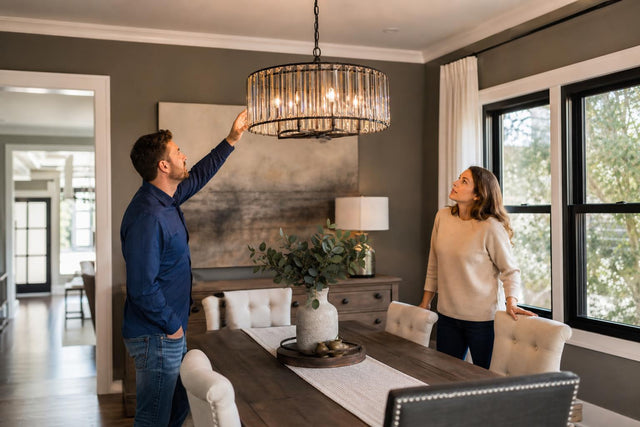
How to Choose the Right Size Chandelier for Dining Room
TL;DR
To choose the right size chandelier for your dining room, add the room’s length and width in feet to get the minimum diameter in inches (a 12×14 ft room = 26-inch chandelier). For a more precise fit, size the chandelier to half or two-thirds your table’s width. Hang it 30 to 36 inches above the table for 8-foot ceilings, adding 3 inches per additional foot. Indian apartments with 9 to 10-foot ceilings should hang fixtures 33 to 42 inches above the table. When in doubt, go bigger.
Getting chandelier sizing wrong is an expensive mistake, and it happens constantly. Joe Rey-Barreau, an educational consultant for the American Lighting Association, has pointed out that choosing a fixture that’s too small is “likely the biggest mistake because it’s very noticeable.” The good news: a tape measure and a few simple formulas are all you need.
This guide covers every measurement, formula, and installation detail required to choose the right size chandelier for a dining room, with specific adjustments for Indian ceiling heights, false ceilings, and electrical standards. Whether you’re furnishing a 4-seater breakfast table or an 8-seater hosting setup, the numbers below will get you to the right fixture.
Explore dining room chandeliers sized for Indian homes, or read on for the complete breakdown.
Chandelier Diameter: The Room-Based Formula
Chandelier diameter (or width) is the widest horizontal measurement of the fixture, tip to tip. It’s the single most important sizing dimension.
The formula: Add the room’s length and width in feet. That number, converted to inches, gives you the minimum chandelier diameter.
Example: A 12 × 14 foot Indian dining room = 12 + 14 = 26-inch minimum chandelier diameter.
| Room Size (ft) | Room Size (m) | Minimum Diameter |
|---|---|---|
| 10 × 12 | 3.0 × 3.7 | 22 inches (56 cm) |
| 12 × 14 | 3.7 × 4.3 | 26 inches (66 cm) |
| 14 × 16 | 4.3 × 4.9 | 30 inches (76 cm) |
This formula works well as a starting point, but it has limits. If your dining room opens into the living area (common in modern Indian apartments with L-shaped or open-plan layouts), calculate the size for the dining zone only, not the entire open floor. Measuring the full 30 × 15 foot living-dining combination will give you an absurdly large number.
The room formula sets a baseline. The table formula, covered next, is what you should actually buy by.
Chandelier Diameter: The Table-Based Formula
If you already own a dining table, sizing the chandelier to the table matters more than sizing it to the room. The chandelier should be one-half to three-quarters the width of the table. Most of the time, this range overlaps with the room-based formula. When they disagree, the table wins for dining rooms.
There’s also a hard maximum: a chandelier should always be at least 12 inches narrower than the table on each side. Anything wider looks top-heavy and risks someone bumping it when they stand up.
Quick-Reference: Chandelier Size by Table Width
| Table Width | Chandelier Diameter | Typical Seating |
|---|---|---|
| 36 in (90 cm) | 18–24 in (46–61 cm) | Breakfast nook, 2-seater |
| 42 in (107 cm) | 21–28 in (53–71 cm) | 4-seater round |
| 48 in (122 cm) | 24–32 in (61–81 cm) | Standard round or square |
| 60 in (152 cm) | 30–40 in (76–102 cm) | 6-seater |
| 72 in (183 cm) | 36–48 in (91–122 cm) | 8-seater |
For a 6-seater with a 60-inch wide table, a chandelier between 30 and 40 inches in diameter hits the sweet spot. A 72-inch table can handle 36 to 48 inches.
The Mock-Up Trick
A practical tip from design forum discussions: cut a piece of newspaper or cardboard to the chandelier’s diameter and lay it on your dining table. This gives you an immediate, physical sense of how the fixture will fill the space. It takes two minutes and can save you from a return.
Hanging Height Above the Dining Table
Hanging height is the distance from the tabletop to the bottom of the chandelier, including any crystals, drops, or lowest-hanging elements.
The rule: The bottom of the chandelier should sit 30 to 36 inches above the table surface for an 8-foot ceiling. For every additional foot of ceiling height, add 3 inches.
Why This Matters for Indian Homes
Most US-focused guides default to 8-foot ceilings. Indian apartments typically have 9 to 10-foot ceilings, which shifts every calculation upward.
| Ceiling Height | Distance Above Table |
|---|---|
| 8 ft (244 cm) | 30–36 in (76–91 cm) |
| 9 ft (274 cm) | 33–39 in (84–99 cm) |
| 10 ft (305 cm) | 36–42 in (91–107 cm) |
| 12 ft+ | Add 3 in per additional foot |
In metric terms, aim for 70 to 80 cm above the table for standard Indian ceiling heights. This gives you focused, flattering light without blocking sightlines across the table.
For double-height ceilings above 12 feet, the rules change significantly. If your dining area sits under a soaring ceiling, sizing chandeliers for double-height ceilings requires a different approach.
Fixture Height (Body Height)
Fixture height is the vertical measurement of the chandelier body itself, excluding the chain, rod, or canopy. People often confuse this with hanging height, but they’re separate measurements.
The formula: Use 2.5 inches of fixture height per 1 foot of room height. An 8-foot ceiling calls for roughly a 20-inch fixture body. A 10-foot ceiling can accommodate a 25-inch body.
Why does this matter independently? Because a fixture with the correct diameter but a body that’s too tall can crowd the visual space above the table, making the room feel compressed. On the other hand, a body that’s too short looks like a pendant pretending to be a chandelier.
Chain/Rod Drop Length
This is the adjustable suspension piece between the ceiling and the fixture. Rather than guessing, calculate it:
Chain/rod length = Ceiling height, minus table height, minus hanging clearance (30–36 in), minus fixture body height.
For a 10-foot ceiling, 30-inch table, 36-inch clearance, and 25-inch fixture body: 120 – 30 – 36 – 25 = 29 inches of chain or rod. Most quality chandeliers come with adjustable chain or downrods, but always verify the maximum drop length before purchasing.
Visual Weight: Why the Same Diameter Can Look Completely Different
This is the concept that most sizing guides skip, and it’s where many mistakes happen.
Visual weight describes how “heavy” or solid a chandelier appears regardless of its actual diameter. A dense crystal chandelier at 38 inches can fill a room the same way an open ring or sputnik chandelier at 48 inches does. The crystal fixture has more visual mass at every point across its diameter, while the open-frame design is mostly air and thin metal lines.
Practical guidance:
- For dense crystal or tiered fixtures, lean toward the smaller end of your size range.
- For airy, minimalist, or wire-frame designs, go toward the larger end.
- If you’re drawn to both styles, browse decorative lighting options to compare visual weight across different designs.
This also explains why the half-to-three-quarters table width range is a range rather than a single number. The right spot within that range depends on the fixture’s density.
Linear Chandeliers for Rectangular Tables
Round chandeliers suit round tables. Rectangular tables, especially longer ones, call for linear (bar-shaped or rectangular) chandeliers. A linear fixture spreads light evenly across the table’s length instead of pooling it in the center.
The formula: A linear chandelier should be one-third to one-half the length of the table. Its width should be roughly one-third the table’s width, with the fixture edge at least 6 inches from the table edge so no one hits it when standing up.
When to Use Two Chandeliers
Tables longer than 10 feet usually benefit from two matching chandeliers rather than one oversized fixture. A single fixture large enough to cover a 12-foot table often looks clunky, and the light distribution suffers at the ends.
Spacing formula for two chandeliers: Divide the table length by the number of chandeliers plus one. For two fixtures over a 72-inch table: 72 ÷ 3 = 24. Each chandelier should be about 24 inches in diameter, placed 24 inches from each end.
For smaller spaces or modern aesthetics where a chandelier feels too grand, pendant lights for dining tables offer a lighter alternative with the same sizing principles.
Lumens and Light Output for Dining Rooms
Size is only half the equation. A correctly sized chandelier that delivers too little light will still feel inadequate. A dining room needs 30 to 40 lumens per square foot, according to US Department of Energy residential guidelines.
Example Calculation
A 12 × 15-foot dining room (180 sq ft):
- Minimum: 180 × 30 = 5,400 lumens
- Maximum: 180 × 40 = 7,200 lumens
A smaller 10 × 12-foot room (120 sq ft) needs 3,600 to 4,800 lumens.
If your chandelier alone can’t hit these numbers, supplement with wall lights for layered dining lighting or recessed fixtures. Layered lighting is almost always better than relying on a single source.
CCT (Color Temperature)
Stick to 2700K for a candlelight-warm glow or 3000K for a crisp, modern warmth. Both flatter skin tones and make food look appetizing. Avoid anything above 3500K at the dining table, which introduces a clinical, bluish quality that kills the mood.
For Indian interiors, 2700 to 3000K is the standard recommendation for dining and living comfort. Adding a dimmer lets you shift from dinner-party brightness to a quiet supper with a single adjustment.
CRI (Color Rendering Index)
CRI measures how accurately a light source renders colors compared to natural light. For a dining room, CRI should be 90 or higher. Below 90, food looks flat and wine looks off. Check the spec sheet before buying, as not all LED bulbs are equal here.
Installation Notes for Indian Homes
False Ceiling Anchoring
This is a safety issue, not just an aesthetic one. Most Indian homes have POP or gypsum false ceilings that cannot bear chandelier weight on their own. Before installing any chandelier, the ceiling must have a structural anchor through the false ceiling into the concrete slab above. Use wood or metal backing to carry the load. Skipping this step risks the fixture pulling free, which is dangerous and damaging.
Electrical Compatibility
Indian homes run on 220 to 240 volts. Many have B22 bayonet sockets as the standard, but premium fixtures often use E27 screw bases, G9, or GU10. Confirm the socket type before ordering replacement bulbs.
Dimmer Compatibility
A dimmer is almost essential for a dining room chandelier. It’s the easiest way to control ambiance. But poor dimmer-driver pairing causes flicker and buzz, especially with LED bulbs. Not all LED bulbs are dimmable, and the dimmer type (leading edge vs. trailing edge) must match the driver. Check compatibility before buying either component.
If you’re concerned about getting the electrical details right, understanding return policies before ordering provides peace of mind for first-time buyers.
Common Chandelier Sizing Mistakes
1. Going too small. This is the number one regret. Professional designers consistently oversize slightly rather than undersize. As the American Lighting Association’s Joe Rey-Barreau puts it, “It’s generally always best to make the mistake on a fixture being too big than too small.” A too-small chandelier looks like an afterthought floating above your table.
2. Ignoring ceiling height. The formulas change with ceiling height. Using the standard 30-inch hanging clearance in a room with 10-foot ceilings leaves the fixture awkwardly high. Always adjust.
3. Sizing to the room when the table should be the anchor. The room formula is a starting point. Once you have a table, the table formula takes priority.
4. Forgetting visual weight. Two chandeliers with identical diameters can look radically different depending on whether one is a dense crystal design and the other is an open geometric frame. Factor in visual density before committing to a diameter.
5. Skipping the lumen check. A beautiful, correctly sized chandelier that can’t light the room properly fails at its primary job.
6. Not accounting for open-plan layouts. Sizing for a combined 400 sq ft living-dining area will give you a comically oversized fixture. Measure the dining zone alone.
For rooms with dramatic ceiling heights or stairwell-adjacent dining areas, lighting ideas for double-height ceilings covers the extended rules.
Choosing the Right Shape
Shape matching is simple but often overlooked:
- Round table → round chandelier. The circular form echoes the table’s geometry and distributes light evenly to all seats.
- Rectangular table → linear chandelier or a rectangular arrangement of pendants. This spreads light along the table’s length.
- Square table → round or square chandelier. Either works; round softens the lines while square reinforces them.
- Oval table → oval chandelier or round chandelier. Oval fixtures are harder to find, so a round fixture sized to the table’s width is a reliable fallback.
Putting It All Together: A Worked Example
You have a 6-seater rectangular table, 72 inches long and 36 inches wide, in a 12 × 14-foot dining room with a 10-foot ceiling in a Mumbai apartment.
- Room formula: 12 + 14 = 26-inch minimum diameter.
- Table formula: 36 × 0.5 to 36 × 0.75 = 18 to 27-inch width. For length, one-third to one-half of 72 = 24 to 36 inches.
- Verdict: A linear chandelier, roughly 24 to 36 inches long and 18 to 27 inches wide.
- Hanging height: 10-foot ceiling = 36 to 42 inches above the table.
- Fixture body height: 10 × 2.5 = 25 inches maximum.
- Lumens: 12 × 14 = 168 sq ft × 30 to 40 = 5,040 to 6,720 lumens.
- CCT: 2700K or 3000K with a compatible dimmer.
- Installation: Confirm structural anchor through the POP false ceiling into the concrete slab.
That’s it. Every number you need, in one pass.
If you want expert help matching these calculations to a specific fixture, book a free design consultation with ALC Studio’s lighting specialists. They handle sizing, layering, and custom options for Indian homes across the country.
Frequently Asked Questions
How do I calculate chandelier size for an open-plan dining area?
Measure only the dining zone, not the entire open floor plan. If your combined living-dining space is 30 × 15 feet but the dining table sits in a 12 × 14 section, use 12 + 14 = 26 inches as your starting diameter.
What if my room formula and table formula give different sizes?
The table formula takes priority for dining rooms. The room formula is a rough sanity check. When the two conflict, size to the table because that’s where people actually sit and look at the fixture.
Can I hang a round chandelier over a rectangular table?
You can, but it works best for shorter rectangular tables (up to about 60 inches). Beyond that, a round fixture won’t distribute light evenly across the full length, and a linear chandelier or a pair of pendants is a better choice.
How heavy is too heavy for an Indian false ceiling?
A POP or gypsum false ceiling alone should not support any chandelier. The weight must transfer through the false ceiling to a structural anchor in the concrete slab above. Consult your electrician or contractor to install proper backing before hanging anything heavier than a lightweight pendant.
Should I always add a dimmer?
For a dining room, yes. A dimmer gives you flexibility between bright task lighting and soft ambient glow. Just ensure the dimmer type is compatible with your LED bulbs or driver. Mismatched pairings cause flickering and buzzing.
Is it better to go slightly bigger or slightly smaller?
Bigger. Every experienced designer and the American Lighting Association recommend erring on the larger side. An undersized chandelier is far more noticeable and harder to fix than one that’s slightly generous.
What bulb socket type should I expect in India?
Most Indian homes use B22 bayonet sockets, but many premium chandeliers come with E27 screw, G9, or GU10 fittings. Check the fixture specifications before ordering replacement bulbs. Indian homes run on 220 to 240V, so verify voltage compatibility if importing a fixture.
How do I choose between one large chandelier and two smaller ones for a long table?
Tables over 10 feet generally look better with two matching fixtures. Divide the table length by three (number of fixtures plus one) to get each fixture’s diameter and spacing from the table ends. Two well-placed chandeliers provide better light distribution and more balanced proportions than one oversized piece.
0 Comments
There are no comments for this article. Be the first one to leave a message!